
To obtain a copy of this publication, or to receive it in an alternate format (Braille, large print, etc.), please fill out the Publication Request Form (http://www.ic.gc.ca/eic/site/iccat.nsf/frm-eng/EABV-9E9HE7) or contact:
Web Services Centre
Innovation, Science and Economic Development Canada
C.D. Howe Building
235 Queen Street
Ottawa, ON K1A 0H5
Canada
Telephone (toll-free in Canada): 1-800-328-6189
Telephone (international): 613-954-5031
TTY (for hearing impaired): 1-866-694-8389
Business hours: 8:30 a.m. to 5:00 p.m. (Eastern Time)
Email: ISED@Canada.ca
Permission to Reproduce
Except as otherwise specifically noted, the information in this publication may be reproduced, in part or in whole and by any means, without charge or further permission from the Department of Industry, provided that due diligence is exercised in ensuring the accuracy of the information reproduced; that the Department of Industry is identified as the source institution; and that the reproduction is not represented as an official version of the information reproduced, or as having been made in affiliation with, or with the endorsement of, the Department of Industry.
For permission to reproduce the information in this publication for commercial purposes, please fill out the Application for Crown Copyright Clearance at http://icweb.ic.gc.ca/eic/site/icgc.nsf/frm-eng/EABV-9DDLWL or contact the Web Services Centre mentioned above.
© Her Majesty the Queen in Right of Canada, as represented by the Minister of Industry, 2016
Aussi offert en français sous le titre Bureau du Surintendant des faillites – Cadre de conformité – Programme des plaintes
PDF version
Audit and Evaluation Branch
February 2016
Recommended for Approval to the Deputy Minister by the Departmental Audit Committee on February 29, 2016
Approved by the Deputy Minister on March 30, 2016
Table of contents
- 1.0 Executive summary
- 2.0 About the audit
- 3.0 Findings and recommendations
- 4.0 Overall conclusion
- Appendix A: OSB program overview
- Appendix B: Audit criteria
- Appendix C: Examples of complaints handling process gaps and areas that lack clarity
- Management Response and Action Plan
List of initialisms and acronyms used in report
- CE
- Complaints and Enquiries
- CF
- Compliance Framework
- ISED
- Innovation, Science and Economic Development Canada
- IT
- Information Technology
- OSB
- Office of the Superintendent of Bankruptcy
1.0 Executive summary
1.1 Background
The Office of the Superintendent of Bankruptcy (OSB) is the regulatory oversight organization of the Government of Canada that supervises the administration of bankruptcies and proposals under the Bankruptcy and Insolvency Act. They also carry out duties under the Companies' Creditors Arrangement Act, which helps eligible financially distressed businesses avoid bankruptcy. As part of its legislative oversight activities, the OSB operates programs to ensure the compliance of key insolvency system stakeholders (such as trustees, debtors and creditors).
In 2010, an external review of the OSB's compliance processes identified that OSB did not have a comprehensive documented national compliance strategy. There was no demonstration of the integration and interrelation between key elements of the OSB's compliance strategy, nor was there linkage between compliance activities and risks within the insolvency system.
As a result of this review, the OSB developed a formalized Compliance Framework (CF) to support a nationally-consistent approach for all compliance activities. While OSB had several compliance programs in place, the external review identified that there was no documented national strategy that linked these compliance activities together and to the risks within the insolvency system.
OSB Overview:
- Approximately 370 employees
- 13 division offices located across Canada with headquarters in the National Capital Region
- Fiscal year 2014/15 budget authority was $42.2 million
- An average of 1,200 complaints each year
Key elements of the OSB's CF are: Complaints; Trustee Compliance; Debtor Compliance; Receiver Compliance; Creditor Compliance; Monitor Compliance; Trend Analysis; and Quality Assurance. A CF Manual was developed that describes the means through which the OSB is to apply its compliance strategies, for each element. Each element is being implemented in phases. The CF Manual provides OSB employees with a common set of activities and procedures to follow in order to achieve a nationally-consistent approach to compliance issues.
The revised Complaints Program and its supporting IT application, INFO+, were implemented in November 2013 (phase 1). This change formalized the processes for handling complaints with a goal of greater consistency in program delivery.
Complaints
A complaint is defined by the OSB as "an expression of dissatisfaction, and an expectation that the OSB will take action to right a perceived wrong."
Complaints received and considered by the OSB can assist them in identifying risks and acts of non-compliance, and provide early warning of emerging issues and trends within the insolvency system. Of the average 1,200 complaints received annually, more than 95% of them related to the Bankruptcy and Insolvency Act or associated Rules and Directives.
1.2 Audit objective, scope and subsequent events
Audit Objective and Scope
The objective of this audit was to provide assurance on the design and operating effectiveness of the Compliance Framework – Complaints Program (Phase 1), as well as to assess whether lessons learned informed the launch of Trustee Compliance (Phase 2).
The audit scope was the OSB Compliance Framework - Complaints Program. The areas of focus included: Governance; Risk Management; Complaints Handling Process; and Lessons learned.
The audit scope timeframe was from August 2013 to June 2015. This timeframe included key activities prior to launch of the updated Complaints Program in November 2013 as well as complaint files opened and closed during the period of November 2013 to June 2015.
Subsequent Events
Subsequent to the audit scope timeframe, management initiated various changes and improvements to their governance structures and processes. These activities were not assessed as part of this audit as they occurred after the audit scope timeframe.
1.3 Overview of audit results
The audit identified areas of the Complaints Program that required improvement or attention.
Governance
The OSB's Operations Committee, comprised of senior management, and the Complaints and Enquiries (CE) Network, who bring forward issues and recommendations on complaints program delivery to the Operations Committee, were key mechanisms designed and put in place to support the identification, escalation and resolution of issues regarding the complaints program design and operation. The audit identified instances where the mechanisms were not operating as effectively as expected in support of the Complaints Program.
As a result, there was an absence of clear decision-making or direction from Operations Committee as expected according to their terms of reference. This meant that the CE Network, and ultimately those performing complaint handling activities, were left to continue with practices that may have offset progress made toward a nationally-consistent approach.
It is recommended that the OSB complete the governance and decision-making structure review that is currently underway to ensure effective support for the performance of the Complaints Program and related processes, and implement changes, where required.
Risk Management
The OSB's approach to identifying, assessing, and responding to operational risks has yet to mature from its current informal and ad-hoc manner to a more systematic and pro-active approach.
Some risk management activities occurred, for example, in deciding when to implement the Complaints Program, as well as through annual planning for the Complaints Program. However, risk management supporting the design and carrying out of day-to-day complaint handling operations is reactive and based on management discussions as issues arise. As a result, potential risk exposures to meeting complaints program expectations may not be addressed prior to their realization.
It is recommended that the OSB develop and implement a plan to systematically risk manage operational risks to the Complaints Program.
Complaints Handling Process
A nationally-consistent approach to handling complaints, and the use of the intelligence gathered from them as input into other compliance programs, has not been fully achieved.
The OSB's national complaints handling process is intended to ensure a consistent approach across all regions. However, as a result of some control and process gaps and unclear roles and responsibilities, inconsistent application was identified across all regions, which may not reflect management's risk tolerance. These inconsistencies increase the potential risks of an inaccurate response and/or damage to the reputation of the OSB.
It is recommended that the OSB review and update the complaints handling process design to ensure it contributes to program expectations, as intended.
Documentation, Training, and Lessons Learned
The complaints handling process was documented, updated and communicated. Training was delivered at the time of the Complaints Program implementation to relevant employees across the regions. Ongoing complaints program training occurs “on-the-job” and includes reliance on key guidance and training materials available on the OSB's intranet. The training materials do not yet reflect the updates in the most recent CF Manual and responsibility for performing these updates was not clearly defined.
It is recommended that these training materials be reviewed, updated, and made available.
Lessons learned from the implementation of the complaints component of the CF were informally discussed and some changes were applied to the implementation of the Trustee Compliance component, primarily in the areas of training and INFO+ development. Given that CF implementation is still ongoing, there is a risk that improvements are not identified and incorporated into the launch of the remaining elements of the CF.
It is recommended that lessons learned are carried out on the implementation of Trustee Compliance and actioned prior to the implementation of other components of the Compliance Framework.
1.4 Audit opinion
In my opinion, the OSB has an effectively designed and operating Complaints Program, with some exceptions noted. Opportunities for improvement and associated recommendations were identified in the areas of governance, risk management, the complaints handling process, documentation and training, and lessons learned activities.
1.5 Statement of conformance
This audit was conducted in accordance with the Internal Auditing Standards for the Government of Canada, as supported by the results of the Audit and Evaluation Branch's quality assurance and improvement program.

Brian Gear
Chief Audit Executive, Innovation, Science and Economic Development
2.0 About the audit
2.1 Background
The Bankruptcy and Insolvency Act and the Companies' Creditors Arrangement Act fall under the accountability of the Minister of Innovation, Science and Economic Development Canada (ISED). The Office of the Superintendent of Bankruptcy (OSB) is the regulatory oversight organization of the Government of Canada that supervises the administration of bankruptcies and proposals under the Bankruptcy and Insolvency Act. The OSB also carries out duties under the Companies' Creditors Arrangement Act which helps eligible financially distressed businesses avoid bankruptcy. The OSB operates within ISED's Small Business, Tourism, and Marketplace Services Sector with an annual budget authority of approximately $42 million. The OSB has approximately 370 employees, with the majority working out of 13 division offices located across Canada.
Significant responsibilities of the Superintendent of the OSB include:
- overseeing the administration of estates in bankruptcy, commercial reorganizations, consumer proposals and receiverships;
- maintaining the public record of insolvency proceedings under the Bankruptcy and Insolvency Act; as well as
- licensing, overseeing and enforcing professional standards for the trustee profession.
As part of its legislative oversight activities, the OSB operates programs to ensure the compliance of key insolvency system stakeholders (such as trustees, debtors and creditors). In May 2010, an external review was completed to evaluate OSB'S existing compliance programs, report on gaps in program design, and make recommendations for changes. While OSB had several compliance programs in place, the external review identified that there was no documented national strategy that linked these compliance activities together and to the risks within the insolvency system.
In response, the OSB worked through fiscal years 2010/11 and 2011/12 to consider the recommendations and established a formalized Compliance Framework (CF) to support a nationally-consistent, risk-based approach for all compliance activities. The new CF Manual describes how the OSB applies its compliance programs to ensure that key stakeholders comply with legislative and regulatory requirements. This Manual also provides OSB employees with a common set of procedures supporting a nationally-consistent approach to compliance issues.
Key elements of the OSB's Compliance Framework:
- Complaints
- Trustee Compliance
- Debtor Compliance
- Receiver Compliance
- Creditor Compliance
- Monitor Compliance
- Trend Analysis
- Quality Assurance
The new CF is being implemented in phases:
- Phase 1 (FY 2013–14) - Complaints;
- Phase 2 (FY 2015–16) - Trustee Compliance; and
- Phase 3 (planned for FY 2015–16) - Debtor Compliance.
The new CF introduces new business requirements which in turn need IT support. As a result, an in-house application, INFO+, was launched to restructure the way data is captured and reported. This initiative included modifying the OSB's current case management system to support new functionality and new reporting capabilities, improve reliability and enhance security. The implementation of INFO+ has been timed to coincide with the phased implementation approach of the CF. The revised Complaints Program and its INFO+ module were implemented in November 2013.
Complaints
The Bankruptcy and Insolvency Act provides the statutory authority for the OSB to deal with complaints. A complaint is defined by the OSB as "an expression of dissatisfaction, and an expectation that the OSB will take action to right a perceived wrong." Complaints can be made by and against stakeholders such as those who owe money, those who are owed money, and licenced insolvency trustees handling funds. Examples of complaints that the OSB investigates under the Bankruptcy and Insolvency Act include:
- complaints about debtors who have hidden assets or have not disclosed all of their liabilities or income to the licenced insolvency trustees;
- complaints against the licenced insolvency trustees for issues such as failure to provide required notices or mishandling of trust funds; and
- complaints concerning the Code of Ethics for Trustees.
The OSB supervises the administration of all files registered under the Bankruptcy and Insolvency Act and is responsible for keeping a record of all complaints received regarding an insolvency matter. The OSB conducts reviews of complaints to determine if there has been non-compliance with the Bankruptcy and Insolvency Act or associated Rules and Directives. If there has been non-compliance and a complaint is considered 'founded', the OSB, at their discretion, can commence enforcement activities such as intervention in the civil court, criminal investigation or professional conduct investigation. Complaints can also assist to identify risks, emerging issues and trends within the insolvency system.
In addition to the Bankruptcy and Insolvency Act authority, the Companies' Creditors Arrangement Act provides the statutory authority requiring the Superintendent of the OSB to receive and keep a record of all complaints regarding the conduct of those individuals assigned to monitor the debtor under this Act.
Annually, the OSB receives more than 25,000 enquiries from insolvency system stakeholders. Approximately 1,200 of these are considered to be complaints, with more than 95% of them related to the Bankruptcy and Insolvency Act. The majority of complaints relate to inadequate business practices concerning advice and services to debtors.
Appendix A shows where the Complaints Program is situated within the overall program structure of the OSB.
2.2 Objective, scope, subsequent events, and methodology
Objective
The objective of this audit was to provide assurance on the design and operating effectiveness of the Compliance Framework – Complaints Program (Phase 1), as well as to assess whether lessons learned informed the launch of Trustee Compliance (Phase 2).
Scope
The audit scope was the OSB Compliance Framework - Complaints Program. The areas of focus included: Governance; Risk Management; Complaints Handling Process; and, Lessons Learned.
The audit scope timeframe was from August 2013 to June 2015. This scope included key activities prior to launch of the updated Complaints Program in November 2013 as well as complaint files related to the Bankruptcy and Insolvency Act that were opened and closed during the period of November 2013 to June 2015.
Methodology
The audit was conducted in accordance with the Internal Auditing Standards for the Government of Canada. Sufficient and appropriate audit procedures have been conducted and evidence gathered to support the accuracy of the conclusion and opinion provided and contained in this report. The opinion is based on a comparison of the conditions, as they existed at the time, against pre-established audit criteria that were discussed with management. The opinion is applicable only to the areas examined and within the scope described herein.
The audit was performed in three phases: planning, conduct and reporting. A risk assessment was executed during the planning phase of this audit to confirm the audit objective and identify areas requiring more in-depth review during the conduct phase. Based on the identified risks, the Audit and Evaluation Branch developed audit criteria that linked back to the overall audit objective (refer to Appendix B).
The methodology used to address the audit's objective included:
- Document examination;
- Conduct of a walkthrough exercise of complaint files in INFO+;
- Conduct of 28 interviews with OSB personnel;
- Three regional group interviews (one per region – total of nine analysts);
- One Regional Service Centre group interview (with one representative from each region); and
- Audit of 18 complaint files (judgementally selected) to validate results of documentation examination, interviews, and group sessions.
All of the audit evidence gathered through the above noted processes was synthesized, analyzed and supports the audit findings presented throughout this report.
A debrief meeting was held with the OSB senior management on November 2, 2015 to present preliminary findings that form the basis of those contained in the report. This meeting also provided the auditee an opportunity to offer any additional information/documentation or clarification regarding the findings.
Subsequent Events
OSB management communicated to the audit team that the following initiatives were put in place subsequent to the audit scope timeframe:
- In July 2015, the OSB re-aligned its senior management reporting structure to facilitate an increased focus on OSB's regulatory policy assessment and development. As a result, the OSB created the positions of Deputy Superintendent, Operations and Corporate Services and Deputy Superintendent Policy Programs and Regulatory Affairs. This resulted in some redistribution of senior management, in particular CF management, roles and responsibilities.
- Since July, OSB management has been in the process of reviewing and updating the governance and decision-making structure, including how this affects the Complaints Program. As well, they have been reviewing roles, responsibilities, and reporting lines for functional oversight of the Complaints Program.
- The National Manager, Complaints and Enquiries and his team are now reporting to the Deputy Superintendent, Operations and Corporate Services (as opposed to the Director General, Outreach Services) to align the complaints activities with the other compliance programs.
- The Complaints Procedures Manual (which replaced the Complaints Training Manual, which had been in effect since October 2013), was published and made available to staff via the OSB intranet on .
- The OSB is planning to adopt a more structured approach to the on-boarding of new employees working in complaints in order to achieve a national approach. In addition, responsibility for maintaining complaints program documentation, including training materials, will be formally assigned.
These activities were not assessed as part of this audit as they occurred after the audit scope period.
3.0 Findings and recommendations
3.1 Introduction
This section presents key findings from the audit of the OSB Compliance Framework – Complaints Program. The findings are based on evidence and analysis from both the initial risk assessment and the detailed audit work.
In addition to the findings below, the Audit and Evaluation Branch has communicated to management, either verbally or by management letter, findings for consideration that were either non-systemic or not directly related to this audit's objective and criteria.
3.2 Governance
The audit identified instances where the governance committees in place to support the escalation and resolution of complaints program and/or process issues were not functioning as intended.
A complaints governance structure was designed and put in place to identify, escalate and resolve issues regarding the complaints program design and operation. The structure included:
- The Complaints and Enquiries (CE) Network: responsible for making decisions on improvements that did not require a change to national policies or procedures and for deciding on which issues to send to other groups within the OSB, such as Policy and Regulatory Affairs. Matters expected to be referred to the Operations Committee included: changes to the delivery of the Complaints Program, issues where a consensus could not be reached during a CE Network meeting, and regional discrepancies to national policies and procedures. The CE Network was chaired by the National Manager, Complaints and Enquiries and members included:
- Members of the Complaints and Enquiries team at Headquarters;
- Assistant Superintendents – Complaints and/or Enquiries;
- Supervisors, Service Centres; and
- Alternates when necessary.
- The Operations Committee: responsible for discussing and deciding on issues arising from the CE Network, and addressing policy and procedural matters to ensure consistency across the OSB. This committee was chaired by the Deputy Superintendent and members included:
- Director General, Program Policy and Regulatory Affairs;
- Regional Directors;
- Senior Advisor to the Deputy Superintendent;
- National Managers of Trustee Compliance, Debtor Compliance, Policy and Regulatory Affairs and Complaints and Enquiries; and
- Corporate Secretary.
Communication channels were in place to disseminate complaints program related information discussed by the Operations Committee and CE Network across the organization. This information was communicated primarily through verbal discussions by committee and network members with managers and staff and the posting of meeting minutes on the OSB intranet with related announcements of their existence.
After its inception in May 2014, the CE Network generally worked well as a forum to raise and discuss complaints program and process related issues. However, the Operations Committee did not always address complaints policy and procedural matters raised at its own meetings, and by the CE Network, as per its terms of reference.
- For example, despite being raised numerous times at the Operations Committee, the issue of individual roles and responsibilities with respect to the engagement of Trustee Compliance and/or Debtor Compliance, by the complaints analyst, was not clarified.
In the absence of direction from the Operations Committee on complaints policy and procedural matters, the CE Network and ultimately individual analysts were left to work out their own solutions, which may have offset the intent of adopting a nationally-consistent approach.
Recommendation 1
The Deputy Superintendent, Operations and Corporate Services, should complete the review that is currently underway of the complaints governance and decision-making structure to ensure effective support for the performance of the Complaints Program and related processes, and implement changes, where required.
3.3 Risk management
Risk management occurs informally and in an ad-hoc manner as issues arise at the operational level of the Complaints Program.
Effective risk management is essential to ensure that the risks to program objectives are identified, assessed and addressed.
The CF Manual has objectives which apply to all compliance activities:
- An appropriate system of compliance oversight is in place;
- Ethical behaviour is the norm among participants in the system;
- The system is transparent; and
- Stakeholders carry out their responsibilities in an effective and timely manner.
However, there are no stated objectives specific to the Complaints Program. Expectations for the program exist and are identified in the CF Manual and Complaints Training Manual. These include:
- The OSB complaints program must meet its statutory requirements outlined in the Bankruptcy and Insolvency Act and Companies' Creditors Arrangement Act;
- The OSB also needs to ensure the effectiveness of the complaints program as complaints are good indicators of non-compliance and risks within the insolvency system;
- The complaints process must be seen by stakeholders as thorough, transparent, fair and professional; and
- Through formalizing its processes for handling complaints, the OSB is striving for greater consistency in program delivery.
The OSB could put its credibility and the relevance of the complaints program to the insolvency system at risk if these objectives and expectations are not fully met.
Management conducted some risk management activities leading up to the decision taken on when to implement the complaints program phase of the CF, and through the annual planning for the complaints program. However, more robust risk management practices supporting the design and execution of day-to-day complaint handling operations is needed.
The OSB's approach to identifying, assessing, and responding to risks relating to the complaints handling process is currently on a reactive basis through management discussions as issues arise. These discussions occur, for example, amongst the Regional Complaints Managers and the National Complaints Manager via the CE Network.
It was not evident that risks at the operational level were identified and assessed and that key controls were designed to mitigate these risks when the Complaints Program was initially re-designed as part of the CF. For example:
- When the OSB determined the level of managerial oversight required throughout the complaints handling process, it was not evident that a risk analysis was conducted and mitigating strategies employed.
- The process for engaging other compliance teams within OSB and the process for escalating complaints to investigation also lacked a risk assessment at the design phase.
- Legal and information management risks associated with the release of information, by a complaints analyst, that may have access to information or privacy implications were not clearly identified and assessed.
These scenarios demonstrate where complaints analysts may be willing to accept a greater level of risk than that acceptable to management. Also, as a result of the current ad-hoc approach, potential risk exposures may not be addressed prior to their realization.
Stronger risk management activities for the Complaints Program supports management's awareness and understanding of tolerance for what could go wrong, why, and how to manage it. This can foster improved design of the complaints handling processes, including control activities, and identification of areas of priority for the complaints program. In addition, strengthening risk management practices in this area can be leveraged for risk management of other OSB compliance programs, as well as contribute to the OSB's broader corporate risk management.
Recommendation 2
The Deputy Superintendent, Operations and Corporate Services, should develop and implement a plan to systematically identify, assess, mitigate and monitor operational risks to the Complaints Program.
3.4 Complaints handling process
A nationally-consistent approach to the handling of complaints and the transfer of intelligence gathered as input to other compliance programs has not yet been fully achieved.
The OSB's national complaints handling process is intended to be consistently applied in all regions. The use of professional judgement and flexibility in application of the process were built into the design of the complaints handling process. As such, some variation is expected and accepted by OSB management and staff.
The complaints handling process is comprised of several key sub-processes as outlined in Figure 1. The outputs of the complaints handling process are used to inform other compliance programs (e.g. Trustee Compliance, Debtor Compliance).
Figure 1: Overview of Complaints Handling Process

In general, complaints made by debtors, creditors, trustees, etc. are received and recorded in INFO+ by a Regional Service Centre agent. Then, a Regional Complaints Manager or their delegate assigns the complaint to a complaints analyst. Complaint acknowledgement is expected to be performed by the person who assigns the complaint or by the assigned analyst depending on whether the complaint is written or verbal. The complaints analysts carry out the review and analysis / investigation to determine whether or not a complaint is founded, provide status updates, issue final responses, and are responsible for file closure. Complaint handling may involve the complaints analyst or their Regional Complaints Manager engaging with Trustee Compliance and Debtor Compliance teams (e.g. for information sharing purposes, to request assistance in carrying out an investigation activity, etc.), and can occur at various stages throughout the life of a complaint.
The audit identified that the design of processes and the definition of roles and responsibilities took into consideration control concepts. For example, the complaints handling process includes segregation of duties between intake, assignment and complaint handling. However, instances were identified of key control and/or process gaps and areas lacking clarity.
Examples are described in Appendix C.
As a consequence, the complaints handling process is not as consistent nationally as intended and may not reflect management's risk tolerance. The process of transferring intelligence gathered from complaints to other compliance programs is not being fully realised. This may result in the Complaints Program not operating as effectively as it should.
Recommendation 3
The Deputy Superintendent, Operations and Corporate Services should review and update the complaints handling process design to ensure that expected practices, roles and responsibilities, and management oversight are contributing to program expectations as intended.
3.5 Documentation and training
Some key training materials have not been updated to reflect the most recent changes to the complaints handling process guidance materials.
Documentation
The complaints handling process was documented in the following key guidance materials which were posted on the OSB intranet:
- CF Manual – Part 2 – Complaints (various versions)
- Complaints Training Manual (October/13 to June/15)
- Complaints User Guide (for INFO+) (October/13 to current)
Since the initial release of the CF in fiscal year 2011/12, there were two updates to CF Manual Part 2 - Complaints; the first in October 2013 just prior to the launch of the updated Complaints Program, and the second in June 2015. Senior management led the initial CF Manual creation as well as its updates and associated training material.
During complaints program implementation in the fall of 2013, communication of key guidance documentation occurred through training activities. On an ongoing basis, updates to the CF Manual were communicated via the OSB intranet “Reaching Out” articles and through verbal communications from management to staff.
The most recent version of the CF Manual, Part 2 – Complaints was approved by the Operations Committee in May 2015 and was posted on the intranet at the end of June. The OSB was also creating a Complaints Procedures Manual to replace the Complaints Training Manual. Senior management has not identified who will be responsible for updating the training material on an ongoing basis.
Training
In preparation for the complaints program launch in November 2013, several actions were taken to ensure OSB staff had the required training and support. Select OSB staff and management, who worked in complaints, were assigned to deliver training in the regions and mandatory classroom training was provided to staff. An intranet WIKI site was created to allow employees to post complaints-related comments and questions. OSB staff and management stated that, overall, the initial training and related guidance materials were effective in supporting them to carry out their roles and responsibilities.
Since implementation, a similar comprehensive training effort has not been provided to employees who started working in complaints subsequent to November 2013, nor has systematic refresher training been provided to longer-term staff. Currently, on-the-job training is provided by more experienced analysts to new or less experienced analysts. Training materials are also available on the OSB intranet. The OSB staff and management identified that additional guidance would be useful for certain aspects of the complaints handling process, such as:
- summarizing complaints upon intake;
- the requirement for review plans; and
- processing final responses.
However, interviewees indicated they were generally satisfied with the current approach of on-the-job training.
Other than the CF Manual, Part 2 - Complaints and the upcoming replacement of the Complaints Training Manual, some training material, such as case scenarios, workflows, and template letters have not been updated and do not reflect the most recent management directives. Given that OSB staff relies on the training materials posted on the OSB intranet, especially in the absence of more formal training, alignment of these materials to reflect the most recent processes and practices becomes even more important.
Recommendation 4
The Deputy Superintendent, Operations and Corporate Services and the Deputy Superintendent Policy Programs and Regulatory Affairs should review, update and distribute training materials to reflect the most recent CF Manual - Part 2 Complaints and related guidance materials.
3.6 Implementation of lessons learned
Lessons learned from the implementation of the complaints component of the Compliance Framework were informally discussed and some changes were applied to the implementation of Trustee Compliance.
Lessons learned or post-reviews are assessments of project activities and processes to ensure that future projects benefit from previous experiences. They help to identify what worked and what did not which management can then leverage to refine practices so that mistakes are not repeated; opportunities for improvement are identified for future application; and to enable best practices to be shared.
Lessons learned from the implementation of the complaints program were discussed informally amongst OSB management, as well as those in the CIO responsible for developing INFO+. Lessons learned related to training and INFO+ development were applied to Trustee Compliance implementation. Specifically:
- The delivery of training was modified for Trustee Compliance to be carried out in phases and employed a train-the-trainer approach;
- The training material was developed as separate documents for key activity areas rather than having one large single document; and
- The approach to developing the INFO+ module for Trustee Compliance helped reduce the amount of time spent on user acceptance testing.
Implementation of the CF is ongoing. There is a risk that the informal approach to identifying and documenting lessons learned will not adequately detect potential improvements, which could result in inefficiencies and missed opportunities. The identification of improvements could allow for possible changes to facilitate the implementation of the remaining elements of the CF, as well as other OSB projects.
Recommendation 5
The Deputy Superintendent, Operations and Corporate Services should ensure that lessons learned from the most recent Compliance Framework component implementation, being Trustee Compliance, are identified, documented, and actioned upon prior to the implementation of Debtor Compliance and the future implementation of other components of the Compliance Framework.
3.7 Management response and action plan
The findings and recommendations of the audit were presented to the Superintendent of Bankruptcy, the Deputy Superintendent Operations and Corporate Services, Deputy Superintendent Program Policy & Regulatory Affairs and other OSB management. Management has agreed with the findings included in the report and will take actions to address the recommendations by December 31, 2016.
Notably, the Deputy Superintendent, Operations and Corporate Services will:
- review and update operational governance to ensure roles and responsibilities are aligned for effective decision making;
- develop and implement an operational risk management plan; and
- initiate a review of the complaints process to identify and address gaps in the process.
All changes and updates will be documented and communicated to staff.
4.0 Overall conclusion
The OSB has an effectively designed and operating Complaints Program, with some exceptions noted. Opportunities to strengthen and improve this program were identified in the areas of governance, risk management, the complaints handling process, documentation and training, and lessons learned activities.
- Governance: OSB management and staff involved in the complaints program are engaged and actively identify issues and areas of improvement for the complaints program. However, the current governance committee structure for the escalation and resolution of program and/or process issues is not functioning as intended.
- Risk Management: OSB management and staff are generally aware of potential risks to the complaints program and processes which, when they arise, are addressed in an ad-hoc manner. The current approach to risk management should be strengthened to more effectively support the achievement of expectations for the Complaints Program.
- Complaints Handling Process: OSB management and staff involved in handling complaints are expected to follow a nationally-consistent approach. The allowable use of professional judgement affords some flexibility; however, with flexibility, comes risk, which may not be acceptable to management. Managing the flexibility within the process will better mitigate risk exposures and strengthen the overall effectiveness of the Complaints Program. Also, addressing the process and controls gaps and clarifying guidance documents should help achieve the desired consistent approach.
- Documentation and Training: The complaints handling process was documented, updated and communicated. Training on complaints was delivered in all regions in November 2013 and on–the-job training is ongoing. The current approach to training relies on training materials available on the OSB intranet, which should be updated to reflect the most recent approved processes and practices.
- Lessons learned: There is an opportunity to improve the current informal approach to executing and documenting lessons learned exercises to benefit the implementation of other phases of the OSB's Compliance Framework.
Appendix A: OSB program overview
Figure: OSB program overview
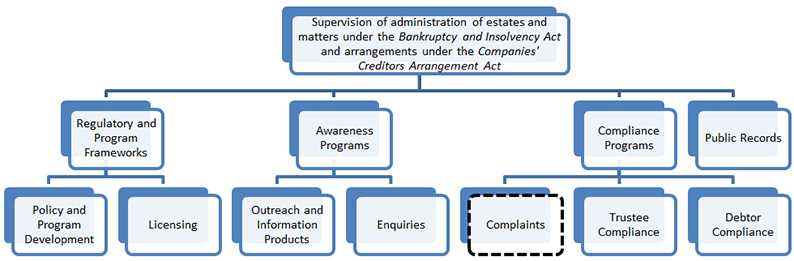
The Complaints Program gathers intelligence and assists the OSB in detecting compliance risk for licenced insolvency trustees and debtors. Information from third parties and complaints are the OSB's primary sources of information about creditors' activities. As well, complaints are currently the only activity that the OSB uses to assess risks related to receiver compliance. Complaints are also the main source of information in dealing with non-compliance of those individuals assigned to monitor debtors.
Definitions:
- Creditor - A creditor is a person who is owed money, goods or services.
- Debtor - A debtor is a person who owes a specific debt (usually money) to another person. In the context of the Bankruptcy and Insolvency Act, a debtor is a person who is insolvent, that is, he or she cannot pay off debt as it becomes due.
- Licenced Insolvency Trustee - A person licensed by the OSB to administer bankruptcies and proposals.
- Receiver - A person appointed by, or on behalf of, a creditor to take control of the assets of a debtor.
- Person - A person includes a human being, a partnership or a corporation that is recognized by law as having rights and duties.
Appendix B: Audit criteria
| OSB Compliance Framework – Complaints Program - Audit Criteria |
| Governance |
| 1. Oversight mechanisms are in place to identify issues to be escalated, resolved and communicated to support the Complaints Program. |
| Risk management |
| 2. There are mechanisms in place for management to identify, assess, mitigate and report on risks related to the Complaints Program. |
| Complaints handling process |
| 3. The complaints handling process is documented, maintained and communicated to relevant employees in a consistent manner across the regions. |
| 4. Training on complaints sufficiently and consistently covers key process areas and is delivered to relevant employees across the regions on an ongoing basis. |
| 5. The complaints handling process is effectively designed and operating as intended (e.g. the outcomes of the complaints handling process inform other compliance programs, being Trustee Compliance and Debtor Compliance, in support of ensuring compliance with the legislative and regulatory framework). |
| Lessons learned activities |
| 6. There are lessons learned mechanisms in place to support knowledge transfer for the ongoing implementation and management of the Compliance Framework. |
Appendix C: Examples of complaints handling process gaps and areas that lack clarity
| Example – Key control gap |
Managerial Oversight
Given this flexibility, there is a potential risk of insufficient management oversight and approval. This could increase the risk of an inaccurate response as well as increase reputational risk. |
| Example – process gaps |
Procedural Guidance – Roles and Responsibilities
|
Procedural Guidance – Interconnection between Complaints and Other Compliance Programs
This resulted in informal and ad-hoc engagement of other compliance teams and variations of file closure activities. As a result there is a potential risk that intelligence gathered from complaints may not have been shared with other compliance programs. |
| Example – lack of clarity |
Review Plans
Review plans are a mechanism to help mitigate the risk of insufficient work being carried out in support of a final response. Based on the current lack of clarity, as well as discretionary managerial oversight of review plans, this risk exposure is increased. Sharing of Information
Subsequent Complaints
|
Management Response and Action Plan
A - For inclusion in the report
The findings and recommendations of the Audit of the Office of the Superintendent of Bankruptcy (OSB) – Compliance Framework – Complaints Program were presented to OSB management. Management has agreed with the findings included in this report and will take action to address all applicable recommendations by December 31, 2016.
Include a brief summary of the management actions including key or significant elements of the detailed management action plan where appropriate.
B - For follow-up purposes - Detailed actions to address the recommendations in the report
| Recommendation | Planned Action on the Recommendation | Responsible Official (position) | Target completion date |
|---|---|---|---|
Recommendation 1: (3–6 months) | (1) Terms of References for operational governance mechanisms will be reviewed and updated to ensure alignment of roles and responsibilities and to facilitate an effective decision-making process, including on issues pertaining to complaints. | Deputy Superintendent, Operations and Corporate Services | June 30, 2016 |
| (2) Update and communicate compliance workflows and roles/responsibilities to ensure full integration of complaints into other compliance activities. | |||
Recommendation 2: (6–9 months) | An operational Risk Management Plan will be developed to regularly (e.g., annually) identify and analyze risks and develop mitigation strategies. The first year will cover: (2) Ensuring national-consistency in risk assessment, analysis and documentation in identified process pertaining to release of information related to complaints under the Access to Information Act and the Privacy Act. | Deputy Superintendent, Operations and Corporate Services | September 30, 2016 and ongoing basis (annually) |
Recommendation 3: (1 year) | (1) Conduct a review of the complaints process including a broad gap analysis. | Deputy Superintendent, Operations and Corporate Services | December 31, 2016 |
| (2) Develop and implement standardized guidelines and common processes to address gaps for complaints, and build national-consistency to reduce incidences of differing interpretation. | no data | ||
| (3) Validate national-consistency by conducting quality assurance reviews of complaints from across the country on a regular basis, which will be reported to senior management on a quarterly basis. | December 31, 2016 | ||
| (4) Enhancement of management oversight at the macro level through reporting and monitoring of complaint activities. All responses will be reviewed by the regional managers and a sample of those responses will be reviewed by the national manager. | March 31, 2016 | ||
Recommendation 4: | (1) Review, update and communicate applicable Complaint training materials to ensure they are current and reflect/support the organizational objectives under the Compliance Framework. (2) Review, develop and communicate appropriate guidance where gaps may exist to strengthen complaint response quality, including in the areas of review plans and final responses. | Deputy Superintendent, Operations and Corporate Services | December 31, 2016 |
Recommendation 5: | (1) A lessons learned exercise was conducted by managers and staff involved in implementation of the updated trustee compliance program in the fall of 2015. The final report will be reviewed, discussed, and approved by OSB’s Executive Committee. (2) Relevant lessons learned will be applied in the planned implementation of the updated Debtor Compliance program. | Deputy Superintendent, Operations and Corporate Services | June 30, 2016 |