
PDF version
Dany Brouillette
Innovation, Science and Economic Development CanadaFootnote *
Daniel Ershov
University of Toronto
Abstract
Using data from the Survey of Innovation and Business Strategy 2009, a management practices index () à la Bloom and Van Reenen (2007) is built to analyze the relationships between management practices, competition, innovation and firm performance in Canada. The results show that the distribution of varies among industries and that large firms tend to have more structured management practices. A positive correlation between () and the intensity of sales and profits is found for manufacturing firms. There is also a positive correlation between () and business innovation, a result that holds for enterprises in all sectors. Finally, the importance of competition depends on how it is measured: the number of competitors in the enterprise's main market is associated with a higher intensity of sales and profits, while it is the entry of new competitors in the main market that matters for innovation.
Final version:
Table of Contents
- 1. Introduction
- 2. Analytical Framework
- 3. Data
- 4. Results
- 5. Conclusion
- References
- Appendix A. The Management Practices Indices
- Appendix B. Variables Definition
- Appendix C. Descriptive Statistics (weighted)
- Appendix D. Detailed Results
1. Introduction
A number of recent reports by industry observers highlight that Canada's lagging performance in terms of productivity growth is associated with the low levels of business innovation (Competition Policy Review Panel, 2008; Expert Panel on Business Innovation, 2009; Drummond and Bentley, 2010; Expert Review Panel on Research and Development, 2012). Several possible causes have been put forward such as industry structure, subpar investments in tangible capital, small market size, "business complacency" and the low importance attributed to education by Canadian managers. The last two factors are of particular interest as they are intangible in nature. Also falling in this intangible assets category, are management practices (MP).
The role of MP in the success of enterprises has long been recognized in economics and other social sciences (see for example Huselid, 1995). And put by Alchian and Demsetz (1972), "efficient production… is a result not of having better resources but in knowing more accurately the relative productive performances of those resources."
The recent empirical work by Bloom and Van Reenen (2007) defines a tractable framework for measuring MP and assessing their relationship with firm performance. MP, and more generally intangible assets, may be an important factor explaining the persistent productivity differentials observed across countries, but also within a country in narrowly defined industries (Bartelsman and Doms, 2000; Syverson, 2004a,b, 2011). If firms in a same industry are observed to use the same inputs and technologies and face the same level of competition, then there must be something else affecting their productivity. Supporting the view that MP matter for productivity, Bloom et al. (2012b) estimated that better MP of US firms accounts on average for 30 percent of the total factor productivity differential between the US and other countries such as France, the UK, Sweden and Germany.
Manufacturing enterprises in Canada fare well compared to their counterparts located in other countries. Only US enterprises have better MP compared to those in Canada (Institute for Competitiveness and Prosperity, 2009). Bloom and Van Reenen (2010) showed that the US has the lowest proportion of badly managed enterprises compared to any other countries, including Canada. Moreover, there is no statistical difference between average MP in Canada, Germany, Sweden and Japan, while Canada is outperforming the UK and France, among others. From a broad perspective, Bloom (2010) mentioned that the marketplace framework in Canada is favourable to the implementation of good MP due to, for example, the high levels of competition and low market regulation. Firms in Canada, however, should make better use of skilled workers.
The objective of this paper is to determine the relationships between MP, firm performance and innovation using a framework similar to the one developed by Bloom and Van Reenen (2007). There are three main research questions: i) what are the firms' characteristics associated with better structured MP; ii) what is the relationship between MP and firm performance; and iii) what is the relationship between MP and innovation. Answering the last question is one of the main contributions of the paper as very little evidence exists on the link between MP and innovation. In addition to MP, the role of competition in firm performance and innovation is also considered. This analysis is based on the data from the Survey of Innovation and Business Strategy 2009 (SIBS) and other administrative sources (Statistics Canada).
The main results can be summarized as follows: i) the distribution of the management practices index differs by sector; ii) the variables positively correlated with include firm size, percentage of workers with a university degree, the presence of a multinational in the enterprise's main market and whether the head office is located in the United States; iii) is positively correlated with sale and profit intensity for manufacturing enterprises only; iv) is positively correlated with innovation—no matter how innovation is defined—for enterprises in all industries; and v) the links between competition, performance and innovation depend on the nature of competition. More precisely, the number of competitors in the enterprise main market is positively correlated with higher performance but it is the entry of new enterprises that matter for innovation.
The rest of the paper is organized as follows. The analytical framework is presented in the second section while the data discussion is in the third one. Section 4 shows the results and Section 5 concludes.
2. Analytical Framework
2.1 Construction of the Management Practices Index
The used in this paper is based on the framework introduced by Bloom and Van Reenen (2006, 2007) (BVR). SIBS provided an opportunity to collect additional MP data for Canada and linked them to economic indicators such as sales, profits and innovation. Most SIBS questions on MP were derived from the BVR survey on MP. This allowed to build a similar but not identical .
The main contribution of BVR was to develop a comprehensive and tractable framework to analyze MP. The BVR index is based on four types of indicators referring to a specific aspect of MP: operational practices, monitoring of performance, target setting and incentives. See the Appendix in Bloom and Van Reenen (2007) for more details.
The BVR work can be linked to several strains of the economic literature: management style (Bertrand and Schoar, 2003); innovative work practices (Ichniowski et al., 1997; Macduffie, 1995; Osterman, 1994); workers empowerment (Cappelli and Neumark, 1999); incentives pay (Lazear, 2000; Bandiera et al., 2007); hiring practices (Oyer and Schaefer, 2011; Autor and Scarborough, 2008); total quality management (Powell, 1995); and information and communication technologies use (Black and Lynch, 2001; Bresnahan, 1999; Bresnahan et al., 2002; Bloom et al., 2012a).
The SIBS MP index is built for 2009 using 19 indicators. Each indicator has been normalized between zero and one, the latter denoting the best practices and zero the worst. A simple average is taken, as shown by Equation (1), so also ranges from zero to one. has at least one element in each type of indicator of the BVR index, but as shown in Section A.1 of Appendix A, the coverage is unequal.
All SIBS MP questions were used, except for the share of workers with a university degree (Q63) and the one about who set the pace of work to achieve production performance targets (Q57). Exclusion of these variables are based on the fact that it is unclear which response should be attributed a higher score. Q63 was nevertheless included as a separate variable in the regression analysis.
The normalization process is specific to each indicator and is consistent with the spirit of the BVR framework. See Section A.2 for more details on the normalization rules used (Appendix A).
Apart from the contents, the other main difference between the BVR survey and the SIBS is the way data were collected. BVR used face-to-face interviews to collect in-depth information on the firm MP. In contrast, paper/electronic questionnaires were used for the SIBS. Because of their collection method, BVR can argue that their index is effectively a proxy for the quality of a firm's MP, but this is less clear for the SIBS. Therefore, the results are going to be interpreted as "more structured MP" rather than as "better MP." This interpretation is borrowed from Bloom et al. (2013), who also used MP data from a paper/electronic MP survey in the US.
The differences listed in this section raises the question of comparability between the BVR and the SIBS MP index. Comparison of the non-parametric distributions from Figure 2 in Bloom (2010) and Figure 2 shows that, overall, both indices yield similar distributions for manufacturing enterprises. The only noticeable difference is the seemingly fatter tails in Figure 2.
2.2 Determinants of MP
The first part of the regression analysis examines the relationship, at the firm level, between and a number of characteristics such as firm size and the degree of competition the firm faces. The relationship takes the following linear form (for 2009):
Firms are denoted by and the usual error term. is a vector of firm characteristics that includes workers education and binary variables for firm size, firm structure, industry and province. See Appendix B for a detailed description of all variables used in this analysis. The inclusion of most of these variables is justified given results from the BVR literature. Bloom (2010) and Institute for Competitiveness and Prosperity (2009) are especially relevant because of their focus on Canada.
Bloom (2010) found that large firms in Canada have the best MP, a evidence supported by SIBS data as shown in Figure 1. There is a clear pattern suggesting that the larger the enterprise, the more structured their MP. average is 0.40 for small enterprises and 0.66 for the x-large, while the average for medium and large ones are around 0.55. It is however unclear which factor is the cause. Large enterprises may need to implement good MP to conduct efficiently their operations, but it may be that good MP are required for growth. As for the other variables, the results must be interpreted as correlations, not causal effects. This applies to all relationships estimated in this paper and to other works in the BVR literature apart from Bloom et al. (2011).
Figure 1: Distributions for by firm size
– Weighted densities, total sample N = 4,227 –
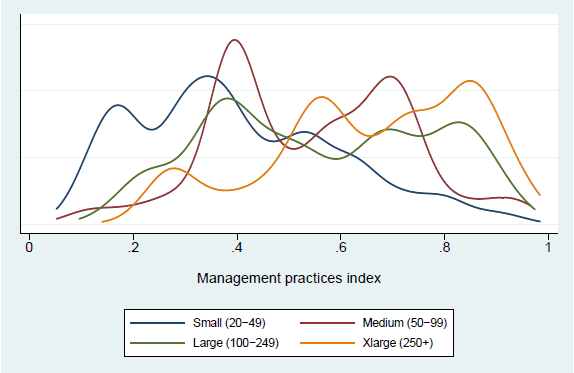
Note: Firm sizes are based on individual labour units.
Structure and ownership of the enterprise also matters for MP. Multinational enterprises (MNE) were found by Bloom and Van Reenen (2010) to have better MP compared to other enterprises. In this paper, a set of binary variables for the location of the headquarters (HQ) outside Canada is used as a proxy for MNE status. A country of control variable was also available, but it was so closely correlated with HQ variables that it could not be included. Note that the drawback of using the HQ variables is their inability to distinguish between a MNE and a non-MNE that both have their HQ in Canada. Another binary variable indicating the multi-establishment status of the enterprise was included as Bloom et al. (2013) reported that multiple establishment enterprises tend to have better MP. Finally, family-owned and managed enterprises are the worst managed compared to dispersed shareholders and private equity ownership (Van Reenen, 2011; Bloom and Sadun, 2009). Unfortunately, ownership information was not available in the SIBS.
Education is summarized by the percentage of workers with a university degree . Unfortunately, the SIBS did not collect data on managers' education. Bloom et al. (2013) showed that the magnitude of the correlation between MP and the workers' education is similar to the one between MP and managers' education. This means that the estimated coefficient of may be overestimated.
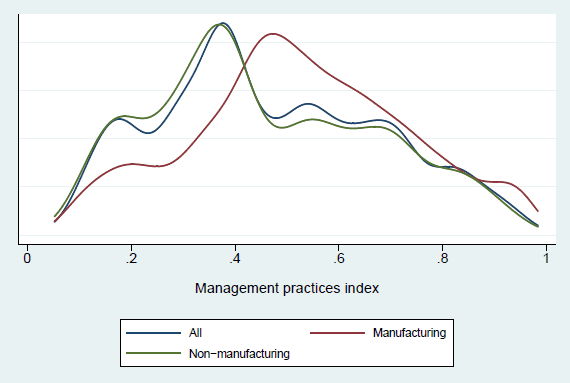
The original BVR framework focussed on manufacturing enterprises, but a project was developed in collaboration with the Institute for Competitiveness and Prosperity to extend their framework to the retail sector. They found that in Canada, the US and the UK, manufacturing enterprises are better managed compared to retail sector enterprises (Institute for Competitiveness and Prosperity, 2010). SIBS data are again consistent with this evidence as shown in Figure 2. It is shown that the left tail of the distribution for non-manufacturing enterprises is much fatter compared to one for manufacturing enterprises. Given the difference between sectors, all descriptive statistics and regression analyses are going to be presented for manufacturing and non-manufacturing sector separately.
Figure 2: Distributions of by sector
– Weighted densities, total sample N = 4,227 –
Caution must, however, be exercised with non-manufacturing data because the SIBS coverage for this sector is not as comprehensive as for the manufacturing sector. For example, out of a population of 13,280 enterprises in the retail trade sector, only 26 were sampled (for more details see Appendix A of Industry Canada, 2011). In contrast, a third of all manufacturing enterprises in the target population (4,394 out of 12,846) were included in the sample. This implies that some non-manufacturing enterprises have large sampling weights that should be kept in mind when analyzing the results.
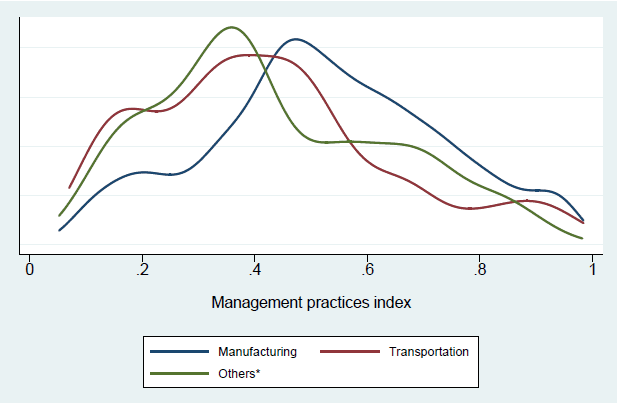
Despite this potential issue with sampling weights, it is possible to further decompose the distribution by two-digit NAICS industry. Two conclusions can be drawn from Figures 5, 6, 7 and 8 in Appendix C. First, there is a lot of variation in within a sector, no matter which sector is considered. Second, there is much more variation among the distributions of non-manufacturing sectors compared to two-digit manufacturing sectors. As mentioned in the previous paragraph, part of these results are due to small sample sizes and high sampling weights for non-manufacturing industries.
The ICAP report on retail also reported that the relationships between MP and size, MNE status, education and ownership have the same sign as in the manufacturing sector. In addition, the authors found that US-owned retail enterprises in Canada are better managed compared to Canadian-owned. Other non-manufacturing sectors studied by BVR, in separate initiatives, are health care services and school (Bloom et al., 2010).
Competition was found to be an important determinant of MP by BVR. Bloom et al. (2012b) mentioned that competition may affect MP through at least two mechanisms. First, this can happen through reallocation of resources toward better managed enterprises. In other words, competition drives badly managed enterprises out of business. Second, competition may reveal information about competitors' MP. This causes managers to revise their "over-optimistic" perceptions of their own performance and to increase managerial efforts. Overall, BVR found that more competition is associated with better MP.
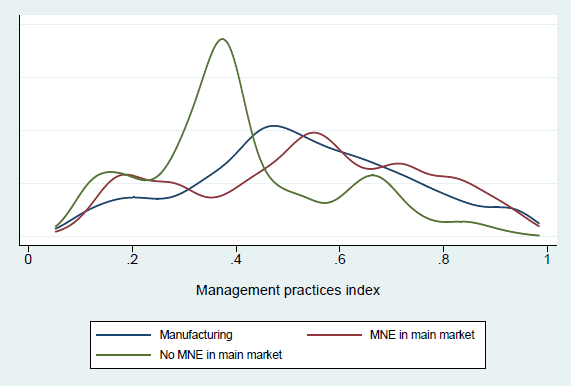
Competition in the BVR literature is measured by the number of competitors, the penetration rate of imports and the Lerner index. In this study, the vector includes four indicators of competition related to the enterprise's main market: the number of goods that compete against the enterprise's highest selling product; the presence of a MNE; the number of competitors; and the entry of new competitors. The main market of an enterprise is defined as the geographic area from which the highest share of revenue from its highest selling product is derived.Footnote 1 Figure 3 shows that enterprises facing a MNE in their main market tend to have more structured MP. This is, again, consistent with the BVR results mentioned previously. In addition to , a Lerner index is also included in Equation (2) as done in Bloom and Van Reenen (2006). A sensitivity analysis was also conducted for the Lerner index and it was bounded to a -10 to 1 interval.
Figure 3: Distributions of by presence of MNE
– Weighted densities, total sample N = 4,227 –
2.3 MP and Labour Productivity
This part aims to estimate the relationship between MP and performance of enterprises operating in Canada, controlling for environmental factors and firm characteristics. The relationship estimated is given by:
denotes the performance of the enterprise in 2008, either measured by sales over employment (sales) or profits over employment (profits). The estimated parameter , is expected to be positive as in the BVR literature (see for example Bloom and Van Reenen, 2010). Note that while SIBS data are only available for 2009, sales and profits for 2009 were not timely available. It is thus assumed that MP were consistent between the two years. In addition to the variable in , the ratio of capital over employment (cap) is also included. It is as the sum of tangible and intangible assets over employment.
There is some evidence in the empirical literature that competition increases productivity. For example, Nickell (1996) reported that the increase in the number of competitors is associated with significantly higher total factor productivity growth. Aghion et al. (2009) suggested that entry of new firms may increase productivity growth, but only in industries that are close to the technology frontier. Griffith et al. (2010) also show that the increased competition in the European Union, measured by the level of profitability, had a positive impact on productivity growth. However, Blanchflower and Machin (1995) did not find much evidence to support a positive relationship between competition and productivity growth. This suggests that different measures of competition matter for firm performance, which justify the inclusion of the variables in Equation (3).
Equation (3) is estimated using the ROBUSTREG SAS procedure which uses residuals from an initial linear regression to identify the outliers and leverage points. Based on these residuals, a set of weights is produced and applied to the data and the model is estimated using an iterative algorithm.Footnote 2 Consequently, each outlier and bad leverage point receives a lower weight, which can be set to zero in extreme cases. Finally, observations for which the sales to employment ratio was equal to zero were removed, but negative profits were allowed.
2.4 MP and Innovation
There is some evidence in the non-BVR literature that other intangibles, such as human capital and organizational changes, are positively related to innovation (Becheikh et al., 2006). Using the Workplace and Employee Survey from 1999–2006, Dostie and Paré (2013) showed that both firm-sponsored classroom and on-the-job training lead to more innovation in Canada. Arvanitis et al. (2013) found similar results for Switzerland for human capital and organizational changes. There are no results on the relationship between innovation output and MP in the BVR literature, but Bloom et al. (2013) reported a positive correlation between R&D (innovation input) and MP for US establishments.
SIBS data suggest that innovation and MP are indeed positively associated. Figure 4 clearly shows that enterprises that have introduced innovation tend to have more structured MP compared to non-innovators. To further investigate this relationship, the following empirical specifications were estimated:
In Equation (4), I is a binary variable capturing whether the enterprise innovated from 2007–09. An innovator is defined as an enterprise that introduced any of the usual four types of innovation: process (PRCS), organizational (ORGZ), product (PRDT) or marketing (MRKT). The vector X contains the same variables as for Equation (2) plus R&D expenditures in 2004—results are robust to other definitions of R&D, 2004–06 average for instance—and the number of advanced technologies used by the enterprises in 2009. As is assumed to be normally distributed, so a simple Probit is used to estimate the relationship.
Figure 4: Distributions of by innovator status
– Weighted densities, total sample N = 4,227 –
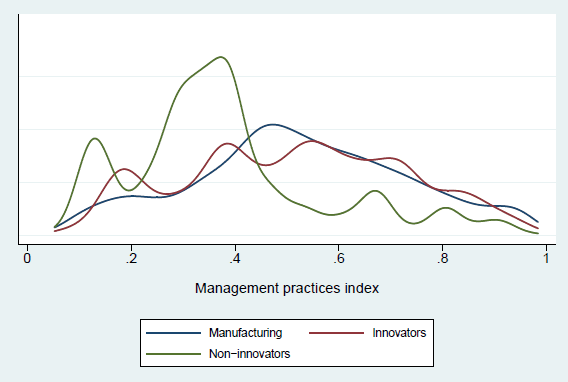
Note: Firm sizes are based on individual labour units.
For Equation (5), three additional definitions of innovation were used: i) technological (PRCS–PRDT) versus non-technological (ORGZ–MRKT); ii) PRCS–ORGZ versus PRDT–MRKT; iii) and PRCS, ORGZ, PRDT and MRKT. Innovation variables remained binary variables, but sets of parameters were estimated. It was assumed that were normally distributed and correlated with each other, so multivariate Probits were used to estimate Equation (5). It was expected that some of will be positive, but it was unclear whether this relationship were to change depending on the type of innovation.
The impact of competition on innovation is not clear from the literature. Aghion et al. (2001) showed that an increase in product market competition has a positive impact on innovation. Similarly, Aghion et al. (2009) noted that entry of competitors spurs innovation in industries close to the technology frontier, a result that reflects their result for productivity. However, Boone (2000) reported that the effect of competition on innovation depends on the relative efficiency of the enterprise compared to its competitors. Therefore, in light of this brief overview of the literature, it is unclear what to expect about the relationship between and .
3. Data
Most variables were derived from the Survey of Innovation and Business Strategy 2009 (SIBS). The SIBS target population included all enterprises with at least 20 employees and $250,000 of revenue in NAICS 11 to 56, but manufacturing enterprises were oversampled. The statistics and results presented in this paper are weighted, so the results can be generalized to the target population. The SIBS final sample consists of 4,227 enterprises.
Data on MP, competition intensity (except the Lerner index), innovation and use of advanced technology were taken from the SIBS. In addition, some control variables such as location of head office and the share of workers with a university degree were also extracted from the SIBS. The other control variables were derived from the Business Register (province of location, industry and multi-establishment status).
SIBS data needed to be supplemented by information from other Statistics Canada administrative databases. Sales, profits, assets (tangible and intangible) and cost of goods sold variables were extracted from the General Index of Financial Information database. Dollars variables were expressed in $M and were deflated using the National Account Productivity price index (KLEMS) produced by Statistics Canada.
Employment was extracted from the Longitudinal Employment Analysis Program database. The individual labour unit (ILU) was used to construct all employment variables, including firm size. ILU is not a count of the number of employees, but a constructed variable reflecting the share of employment attributable to an enterprise. For example, if an employee works in two enterprises and derived half of his salary from each, ILU is equal to 0.5 for both enterprises for this employee.
The Research and Development in Canadian Industry database provides data on R&D expenditures. As a practical matter for the year 2004, this database was a census of all R&D performers in Canada, so any missing observation was considered to be a zero.
4. Results
4.1 Determinants of the
Table 1 summarizes the results from the regression of on firm characteristics and competition indicators. The full set of estimated parameters is presented in Table 4 of Appendix D. Overall, results are fairly robust across sectors and consistent with the BVR literature.
Firm size is one of the most important variables. Consistent with the evidence in Figure 1, there is a positive relationship between firm size and and the magnitude of the estimated parameters increases with size. These results hold for both sectors and estimated parameters for the non-manufacturing sector are larger. Enterprises with a higher percentage of workers with a university degree tend to have more structured MP. The location of head office also matters, especially if it is located in the US. The multiple establishments variable is negatively correlated with for non-manufacturing enterprises only.
| Variable | Manufacturing | Non-manufacturing |
|---|---|---|
| – Characteristics – | ||
| MEDIUM | 0.1025 | 0.1544 |
| LARGE | 0.1083 | 0.1827 |
| XLARGE | 0.1873 | 0.2378 |
| %LARGE | 0.0018 | 0.0026 |
| HQ_US | 0.0586 | 0.0943 |
| HQ_EU | 0.0668 | 0.0543 |
| HQ_ROW | 0.0199 | −0.0994 |
| MULTI | 0.0083 | −0.0211 |
| –Competition variables – | ||
| MNE | 0.0587 | 0.1022 |
| #COMP | −0.0081 | −0.0006 |
| ENTRY | 0.0143 | −0.0306 |
| #GOODS | 0.0006 | 0.0106 |
| LERNER | −0.0063 | 0.0998 |
| Estimated parameters significant at a 0.10 level or less are in bold. Detailed results are presented in Table 4 of Appendix D. |
||
In terms of competition, the presence of a MNE in the enterprise's main market for its highest selling product is positively correlated with . Few other competition variables are found to be significant. For the manufacturing sector, there is a negative relationship between the number of competitors in the main market and as in Bloom and Van Reenen (2007). For non-manufacturing enterprises, a positive link has been identified between the Lerner index and . Exclusion of the Lerner index does not have much impact as shown in Table 4.
4.2 Relationships between Sales, Profits and
Table 2 summarizes the results for sales and profits regressions. The full set of estimated parameters is presented in Table 5 of Appendix D. The main difference between sectors relates to as the estimated coefficient for this variable is positive and significant for manufacturing enterprises, but not for non-manufacturing enterprises.
One possible explanation for this result is the heterogeneity among enterprises outside the manufacturing sector. Complementary evidence on this heterogeneity is provided in Figures 6 to 8 in Appendix C. These figures show that, at least in terms of MP distributions, non-manufacturing industries are less similar among themselves compared to the three-digit manufacturing industries (Figure 5). The results may also be driven by some non-manufacturing enterprises with large sampling weights—the SIBS coverage being much less comprehensive outside the manufacturing sector.
| Manufacturing | Non-manufacturing | |||
|---|---|---|---|---|
| Variable | Sales | Profits | Sales | Profits |
| – Characteristics – | ||||
| cap | + | + | + | + |
| + | + | no data | no data | |
| MEDIUM | + | + | no data | – |
| XLARGE | + | – | no data | – |
| LARGE | + | – | – | – |
| %UNIV | no data | + | + | + |
| HQUS | + | + | + | + |
| HQEU | + | + | no data | no data |
| HQROW | no data | – | no data | no data |
| MULTI | + | + | + | + |
| –Competition Variables – | ||||
| MNE | + | – | no data | – |
| #COMP | no data | + | + | + |
| ENTRY | no data | – | no data | – |
| #GOODS | no data | – | – | – |
| +/−: significant at a 0.10 level or less. Detailed results are presented in Table 5 of Appendix D. |
||||
To further investigate this issue, Equation (3) was estimated for two additional non-manufacturing sectors groupings: resources-based and best-managed. The first group includes NAICS 11 (agriculture), 21 (mining and oil and gas extraction), 22 (utilities) and 23 (construction). The second is a grouping of NAICS 52 (finance and insurance) and 54 (professional services), which are the two services sectors with the highest average (Figure 7). The estimated coefficient for (not shown here) is negative and significant in the sales regression for the best-managed group and in the profits regression for the resources-based group. While these results seems to confirm the importance of heterogeneity and the effect of the sampling strategy used, it is hard to explain why the sign for is negative.
A second explanation for the non-significance of in Table 2 is that the SIBS MP questions were less appropriate for non-manufacturing activities. Testing of the questionnaire revealed that respondents in non-manufacturing enterprises had more difficulty answering some of these questions. A different framework for the non-manufacturing sector would have been better, as in Institute for Competitiveness and Prosperity (2010) for the retail trade sector—but this was not possible to implement at the time SIBS was developed. In turn, this suggests that may not accurately measure the extent of MP in non-manufacturing industries.
Turning to the competition indicators, the results in Table 2 indicate that facing more competitors (#COMP) is associated with better performance while a higher number of goods competing with the enterprise's highest selling product (#GOODS) has the opposite effect. Presence of a MNE and entry of new competitors are also negatively correlated with profits in both sectors. Two conclusions can be drawn from the competition results. First, not all aspects of competition correlate in the same way with firm performance. Second, profits seem more sensitive to competition compared to sales.
Among the other variables, the estimated coefficient of asset-to-employment ratio cap has a positive sign in all specifications, which is also the case for HQ_US (head office located in the United States) and MUTLI (multi-establishments). The percentage of workers with a university degree is positively correlated with performance, except for the sales regression for manufacturing enterprises. Finally, performance increased with firm size only for manufacturing enterprises in the sales regression.
4.3 Relationships between Innovation and
Table 3 summarizes the results from the innovation regressions. Column (1) shows the results for the general indicator of innovation; Column (2) shows the ones for technological and non-technological innovations; Column (3) shows the results for the PRDT–MRKT and PRCS–ORGZ innovation groupings; and the last column shows them for the four types of innovation. All estimated parameters are presented in Tables (5) to (7) in Appendix D.
The most important result is the estimated positive correlation between and innovation. This holds for manufacturing enterprises no matter how innovation is measured and for most indicators for non-manufacturing enterprises. This is an important result because it shows how critical MP is for innovation even when accounting for other control variables such as innovation inputs, firm size, enterprise structure and competition indicators.
| Manufacturing | ||||||||||||
|---|---|---|---|---|---|---|---|---|---|---|---|---|
| Variable | (1) | no data | (2) | no data | (3) | no data | (4) | |||||
| INNO | no data | TECH | NTECH | no data | PD–MK | PC–OG | no data | PRCS | ORGZ | PRDT | MRKT | |
| – Characteristics – | ||||||||||||
| + | no data | + | + | no data | + | + | no data | + | + | + | + | |
| RD | no data | no data | no data | no data | no data | no data | no data | no data | no data | no data | no data | no data |
| ADVTECH | + | no data | + | + | no data | + | + | no data | no data | no data | – | no data |
| MEDIUM | no data | no data | no data | no data | no data | – | no data | no data | no data | – | no data | no data |
| LARGE | no data | no data | no data | – | no data | no data | no data | no data | no data | – | no data | – |
| XLARGE | – | no data | no data | – | no data | no data | no data | no data | + | + | + | + |
| %UNIV | no data | no data | no data | + | no data | + | no data | no data | no data | no data | + | + |
| HQ_US | no data | no data | – | no data | no data | no data | no data | no data | – | no data | no data | no data |
| HQ_EU | no data | no data | no data | no data | no data | no data | + | no data | – | no data | no data | no data |
| HQ_ROW | no data | no data | – | – | no data | no data | no data | no data | – | – | – | no data |
| MULTI | – | no data | no data | no data | no data | no data | no data | no data | no data | no data | no data | no data |
| –Competition Variables – | ||||||||||||
| MNE | + | no data | no data | no data | no data | + | no data | no data | no data | no data | + | no data |
| #COMP | – | no data | – | no data | no data | no data | no data | no data | no data | no data | – | no data |
| ENTRY | + | no data | + | + | no data | + | + | no data | + | + | + | + |
| #GOODS | no data | no data | + | no data | no data | + | no data | no data | no data | no data | + | + |
| Non-Manufacturing | ||||||||||||
|---|---|---|---|---|---|---|---|---|---|---|---|---|
| Variable | (1) | (2) | (3) | (4) | ||||||||
| INNO | TECH | NTECH | PD–MK | PC–OG | PRCS | ORGZ | PRDT | MRKT | ||||
| – Characteristics – | ||||||||||||
| MP | no data | no data | no data | + | no data | + | + | no data | + | + | no data | + |
| RD | no data | no data | + | no data | no data | no data | no data | no data | no data | no data | no data | no data |
| ADVTECH | + | no data | + | no data | no data | no data | + | no data | + | + | + | no data |
| MEDIUM | no data | no data | no data | no data | no data | no data | no data | no data | no data | no data | + | no data |
| LARGE | + | no data | no data | – | no data | + | no data | no data | no data | + | no data | + |
| XLARGE | – | no data | no data | no data | no data | + | no data | no data | no data | + | + | no data |
| %UNIV | no data | no data | no data | no data | no data | no data | no data | no data | no data | no data | no data | no data |
| HQ_US | no data | no data | – | no data | no data | no data | + | no data | no data | + | no data | no data |
| HQ_EU | no data | no data | no data | no data | no data | no data | no data | no data | no data | no data | no data | no data |
| HQ_ROW | no data | no data | – | no data | no data | no data | no data | no data | no data | no data | no data | no data |
| MULTI | – | no data | no data | no data | no data | no data | – | no data | – | – | no data | no data |
| –Competition variables – | ||||||||||||
| MNE | + | no data | + | no data | no data | no data | + | no data | + | no data | + | no data |
| #COMP | no data | no data | no data | – | no data | no data | no data | no data | + | – | – | no data |
| ENTRY | + | no data | + | + | no data | + | no data | no data | no data | + | + | + |
| #GOODS | – | no data | – | no data | no data | no data | no data | no data | – | no data | no data | no data |
| +/–: significant at a 0.10 level or less. Detailed results are presented in Tables 5, 6 and 7 of Appendix D. |
||||||||||||
Of the two inputs to innovation, R&D expenditures (RD) and the number of advanced technologies used (ADVTECH), only the latter is found to be positively correlated with innovation. For manufacturing enterprises, this relationship holds for all aggregated measures of innovation as shown by Columns (1), (2) and (3). In contrast, for non-manufacturing enterprises, the results suggest that ADVTECH is positively correlated with PRCS, ORGZ and PRDT innovations.
RD is significant only for technological innovation introduced by non-manufacturing enterprises (Column (2)). Although a similar result was found in Brouillette (2013), R&D is nevertheless still important for innovation in Canada. It is likely that R&D expenditures affect indirectly innovation, for example, through the use of advanced technology.
The influence of the competition indicators depend on how competition is measured. The most striking result is the entry of new competitors in the enterprise's main market for its highest selling product. The estimated parameters for ENTRY is systematically positive and significant for all types of innovation in the manufacturing sector regressions and for almost all cases in the non-manufacturing sector regressions, a result consistent with Aghion et al. (2009). Another aspect of competition that is positively correlated with innovation is the presence of a MNE in the enterprise's main market although fewer significant relationships were found. Results are consistent for both manufacturing and non-manufacturing sectors. The link between the number of competitors (#COMP) in the main market is negative overall for both sectors. This contrasts with the results for the performance analysis where this variable was found to have a positive and significant sign.
The results also show that a small number of positive estimated correlations between innovation and %UNIV were found in the manufacturing sector, but no such association was found in the non-manufacturing sector. This is in contrast to the results of the performance analysis where %UNIV is more important for non-manufacturing enterprises.
The relationship between firm size and innovation is less clear. Compared to small ones, large and x-large non-manufacturing enterprises are more susceptible to innovate, but results depend on the innovation indicator used. Results are even more mixed for manufacturing enterprises. Finally, the links between innovation and the location of headquarters and multi-establishment status are mostly negative.
5. Conclusion
This analysis confirms the presence of a positive correlation between firms' financial performance and business innovation and well structured management practices (MP). This study also provides evidence on the role played by competition.
The results show large differences in MP distribution across industries. Firm size, presence of a multinational enterprise (MNE) in the enterprise's main market, head office located in the United States and the percentage of workers with a university degree are the main determinants of MP. In terms of firm performance, MP are positively correlated with the intensity of sales and profits in the manufacturing sector, but not in the non-manufacturing sector. In contrast, MP are important for all industries when it comes to innovation. Finally, the role of competition depends on its nature and to a certain extent of the industry considered. The presence of a MNE and entry of new competitors are positively correlated with innovation, while it is the number of competitors that is important for firm performance.
From a policy perspective, this analysis highlights the importance of intangible capital for firm performance and business innovation. While this analysis focusses on MP, other intangibles such as managers' education, investments in skills and intellectual property management are perhaps equally important for growth and innovation. More research at the enterprise-level on theses intangibles is needed to better understand their interactions with productivity growth. This would allow better support to enterprises so that they can achieve their full potential.
Two caveats should be mentioned. The first one relates to data limitation for performance indicators. As described in Section 3, the last year available for these data was 2008. Since most SIBS data cover 2009 only—this is the case for MP and competition indicators—the implicit assumption made is that these variables did not change between 2008 and 2009.
The second caveat is about the endogeneity of the MP index. Although this is acknowledged as a serious issue, it was not possible to address it in this paper for lack of instruments. This may change with the availability of the SIBS 2012 data in 2014. By combining the 2009 and 2012 waves, this will provide a measure of the change in management practices that could be compared to the change in firms' performance or innovation.
References
- Aghion, Philippe, Christopher Harris, Peter Howitt, and John Vickers (2001) 'Competition, Imitation and Growth with Step-by-Step Innovation.' Review of Economic Studies 68(3), 467–492.
- Aghion, Philippe, Richard Blundell, Rachel Griffith, Peter Howitt, and Susanne Prantl (2009) 'The Effect of Entry on Incumbent Innovation and Productivity.' Review of Economics and Statistics 91(1), 20–32.
- Alchian, Armen A., and Harold Demsetz (1972) 'Production, Information Costs, and Economic Organization.' American Economic Review 62(5), 777–795.
- Arvanitis, Spyros, Euripidis N. Loukis, and Vasiliki Diamantopoulou (2013) 'Are ICT, Workplace Organization and Human Capital Relevant for Innovation? A Comparative Study Based on Swiss and Greek Micro Data.' KOF Working Paper No. 333.
- Autor, David H., and David Scarborough (2008) 'Does Job Testing Harm Minority Workers? Evidence from Retail Establishments.' Quarterly Journal of Economics 123(1), 219–277.
- Bandiera, Oriana, Iwan Barankay, and Imran Rasul (2007) 'Incentives for managers and inequality among workers: Evidence from a firm-level experiment.' The Quarterly Journal of Economics 122(2), 729–773.
- Bartelsman, Eric J., and Mark E. Doms (2000) 'Understanding Productivity: Lessons from Longitudinal Microdata.' Journal of Economic Literature 38(3), 569–594.
- Becheikh, Nizar, Réjean Landry, and Nabil Amara (2006) 'Lesson from Innovation Empirical Studies in the Manufacturing Sector: A Systematic Review of the Literature from 2993–2003.' Technovation 26(5–6), 644–664.
- Bertrand, Marianne, and Antoinette Schoar (2003) 'Managing with Style: The Effect of Managers on Firms Policies.' Quarterly Journal of Economics 68(4), 1169–1208.
- Black, Sandra, and Lisa M. Lynch (2001) 'How to Compete: The Impact of Workplace Practices and Information Technology on Productivity.' The Review of Economics and Statistics 83(3), 434–445.
- Blanchflower, David, and Stephen Machin (1995) 'Product Market Competition, Wages, and Productivity: International Evidence from Establishment-Level Data'.
- Bloom, Nicholas (2010) 'Measuring and Explaining Management Practices in Canada'.
- Bloom, Nicholas, and John Van Reenen (2006) 'Measuring and Explaining Management Practices Across Firms and Countries'.
—(2007) 'Measuring and Explaining Management Practices Across Firms and Countries.' Quarterly Journal of Economics 122(4), 1351–1408.
—(2010) 'Why Do Management Practices Differ across Firms and Countries?' Journal of Economic Perspectives 24(1), 203–224.
- Bloom, Nicholas, and Raffaella Sadun (2009) 'Do Private Equity-Owned Firms Have Better Management Practice?' In Globalization of Alternatice Investments, Working Papers Volume 2 – The Global Economic Impact of Private Equity Report 2009, ed. Anuradha Guring and Josh Lerner (World Economic Forum).
- Bloom, Nicholas, Benn Eifert, Aprajit Mahajan, David McKenzie, and John Roberts (2011) 'Does Management Matter? Evidence from India.' International Growth Center Working Paper no. 10/0873.
- Bloom, Nicholas, Carol Propper, Stephan Seiler, and John Van Reenen (2010) 'The Impact of Competition on Management Quality: Evidence from Public Hospital.' Center for Economic Performance Discussion Paper No 983.
- Bloom, Nicholas, Erik Brynjolfsson, Lucia Foster, Ron Jarmin, Itay SaportaEksten, and John Van Reenen (2013) 'Management in America.' Presented at the American Economic Association Meeting 2013.
- Bloom, Nicholas, Raffaella Sadun, and John Van Reenen (2012a) 'Americans Do IT Better: US Multinationals and the Productivity Miracle.' American Economic Review 102(1), 167–201.
—(2012b) 'Management as a Technology.' Presented at the American Economic Association Meeting 2013.
- Boone, Jan (2000) 'Competitive Pressure: The Effects on Investments in Product and Process Innovation.' RAND Journal of Economics 31(3), 549–569.
- Bresnahan, Timothy F. (1999) 'Computerisation and Wage Dispersion: An Analytical Reinterpretation.' Economic Journal 109(456), F390–415.
- Bresnahan, Timothy F., Erik Brynjolfsson, and Lorin M. Hitt (2002) 'Information Technology, Workplace Organization, and the Demand for Skilled Labor: Firm-Level Evidence.' The Quarterly Journal of Economics 117, 339–376.
- Brouillette, Dany (2013) 'Drivers of Innovation, Complementarity of Innovation, and Performance of Enterprises in Canada.' mimeo, Industry Canada.
- Cappelli, Peter, and David Neumark (1999) 'Do "High Performance" Work Practices Improves Establishment-Level Outcomes?' NBER Working Paper 7374.
- Competition Policy Review Panel (2008) 'Compete to Win.' Government of Canada, Ottawa.
- Dostie, Benoit, and Jonathan Paré (2013) 'Formation Parrainée par l'Employeur et Performance en Innovation.' Centre sur la productivité et la prospérité.
- Drummond, Don, and Alistair Bentley (2010) 'The productivity puzzle: Why is the Canadian record so poor and what can be done about it?' TD Economics Special Report.
- Expert Panel on Business Innovation (2009) 'Innovation and Business Strategies: Why Canada Falls Short.' Council of Canadian Academies (CCA).
- Expert Review Panel on Research and Development (2012) 'Innovation Canada: A Call to Action.' Government of Canada, Ottawa.
- Griffith, Rachel, Rupert Harrison, and Helen Simpson (2010) 'Product Market Reform and Innovation in the EU.' Scandinavian Journal of Economics 112(2), 389–415.
- Huselid, Mark A. (1995) 'The Impact of Human Resource Management Practices on Turnover, Productivity, and Corporate Financial Performance.' Academy of Management Journal 38(3), 635–672.
- Ichniowski, Casey, Kathryn Shaw, and Giovanna Prennushi (1997) 'The Effects of Human Resource Management Practices on Productivity: A Study of Steel Finishing Lines.' American Economic Review 87(3), 291–313.
- Industry Canada (2011) 'Business Innovation and Strategy: A Canadian Perspective.' Government of Canada, Ottawa.
- Institute for Competitiveness and Prosperity (2009) 'Management Matters.' ICAP Working Paper 12, Toronto.
—(2010) 'Management Matters in Retail.' ICAP Working Paper 13, Toronto. Lazear, Edward P. (2000).
—'Performance Pay and Productivity.' American Economic Review 90(5), 1346–1361.
- Macduffie, John Paul (1995) 'Human Resource Bundles and Manufacturing Performance: Organizational Logic and Flexible Production Systems in the World Auto Industry.' Industrial and Labour Relations Review 48(2), 197–221.
- Nickell, Stephen J. (1996) 'Competition and Corporate Performance.' Journal of Political Economy 104(4), 724–746.
- Osterman, Paul (1994) 'How Common Is Workplace Transformation and Who Adopts it?' Industrial and Labour Relations Review 47(2), 173–188.
- Oyer, Paul, and Scott Schaefer (2011) 'Personnel Economics: Hiring and Incentives.' In Handbook of Labor Economics, Vol 4b, ed. Orley Ashenfelter and David Card (North Holland) pp. 1769–1823.
- Powell, Thomas C. (1995) 'Total Quality Management as Competitive Advantage: A Review and Empirical Study.' Strategic Management Journal 16(1), 15–37.
- Syverson, Chad (2004a) 'Market Structure and Productivity: A Concrete Example.' Journal of Political Economy 112(6), 1181–1222.
—(2004b) 'Product Substitutability and Productivity Dispersion.' The Review of Economics and Statistics 86(2), 534–550.
—(2011) 'What Determines Productivity.' Journal of Economic Literature 49(2), 326–365.
- Van Reenen, John (2011) 'Boss-Onomics: Does Management Matter?' Industry Canada's Distinguished Speaker Series.
Appendix A. The Management Practices Indices
A.1 Comparison of MP Indicators from the BVR Survey and the SIBS
| BVR index (Bloom and Van Reenen, 2007) |
BVR types of indicators |
SIBS index () |
|
|---|---|---|---|
| 1 Modern manufacturing, introduction | Operations | No equivalent | |
| 2 Modern manufacturing, rationale | Operations | No equivalent | |
| 3 Process documentation | Operations | Q52 | The enterprise has a systematic process to resolve problems associated with production of goods or delivery of services |
| 4 Performance tracking | Monitoring | Q53 | Number of key production performance indicators (KPPI) monitored in the enterprise |
| 5 Performance review | Monitoring | Q54 | Frequency at which KPPI are shown to managers of operations |
| Q55 | Frequency at which KPPI are shown to workers | ||
| Q56 | Frequency of review of KPPI by top and middle managers | ||
| 6 Performance dialogue | Monitoring | Q62 | Employees' involvement in the decision-making process on task allocation |
| 7 Consequence management | Monitoring | No equivalent | |
| 8 Target breadth | Targets | No equivalent | |
| 9 Target interconnection | Targets | No equivalent | |
| 10 Target time horizon | Targets | Q58 | Time frame of the enterprise production performance targets for its highest product |
| 11 Targets are stretching | Targets | No equivalent | |
| 12 Performance clarity | Monitoring | Q64d | Formal performance agreements based on objective, quantifiable results are prepared for managerial/supervisory/executive employees at least annually |
| Q64e, Q64f | Formal appraisals are conducted for the majority of managerial and non-managerial staff at least annually | ||
| 13 Managing human capital | Targets | No equivalent | |
| 14 Rewardinghigh-performance | Incentives | Q59 | How does the enterprise reward production performance target achievement |
| 15 Removing poor performers | Incentives | Q61 | Enterprise's main policy to deal with employees not meeting expectations |
| 16 Promoting high performers | Incentives | Q60 | Enterprise's main way to promote employees |
| Q64b | Formal training programs are available to employees to teach them the skills required to perform their job | ||
| Q64c | Formal training programs are available to employees to increase their promotability | ||
| 17 Attracting human capital | Incentives | Q64a | At least one of the following selection methods to select candidates is used: personality/attitude tests, intelligence or aptitude tests, work sample |
| 18 Retaining human capital | Incentives | Q64g | Incentives programs such as employee stock ownership,profit-sharing,gain-sharing or merit bonus are available to non-managerial employees |
| Q64h | Incentives programs are available to managerial, supervisory, or executive employees | ||
| Q64i | Incentives programs are available to all employees | ||
A.2 Details on
| QUESTION | SCORE | QUESTION | SCORE | ||
|---|---|---|---|---|---|
| Q52 Systematic process | No | 0 | Q64a Use selection | No | 0 |
| to solve problems | Yes | 1 | methods for candidates | Yes | 1 |
| Q53 #KPPI | None | 0 | Q64b Training | No | 0 |
| At least one | 1 | for skills | Yes | 1 | |
| Q54 Frequency KPPI | Never/don't know | 0 | Q64c Training for | No | 0 |
| shown to managers | Any frequency | 1 | promotion | Yes | 1 |
| Q55 Frequency KPPI | Never/don't know | 0 | Q64d Performance | No | 0 |
| shown to workers | Any frequency | 1 | agreements | Yes | 1 |
| Q56 Frequency KPPI | Don't know | 0 | Q64e Appraisal | No | 0 |
| shown to executives | Rarely | for workers | Yes | 1 | |
| Periodically | |||||
| Continually | 1 | ||||
| Q58 Time frame | No targets | 0 | Q64f Appraisal | No | 0 |
| for performance | Short-term | for managers | Yes | 1 | |
| targets | Long-term | ||||
| Both | 1 | ||||
| Q59 Rewards | None | 0 | Q64g Incentives | No | 0 |
| Managers only | ½ | for workers | Yes | 1 | |
| All staff | 1 | ||||
| Q60 Promotion | Tenure | 0 | Q64h Incentives | No | 0 |
| based on … | Effort and tenure | ½ | for managers and | Yes | 1 |
| Effort | 1 | executives | |||
| Q61 If employees | Never moved | 0 | Q64i Incentives | No | 0 |
| don't meet | Warned | for all | Yes | 1 | |
| expectations | Warned, re-trained | ||||
| Removed | 1 | ||||
| Q62 Employees | No | 0 | |||
| make decisions | yes | 1 | |||
The SIBS questionnaire is constructed in such a way that Q54 to Q59 have to be answered only if the number of key production performance indicators monitored (Q53) is greater than zero. This means that for all enterprises not monitoring any, the maximum score is 14, not 19. A score of 0 was nevertheless assigned to Q54–Q59 for these enterprises so that an enterprise with fewer MP obtains a lower value of compared to one with more practices. Without this assumption, Enterprise A with = 13/14 (0.93) would rank higher than Enterprise B with = 17/19 (0.89). Enterprise B should, however, rank higher compared to Enterprise A because it has a broader set of MP and its performance for indicators other than those of Q54–Q59 is as good as for Enterprise A.
Appendix B. Variables Definition
| NAME | DESCRIPTION | SOURCE |
|---|---|---|
| MP | Management practice index (2009) | SIBS |
| sales | Sales over employment ratio in $M (2008) | GIFI, LEAP |
| profits | Profits over employment ratio in $M (2008) | GIFI, LEAP |
| INNO | = 1 if enterprise has innovated (2007–09) | SIBS |
| = 1 if PRCS innovation has been introduced (2007–09) | SIBS | |
| = 1 if ORGZ innovation has been introduced (2007–09) | SIBS | |
| = 1 if PRDT innovation has been introduced (2007–09) | SIBS | |
| = 1 if MRKT innovation has been introduced (2007–09) | SIBS | |
| = 1 if PRCS or PRDT have been introduced (2007–09) | SIBS | |
| = 1 if ORGZ or MRKT have been introduced (2007–09) | SIBS | |
| = 1 if PRDT or MRKT have been introduced (2007–09) | SIBS | |
| = 1 if PRCS or ORGZ have been introduced (2007–09) | SIBS |
| NAME | DESCRIPTION | SOURCE |
|---|---|---|
| MNE | = 1 if a MNE is present in the main market (2009) | SIBS |
| #COMP | Number of competitors in the main market (2009) Categories: 1 = 1 comp.; 2 = 2 comp.; 3 = 3 comp.; 4 = 4–5 comp.; 5 = 6–10 comp.; 6 = 11–20 comp.; 7 = 20+ comp. |
SIBS |
| ENTRY | = 1 if a new competitor entered main market (2009) | SIBS |
| #GOODS | Number of competing products in main market (2009) Categories: 1 = 1–2 prod.; 2 = 2–4 prod.; 3 = 5–7 prod.; 4 = 8–9 prod.; 5 = 10–19 prod.; 6 = 20–49 prod.; 7 = 50–100 prod.; 8 = 100+ prod. |
SIBS |
| SALES | Sales in $M (2008) | GIFI |
| COGS | Cost of goods sold in $M (2008) | GIFI |
| LERNER | Lerner index (2008): | GIFI |
| NAME | DESCRIPTION | SOURCE |
|---|---|---|
| SIZE | Binary variables for firm size (ILU) (2009) SMALL: [20-50[ ILU; MEDIUM: [50-100[ ILU; LARGE: [100-250[ ILU; XLARGE: 250+ ILU. SMALL size is the reference. |
LEAP |
| PROV | Binary variables for the location of the enterprise (2009) QC: Québec; ON: Ontario; AB: Alberta; BC: British Columbia; ROC: Rest of Canada. ON is the reference. |
BR |
| NAICS | Binary variables for industries (2009) MANU 1: NAICS 31; MANU 2: NAICS 32; MANU 3: NAICS 33; RES: NAICS 11, 21, 22 and 2 SERV : NAICS 41, 44–45, 48–49, 51, 52, 53, 54, 55 and 56. MANU 1 is the reference for manufacturing and RES is the reference for non-manufacturing. |
BR |
| HQ | Binary variables for location of head office (2009) HQ CA: Canada; HQ US: United States; HQ EU: Europe; HQ ROW: All other countries. HQ CA is the reference. |
SIBS |
| %UNIV | Percentage of workers with university degree (1009) | SIBS |
| MULTI | = 1 if the enterprise has multiple establishments | BR |
| CAP | Sum of tangible and intangible assets in $M (2008) | GIFI |
| cap | CAP over employment ratio in $M (2008) | GIFI |
| RD | R&D expenditures in $M (2004) | RDCI |
| ADVTECH | Number of advanced technologies used (2009) | SIBS |
Appendix C. Descriptive Statistics (weighted)
| – Manufacturing N = 2,890 – | |||||
|---|---|---|---|---|---|
| MP | 0.54 [0.4] | #comp (%) | size (%) | ||
| salesFootnote b ($M) | 0.16 [0.2] | 1 | 3.9 [0.4] | small | 54.3 |
| profitsFootnote c ($M) | 0.04 [0.1] | 2 | 4.9 [0.5] | medium | 24.3 |
| INNO (%) | 81.2 [0.9] | 3 | 9.0 [0.6] | large | 13.8 |
| 58.1 [1.2] | 4–5 | 24.4 [1.0] | xlarge | 7.2 | |
| 53.9 [1.2] | 6–10 | 23.2 [1.0] | prov (%) | ||
| 48.6 [1.1] | 11–20 | 9.8 [0.7] | on | 41.9 | |
| 40.0 [1.1] | 20+ | 24.8 [1.0] | qc | 28.5 | |
| 70.3 | #goods (%) | ab | 9.1 | ||
| 64.5 | 0–2 | 18.4 | bc | 12.2 | |
| 61.8 | 2–4 | 23.4 | roc | 8.3 | |
| 71.5 | 5–7 | 15.1 | hq (%) | ||
| CAPFootnote b ($M) | 0.08 [0.2] | 8–9 | 2.3 | hq_ca | 88.2 [0.5] |
| RDFootnote e ($M) | 0.90 [12.6] | 10–19 | 16.0 | hq_us | 7.6 [0.4] |
| advtech | 1.64 [3.8] | 20–49 | 10.2 | hq_eu | 3.1 [0.3] |
| %univFootnote a (%) | 11.1 [2.7] | 50–100 | 3.6 | hq_row | 1.1 [0.2] |
| multi (%) | 15.5 | 100+ | 11.2 | no data | |
| MNE (%) | 66.0 [1.1] | naics (%) | no data | ||
| entry (%) | 31.1 [1.1] | manu_1 | 16.7 | no data | |
| lernerFootnote d | 0.28 | manu_2 | 30.4 | no data | no data |
| no data | no data | manu_3 | 52.9 | no data | no data |
|
When available, standard error is in brackets. Sources: Statistics Canada SIBS, GIFI, LEAP, RDCI and br. |
|||||
| – Non-ManufacturingFootnote f N = 2,890 – | |||||
|---|---|---|---|---|---|
| MP | 0.45 [1.4] | #COMP (%) | SIZE (%) | ||
| salesFootnote g ($M) | 0.18 [1.0] | 1 | 2.9 [1.5] | SMALL | 59.1 |
| profitsFootnote h ($M) | 0.05 [0.3] | 2 | 6.1 [3.4] | MEDIUM | 18.8 |
| INNO (%) | 63.6 [5.4] | 3 | 13.9 [2.3] | LARGE | 17.0 |
| 27.9 [3.9] | 4–5 | 9.8 [1.5] | XLARGE | 5.1 | |
| 30.2 [4.2] | 6–10 | 28.9 [4.4] | PROV (%) | ||
| 31.6 [4.2] | 11–20 | 17.4 [4.4] | ON | 36.2 | |
| 34.3 [4.3] | 20+ | 21.1 [3.2] | QC | 27.1 | |
| 47.3 | #goods (%) | AB | 12.1 | ||
| 47.0 | 0–2 | 24.4 | BC | 11.8 | |
| 44.1 | 2–4 | 22.7 | ROC | 12.9 | |
| 45.3 | 5–7 | 12.6 | HQ (%) | ||
| CAPFootnote g ($M) | 0.09 [1.2] | 8–9 | 4.1 | HQ_CA | 95.4 [0.9] |
| RDFootnote k ($M) | 3.26 [40.1] | 10–19 | 18.2 | HQ_US | 3.8 [0.9] |
| advtech | 0.97 [9.5] | 20–49 | 9.2 | HQ_EU | 0.5 [0.1] |
| %univFootnote i (%) | 16.9 [7.7] | 50–100 | 3.1 | hq_row | 0.3 [0.1] |
| multi (%) | 21.1 | 100+ | 5.7 | ||
| MNE (%) | 46.4 [5.5] | naics (%) | |||
| entry (%) | 32.7 [5.2] | serv | 75.5 | ||
| lernerFootnote j | 0.45 | RES | 24.5 | ||
|
When available, standard error is in brackets. Sources: Statistics Canada SIBS, GIFI, LEAP, RDCI and BR. |
|||||
Sample size for sales and profits regressions are smaller than the full SIBS sample (4,227). There are four explanations to this. First, sales and profits (GIFI) have some missing records. Second, as mentioned in Section 2.3, the ROBUSTREG SAS procedure assigned a weight—not the sampling weights—of zero to some outliers and bad leverage points which effectively removed them. Third, enterprises with a sales to employment ratio equals to zero were removed. Negative profits, however, are permitted. Fourth, the Lerner index was bounded between -10 and 0.
Figure 5: Distributions of for NAICS 31, 32 and 33
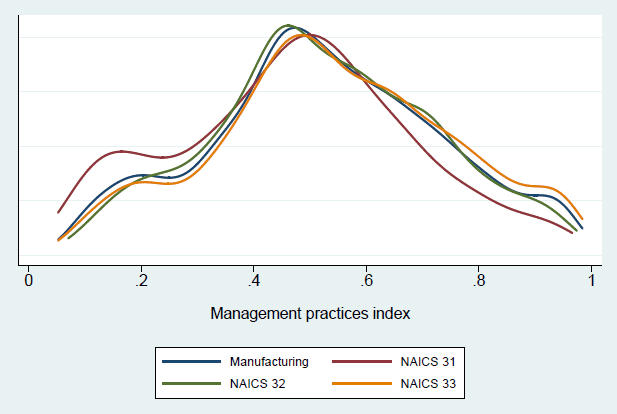
Figure 6: Distributions of for NAICS 21 and 22
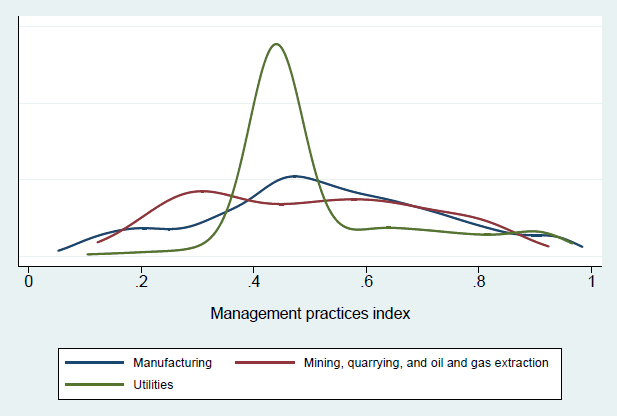
Figure 7: Distributions of for NAICS 51, 52 and 54
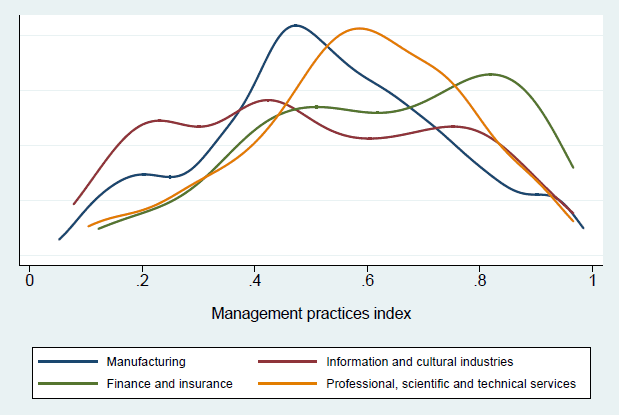
Figure 8: Distributions of for NAICS 48 and other
Appendix D. Detailed Results
Table 4: Detailed Results of Equation (2)
– Dep. var.: , weighted OLS regressions –
(Characteristics)
| Variable | Manufacturing | Non-manufacturing | ||
|---|---|---|---|---|
| – Characteristics – | ||||
| CONS | 0.4032Footnote a | 0.4067Footnote a | 0.2514Footnote a | 0.3127Footnote a |
| (0.0001) | (0.0001) | (0.0002) | (0.0001) | |
| MEDIUM | 0.1025Footnote a | 0.1001Footnote a | 0.1544Footnote a | 0.1539Footnote a |
| (0.0004) | (0.0004) | (0.0003) | (0.0001) | |
| LARGE | 0.1083Footnote a | 0.1060Footnote a | 0.1827Footnote a | 0.1855Footnote a |
| (0.0001) | (0.0001) | (0.0001) | (0.0001) | |
| XLARGE | 0.1873Footnote a | 0.1851Footnote a | 0.2378Footnote a | 0.2465Footnote a |
| (0.0001) | (0.0001) | (0.0001) | (0.0001) | |
| %UNIV | 0.0018Footnote a | 0.0019Footnote a | 0.0026Footnote a | 0.0027Footnote a |
| (0.0003) | (0.0001) | (0.0001) | (0.0001) | |
| HQ_US | 0.0586Footnote a | 0.0602Footnote a | 0.0943Footnote a | 0.0606 |
| (0.0003) | (0.0001) | (0.0081) | (0.1111) | |
| HQ_EU | 0.0668Footnote a | 0.0671Footnote a | −0.0121 | 0.02690 |
| (0.0006) | (0.0004) | (0.8326) | (0.6497) | |
| HQ_ROW | 0.0199 | 0.0199 | 0.0543 | 0.1040 |
| (0.4080) | (0.389) | (0.5673) | (0.2006) | |
| MULTI | 0.0083 | 0.0080 | −0.0994Footnote a | −0.1031Footnote a |
| (0.5735) | (0.5698) | (0.0188) | (0.0046) | |
| SERV | −0.0211 | −0.0215 | ||
| (0.6316) | (0.5758) | |||
| MANU_2 | 0.0489Footnote a | 0.0459Footnote a | ||
| (0.0004) | (0.0006) | |||
| MANU_3 | 0.0579Footnote a | 0.0550Footnote a | ||
| (0.0004) | (0.0006) | |||
| QC | −0.0331Footnote b | −0.0303Footnote b | 0.0373 | 0.0292 |
| (0.0660) | (0.0863) | (0.3890) | (0.4438) | |
| AB | −0.007 | −0.0058 | 0.0210 | 0.0368 |
| (0.7708) | (0.7975) | (0.6766) | (0.3742) | |
| BC | −0.0212 | −0.0156 | −0.0530 | −0.0556 |
| (0.3229) | (0.4534) | (0.3054) | (0.2627) | |
| ROC | −0.0101 | −0.0118 | −0.0109 | 0.0293 |
| (0.6409) | (0.5826) | (0.7510) | (0.3104) | |
|
P-values are between parenthesis. |
||||
Table 4: Detailed Results of Equation (2) – (continued)
– Dep. var.: MPindex, weighted OLS regressions –
(Competition variables)
| Variable | Manufacturing | Non-manufacturing | ||
|---|---|---|---|---|
| –Competition variables – | ||||
| MNE | 0.0587Footnote c | 0.0597Footnote c | 0.1022Footnote c | 0.0995Footnote c |
| (0.0001) | (0.0001) | (0.0029) | (0.0011) | |
| #COMP | 0.0081Footnote c | 0.0086Footnote c | 0.0006 | 0.0062 |
| (0.0135) | (0.0070) | (0.9490) | (0.4647) | |
| ENTRY | 0.0143 | 0.0146 | 0.0306 | 0.0261 |
| (0.3395) | (0.3139) | (0.4013) | (0.4101) | |
| #GOODS | 0.0006 | 0.0008 | 0.0106 | 0.0134Footnote c |
| (0.8277) | (0.7718) | (0.1104) | (0.0354) | |
| LERNER | 0.0063 | 0.0998Footnote c | ||
| (0.8168) | (0.0129) | |||
| N | 2,730 | 2,890 | 1,129 | 1,337 |
| R-SQUARE | 0.2128 | 0.4361 | 0.2086 | 0.3951 |
|
P-values are between parenthesis. |
||||
Table 5: Detailed Results of Equations (3) and (4)
– Dep. var.: salesFootnote 3, profitsFootnote 3 and INNO regressions – Characteristics
| Variable | Manufacturing | Non-manufacturing | ||||
|---|---|---|---|---|---|---|
| sales | profits | INNO | sales | profits | INNO | |
| –Characteristics – | ||||||
| CONS | 0.0751Footnote d | 0.0162Footnote d | −0.6298Footnote d | 0.1673Footnote d | 0.0314Footnote d | −1.2375Footnote d |
| (0.0000) | (0.0000) | (0.0000) | (0.0000) | (0.0000) | (0.0170) | |
| cap | 0.3117Footnote d | 0.0507Footnote d | 0.0939Footnote d | 0.0950Footnote d | ||
| (0.0000) | (0.0000) | (0.0000) | (0.0000) | |||
| 0.0494Footnote d | 0.0232Footnote d | 2.1554Footnote d | −0.0116 | −0.0011Footnote d | 0.7406 | |
| (0.0000) | (0.0000) | (0.0000) | (0.1928) | (0.7063) | (0.2590) | |
| RD | 0.1060 | 0.0782 | ||||
| (0.2240) | (0.3830) | |||||
| ADV_TECH | 0.2320Footnote d | 0.4232Footnote d | ||||
| (0.0000) | (0.0000) | |||||
| MEDIUM | 0.0145Footnote d | 0.0031Footnote d | −0.0218 | 0.0021 | −0.0125Footnote d | −0.1451 |
| (0.0000) | (0.0009) | (0.8420) | (0.4898) | (0.0000) | (0.6820) | |
| LARGE | 0.0138Footnote d | −0.0042Footnote d | −0.0629 | −0.0034 | −0.0149Footnote d | 1.1507Footnote d |
| (0.0011) | (0.0110) | (0.5680) | (0.3348) | (0.0000) | −0.0040 | |
| XLARGE | 0.0159Footnote e | −0.0120Footnote d | −0.2490Footnote e | −0.1177Footnote d | −0.0270Footnote d | 0.8465Footnote d |
| (0.0765) | (0.0004) | (0.0640) | (0.0000) | (0.0000) | (0.0440) | |
| %UNIV | (0.0000) | 0.0002Footnote d | 0.0054 | 0.0004Footnote d | 0.0003Footnote d | −0.0035 |
| (0.8533) | (0.0000) | (0.1050) | (0.0000) | (0.0000) | (0.4450) | |
| HQ_US | 0.0057Footnote d | 0.0059Footnote d | −0.1072 | 0.1082Footnote d | 0.0692Footnote e | 0.5129 |
| (0.0000) | (0.0107) | (0.4130) | (0.0000) | (0.0000) | (0.2020) | |
| HQ_EU | 0.0102Footnote d | 0.0105Footnote d | −0.1117 | 0.0241 | 0.0076 | 0.0171 |
| (0.0000) | (0.0100) | (0.5620) | (0.8543) | (0.8071) | (0.9780) | |
| HQ_ROW | 0.0216 | −0.0188Footnote d | −0.3737 | −0.1444 | −0.0177 | 0.1221 |
| (0.2594) | (0.0172) | (0.1590) | (0.3149) | (0.6231) | (0.8360) | |
| MULTI | 0.0118Footnote d | 0.0045Footnote d | −0.1773Footnote e | 0.3147Footnote d | 0.0140Footnote d | −0.6923Footnote d |
| (0.0027) | (0.0026) | (0.0920) | (0.0000) | (0.0000) | (0.0200) | |
| SERV | −0.0824Footnote d | −0.0001 | 0.5240 | |||
| (0.0000) | (0.9095) | (0.1190) | ||||
| MANU_2 | 0.0172Footnote d | 0.0043Footnote d | 0.2798Footnote d | |||
| (0.0000) | (0.0019) | (0.0130) | ||||
| MANU_3 | 0.0232Footnote d | 0.0048Footnote d | 0.2188Footnote d | |||
| (0.0000) | (0.0001) | (0.0370) | ||||
| QC | −0.0187Footnote d | −0.0063Footnote d | −0.0111 | 0.0177Footnote d | 0.0029Footnote d | 0.3758 |
| (0.0000) | (0.0000) | (0.9140) | (0.0000) | (0.0153) | (0.2080) | |
| AB | 0.0067Footnote e | 0.0068Footnote d | −0.4310Footnote d | −0.0554Footnote d | 0.0091Footnote d | 0.3256 |
| (0.0772) | (0.0000) | (0.0020) | (0.0000) | (0.0000) | (0.4550) | |
| BC | −0.0115Footnote d | −0.0026Footnote d | −0.0121 | −0.0411Footnote d | −0.0045Footnote d | −0.1816 |
| (0.0005) | (0.0430) | (0.9290) | (0.0000) | (0.0299) | (0.6540) | |
| ROC | −0.0174Footnote d | −0.0073Footnote d | −0.1189 | −0.0517Footnote d | −0.0188Footnote d | −0.3666 |
| (0.0000) | (0.0000) | (0.3960) | (0.0000) | (0.0000) | (0.3870) | |
: Number of observations for which the ROBUSTREG procedure weight is set to zero
: Final number of observations for ROBUSTREG regressions.
P-values are between parenthesis.
Table 5: Detailed Results of Equations (3) and (4) – (continued)
– Dep. var.: salesFootnote 4, profitsFootnote 4 and INNO regressions –
(Competition variables)
| Variable | Manufacturing | Non-manufacturing | ||||
|---|---|---|---|---|---|---|
| sales | profits | INNO | sales | profits | INNO | |
| – Competition variables – | ||||||
| MNE | 0.0118Footnote e | 0.0046Footnote e | 0.2123Footnote e | −0.0033 | −0.0097Footnote e | 0.8614Footnote e |
| (0.0000) | (0.0000) | (0.0180) | (0.2134) | (0.0000) | (0.002) | |
| #COMP | −0.0029Footnote e | −0.0003 | −0.0425Footnote f | 0.0047Footnote e | 0.0042Footnote e | 0.0417 |
| (0.0000) | (0.2062) | (0.0980) | (0.0000) | (0.0000) | (0.5850) | |
| ENTRY | −0.0011 | 0.0000 | 0.3650Footnote e | −0.0036 | −0.0018Footnote e | 0.9936Footnote e |
| (0.6232) | (0.9951) | (0.0000) | (0.1473) | (0.0399) | (0.0020) | |
| #GOODS | 0.0003 | 0.0001 | 0.0222 | −0.0029Footnote e | −0.0018Footnote e | −0.1174Footnote e |
| (0.4532) | (0.6915) | (0.2440) | (0.0007) | (0.0000) | (0.0280) | |
| 2,688 | 2,707 | 1,104 | 1,208 | |||
| 154 | 123 | 103 | 66 | |||
| 2,534 | 2,584 | 1,001 | 1,142 | 2,890 | 1,337 | |
|
: Number of observations for which the ROBUSTREG procedure weight is set to zero |
||||||
Table 6: Detailed Results of Equations (5)
– Dep. var.: , , and weighted Biprobit –
(Characteristics)
| Variable | Manufacturing | Non-Manufacturing | ||||||
|---|---|---|---|---|---|---|---|---|
| – Characteristics – | ||||||||
| CONS | 0.6765Footnote g | 1.6133Footnote g | 0.9958Footnote g | 0.9958Footnote g | 1.2980Footnote g | 1.4362Footnote g | 1.8312Footnote g | 2.2768Footnote g |
| (0.0000) | 0.0 | 0.0 | 0.0 | (0.0190) | (0.0060) | (0.0010) | 0.0 | |
| 1.7467Footnote g | 2.6589Footnote g | 0.9284Footnote g | 2.2058Footnote g | 0.5456 | 1.8365Footnote g | 1.1644Footnote g | 2.3178Footnote g | |
| (0.0000) | 0.0 | (0.010) | 0.0 | (0.3590) | (0.0010) | (0.030) | 0.0 | |
| RD | 0.0318 | 0.0060 | 0.0042 | 0.0195 | 0.1112Footnote g | 0.0119 | 0.0085 | 0.0009 |
| (0.4630) | (0.1850) | (0.6680) | (0.2840) | (0.0460) | (0.6550) | (0.5960) | (0.970) | |
| ADV_TECH | 0.2234Footnote g | 0.1646Footnote g | 0.1824Footnote g | 0.2070Footnote g | 0.3061Footnote g | 0.0886 | 0.1099 | 0.4023Footnote g |
| (0.0000) | (0.0000) | (0.0000) | (0.0000) | (0.0000) | (0.2430) | (0.180) | (0.0000) | |
| MEDIUM | 0.0538 | 0.0533 | 0.2077Footnote h | 0.0401 | 0.1792 | 0.2415 | 0.2386 | 0.0027 |
| (0.5970) | (0.5750) | (0.0740) | (0.6820) | (0.5960) | (0.4150) | (0.4720) | (0.9940) | |
| LARGE | 0.0130 | 0.1907Footnote g | 0.0325 | 0.0340 | 0.0076 | 0.7307Footnote g | 0.5528Footnote h | 0.4802 |
| (0.8960) | (0.0410) | (0.7280) | (0.730) | (0.9810) | (0.0270) | (0.0960) | (0.1240) | |
| XLARGE | 0.0369 | 0.2931Footnote g | 0.1640 | 0.1525 | 0.3593 | 0.5537 | 0.9272Footnote g | 0.5116 |
| (0.7560) | (0.0090) | (0.1360) | (0.1950) | (0.3750) | (0.1570) | (0.010) | (0.1720) | |
| %UNIV | 0.0041 | 0.0048Footnote g | 0.0114Footnote g | 0.0001 | 0.0067 | 0.0039 | 0.0035 | 0.0047 |
| (0.1550) | (0.0450) | (0.0020) | (0.9730) | (0.1020) | (0.2970) | (0.2920) | (0.3120) | |
| HQ_US | 0.3205Footnote g | 0.0663 | 0.0137 | 0.1171 | 0.0313 | 0.5603 | 0.0074 | 0.9015Footnote g |
| (0.0130) | (0.5640) | (0.9090) | (0.3480) | (0.9460) | (0.1480) | (0.9870) | (0.0110) | |
| HQ_EU | 0.2037 | 0.0274 | 0.0901 | 0.0114 | 0.0334 | 0.2686 | 0.1417 | 0.4095 |
| (0.2500) | (0.8690) | (0.5790) | (0.9480) | (0.9330) | (0.5260) | (0.7450) | (0.460) | |
| HQ_ROW | 0.4840Footnote g | 0.4585Footnote g | 0.1836 | 0.4398Footnote g | 0.0381 | 0.1424 | 0.7232 | 0.2596 |
| (0.0240) | (0.0310) | (0.420) | (0.0430) | (0.9370) | (0.8430) | (0.3220) | (0.580) | |
| MULTI | 0.1537 | 0.0205 | 0.0395 | 0.1111 | 0.4203 | 0.2184 | 0.0370 | 1.3776Footnote g |
| (0.1050) | (0.8220) | (0.6770) | (0.240) | (0.1390) | (0.5030) | (0.9060) | 0.0 | |
| SERV | 0.3677 | 0.7463Footnote g | 0.8700Footnote g | 0.1605 | ||||
| (0.2490) | (0.0250) | (0.0150) | (0.5560) | |||||
| MANU_2 | 0.1751Footnote h | 0.0576 | 0.0388 | 0.2439Footnote g | ||||
| (0.0820) | (0.5630) | (0.6860) | (0.0170) | |||||
| MANU_3 | 0.1560Footnote h | 0.0446 | 0.0061 | 0.1191 | ||||
| (0.0990) | (0.6330) | (0.950) | (0.2110) | |||||
| QC | 0.0810 | 0.1486Footnote h | 0.1962Footnote g | 0.0795 | 0.1634 | 0.5942Footnote g | 0.5393Footnote h | 0.1118 |
| (0.3840) | (0.0960) | (0.0440) | (0.3850) | (0.5670) | (0.0460) | (0.0690) | (0.6590) | |
| AB | 0.4756Footnote g | 0.0838 | 0.2624Footnote h | 0.210 | 0.0206 | 0.2266 | 0.4468 | 0.4930 |
| (0.0000) | (0.4910) | (0.0530) | (0.1010) | (0.960) | (0.5130) | (0.2290) | (0.1710) | |
| BC | 0.0627 | 0.1824 | 0.1030 | 0.0478 | 0.0686 | 0.0363 | 0.1013 | 0.3182 |
| (0.6180) | (0.110) | (0.4090) | (0.6940) | (0.8560) | (0.9290) | (0.7970) | (0.3360) | |
| ROC | 0.0955 | 0.0665 | 0.0603 | 0.1195 | 0.3637 | 0.5107 | 0.0939 | 0.4863Footnote h |
| (0.4560) | (0.5850) | (0.6510) | (0.3380) | (0.3310) | (0.1150) | (0.8030) | (0.0950) | |
|
P-values are between parenthesis. Footnotes
|
||||||||
Appendix D (continued)
Table 6: Detailed Results of Equations (5) – (continued)
– Dep. var.: , , and weighted Biprobit –
(Competition variables)
| Variable | Manufacturing | Non-Manufacturing | ||||||
|---|---|---|---|---|---|---|---|---|
| – Competition variables – | ||||||||
| MNE | 0.0882 | 0.0920 | 0.1353Footnote j | 0.0257 | 1.0230Footnote i | 0.1318 | 0.0496 | 0.8919Footnote i |
| (0.2770) | (0.2440) | (0.0940) | (0.7530) | (0.0000) | (0.5940) | (0.8410) | (0.0000) | |
| #COMP | 0.0582Footnote i | 0.0207 | 0.0335 | 0.0019 | 0.0358 | 0.1326Footnote j | 0.0226 | 0.0435 |
| (0.0170) | (0.3720) | (0.140) | (0.9350) | (0.6710) | (0.0520) | (0.7640) | (0.4580) | |
| ENTRY | 0.3330Footnote i | 0.3186Footnote i | 0.3157Footnote i | 0.1446Footnote j | 0.9473Footnote i | 1.1182Footnote i | 1.1408Footnote i | 0.3007 |
| (0.0000) | (0.0000) | (0.0000) | (0.0770) | (0.0020) | (0.0000) | (0.0000) | (0.2060) | |
| #GOODS | 0.0336Footnote i | 0.0264 | 0.0391Footnote i | 0.0151 | 0.0986Footnote i | 0.0450 | 0.0745 | 0.0116 |
| (0.0440) | (0.1160) | (0.0220) | (0.3710) | (0.0340) | (0.3250) | (0.1190) | (0.7920) | |
| N | 2,890 | 2,890 | 1,337 | 1,337 | ||||
| 0.4132Footnote i | 0.3988Footnote i | 0.4007Footnote i | 0.3190Footnote i | |||||
|
P-values are between parenthesis. |
||||||||
Table 7: Detailed Results of Equations (5)
– Dep. var.: , , and weighted multivariate Probit –
(Characteristics)
| Variable | Manufacturing | Non-manufacturing | ||||||
|---|---|---|---|---|---|---|---|---|
| PRDT | ORGZ | PRDT | MRKT | PRDT | ORGZ | PRDT | MRKT | |
| – Characteristics – | ||||||||
| CONS | -1.0364Footnote k | -1.9299Footnote k | −0.9625Footnote k | -1.2442Footnote k | -1.9216Footnote k | -2.5825Footnote k | -1.7676Footnote k | -1.9739Footnote k |
| (0.0000) | 0.0000 | 0.0000 | 0.0000 | 0.0000 | 0.0000 | −0.0010 | 0.0000 | |
| MPindex | 1.8407Footnote k | 2.6694Footnote k | 0.6937Footnote k | 1.1656Footnote k | 0.8562Footnote l | 2.7276Footnote k | 0.7409 | 1.2384Footnote k |
| (0.0000) | 0.0000 | −0.0140 | 0.0000 | −0.0970 | 0.0000 | −0.1830 | −0.0110 | |
| RD | 0.0076 | −0.0010 | 0.0193 | 0.0006 | 0.0000 | −0.0035 | 0.0147 | 0.0208 |
| (0.4520) | −0.8490 | −0.1510 | −0.8930 | −0.9960 | −0.7050 | −0.2210 | −0.1490 | |
| ADVTECH | −0.0217 | −0.0090 | −0.1835Footnote k | −0.1128 | 0.3478Footnote k | 0.2003Footnote k | 0.1951Footnote k | −0.0174 |
| (0.8220) | −0.9240 | −0.0740 | −0.2780 | 0.0000 | −0.0040 | −0.0120 | −0.7810 | |
| MEDIUM | −0.0467 | −0.1560Footnote l | 0.0525 | −0.0719 | −0.2673 | 0.3136 | 0.5614Footnote l | −0.0559 |
| (0.6040) | −0.0800 | −0.5570 | −0.4130 | −0.4260 | −0.2880 | −0.0800 | −0.8490 | |
| LARGE | −0.0679 | −0.2733Footnote * | −0.0893 | −0.2020Footnote l | −0.0585 | 0.5997Footnote k | 0.0001 | 0.6742Footnote k |
| (0.5330) | −0.0150 | −0.4120 | −0.0640 | −0.8630 | −0.0230 | -1.0000 | −0.0290 | |
| XLARGE | 0.2315Footnote k | 0.1500Footnote k | 0.1738Footnote k | 0.1514Footnote k | 0.2761 | 0.7148Footnote k | 0.7894Footnote k | 0.1917 |
| (0.0000) | 0.0000 | 0.0000 | 0.0000 | −0.4460 | −0.0280 | −0.0250 | −0.6100 | |
| %UNIV | −0.0030 | 0.0028 | 0.0102Footnote k | 0.0056Footnote k | −0.0049 | 0.0044 | 0.0020 | −0.0012 |
| (0.2100) | −0.1890 | 0.0000 | −0.0300 | −0.3080 | −0.1900 | −0.5100 | −0.7140 | |
| HQUS | −0.4647Footnote k | −0.0632 | 0.0092 | −0.1693 | 0.5480 | 1.2791Footnote k | 0.4407 | −0.2119 |
| (0.0000) | −0.5930 | −0.9360 | −0.1490 | −0.2390 | 0.0000 | −0.3250 | −0.6120 | |
| HQEU | −0.2752Footnote l | 0.1438 | 0.0396 | −0.1822 | −0.0519 | 0.2798 | −0.2781 | −0.0202 |
| (0.0840) | −0.3590 | −0.7910 | −0.2180 | −0.8900 | −0.4840 | −0.4680 | −0.9630 | |
| HQROW | −0.3801Footnote l | −0.4642Footnote k | −0.3653Footnote l | −0.1109 | 0.2865 | 0.0554 | −0.8006 | −0.2358 |
| (0.0620) | −0.0140 | −0.0850 | −0.6110 | −0.4280 | −0.9250 | −0.2680 | −0.7020 | |
| MULTI | −0.1030 | 0.0290 | −0.0678 | 0.0700 | −0.6982Footnote k | −0.9863Footnote k | −0.1215 | 0.0374 |
| (0.2470) | −0.7480 | −0.4660 | −0.4670 | −0.0030 | 0.0000 | −0.6680 | −0.9000 | |
| SERV | −0.0605 | 0.4740Footnote l | 0.8704Footnote k | 0.9717Footnote k | ||||
| (0.8330) | −0.0920 | −0.0130 | −0.0060 | |||||
| MANU2 | 0.1313 | 0.1357 | 0.0643 | −0.1028 | ||||
| (0.1700) | −0.1720 | −0.5070 | −0.2680 | |||||
| MANU3 | 0.0488 | 0.0955 | 0.0185 | −0.1863Footnote k | ||||
| (0.5920) | −0.3120 | −0.8460 | −0.0440 | |||||
| QC | 0.0642 | 0.1648Footnote l | 0.2001Footnote k | 0.1048 | −0.4710Footnote l | 0.4666Footnote k | 0.3214 | 0.4472 |
| (0.4620) | −0.0550 | −0.0250 | −0.2420 | −0.0970 | −0.0500 | −0.2400 | −0.1000 | |
| AB | −0.2618Footnote k | −0.1483 | −0.3305Footnote k | −0.1085 | 0.2341 | −0.0632 | −0.1259 | −0.4815 |
| (0.0410) | −0.2190 | −0.0090 | −0.4240 | −0.5460 | −0.8320 | −0.7250 | −0.1500 | |
| BC | −0.0696 | 0.1150 | 0.0146 | 0.1665 | −0.3708 | 0.5167 | 0.3947 | 0.0269 |
| (0.5410) | −0.3050 | −0.9020 | −0.1470 | −0.2420 | −0.1350 | −0.2990 | −0.9480 | |
| ROC | −0.0583 | 0.0304 | −0.0279 | −0.0951 | −0.4455 | −0.2113 | 0.2105 | −0.4242 |
| (0.6400) | −0.8030 | −0.8230 | −0.4550 | −0.1380 | −0.4650 | −0.5860 | −0.1700 | |
|
P-values are between parenthesis. |
||||||||
Table 7: Detailed Results of Equations (5) – (continued)
– Dep. var.: , , and weighted multivariate Probit –
(Competition variables)
| Variable | Manufacturing | Non-manufacturing | ||||||
|---|---|---|---|---|---|---|---|---|
| PRDT | ORGZ | PRDT | MRKT | PRDT | ORGZ | PRDT | MRKT | |
| – Competition variables – | ||||||||
| MNE | −0.0559 | 0.0388 | 0.1735Footnote m | −0.0141 | 0.7933Footnote m | 0.284 | 0.5025Footnote m | 0.1515 |
| −0.478 | −0.613 | −0.027 | −0.86 | −0.001 | −0.145 | −0.029 | −0.514 | |
| #COMP | −0.0058 | 0.032 | −0.0506Footnote m | −0.0058 | 0.1699Footnote m | −0.1275Footnote m | −0.1682Footnote m | −0.0552 |
| −0.796 | −0.158 | −0.022 | −0.794 | −0.027 | −0.016 | −0.025 | −0.443 | |
| ENTRY | 0.2032Footnote m | 0.2623Footnote m | 0.3076Footnote m | 0.2975Footnote m | −0.16 | 0.7168Footnote m | 1.3516Footnote m | 1.1618Footnote m |
| −0.008 | −0.001 | 0 | 0 | −0.499 | 0 | 0 | 0 | |
| #GOODS | 0.014 | 0.01 | 0.0503Footnote m | 0.0366Footnote m | −0.0731Footnote ** | 0.0125 | −0.0553 | −0.0367 |
| −0.367 | −0.545 | −0.002 | −0.023 | −0.077 | −0.75 | −0.222 | −0.404 | |
| N | 2,890 | 1,337 | ||||||
| 12 | 0.4217Footnote m | 0.2087Footnote n | ||||||
| 13 | 0.3842Footnote m | 0.2726Footnote m | ||||||
| 14 | 0.2368Footnote m | −0.0518 | ||||||
| 23 | 0.2547Footnote m | 0.5523Footnote m | ||||||
| 24 | 0.3565Footnote m | 0.5062Footnote m | ||||||
| 34 | 0.4040Footnote m | 0.6603Footnote m | ||||||
|
P-values are between parenthesis. |
||||||||