
December is Arctic Science Month! Find out about Canada’s Arctic through the eyes of Government of Canada scientists studying oceans and seacoasts, changing landscapes and alternative energy solutions. Arctic Science Month celebrates the vital research of Canada’s scientists and researchers working in northern regions and with local communities across the country. Don’t miss out — be a part of the conversation by following the hashtag #ArcticScience.
Features


Arctic science stories
A journey shaped by ice
Shawn Marshall has spent most of his life studying glaciers, understanding their movements, measuring their displacement, and investigating the factors behind their gradual disappearance.
"Breaking the ice" on safer and more efficient Arctic navigation
A machine learning method to support shipping operations in ice: Applications to tactical voyage routing and strategic regulatory assessment.
Autonomous fleet ice management via reinforcement learning
The collective goal for these autonomous vessels is to clear sea ice from Northern shipping channels.
Polar paradigms 2045: Defending Canada’s sovereignty
IDEaS fictional intelligence contest: The DND/CAF is seeking visionary essays in hard science fiction that explore how emerging technologies can empower military forces to defend Canada’s sovereignty and national interests in the Arctic.
Satellite trio will test new systems of monitoring in the High Arctic
Three recently launched research and development (R&D) microsatellites, known as the Gray Jay Pathfinder mission, will orbit in high latitudes to evaluate new technologies to provide situational awareness in the Arctic Circle for the Canadian Armed Forces (CAF).
DRDC continues to AMAZE with Arctic emissions reduction research
The Arctic can be a challenging place for technology, with remoteness, harsh weather and freezing temperatures adding a layer of complexity.
DRDC demonstrates satellite capabilities during Op NANOOK
This experimental work supported a program of Arctic warfare-related experimentation and Canada’s commitment to improving the CAF’s expertise, readiness, and interoperability in the Arctic region.
Decades of polar bear knowledge
Scientist Evan Richardson “wears many hats”, conducting fieldwork, analyzing data and writing papers, mentoring students and postdocs, providing advice, and engaging northern communities between Hudson Bay, the shores of the Arctic Ocean, and Winnipeg, his home base at Environment and Climate Change Canada.
Tuvaijuittuq Marine Protected Area
This culturally and historically significant marine area is unique due to the presence of multi-year pack ice. A better understanding of this region will be critical as climate change continues to result in the dramatic declines in sea ice.
“The problem is too big to tackle alone”: Collaborative program of work enables knowledge sharing on climate change and security
Researchers are investigating topics to assess, adapt to and mitigate the impacts of climate change for NATO militaries.
DRDC tests Arctic survival kits for military aircraft with Allies
Surviving a plane crash in the Arctic is dependent on having the right equipment and skills to withstand the extreme temperatures and avoid cold weather injuries until rescue.
Canada's National Parks in the Arctic
Protecting and presenting outstanding representative examples of natural landscapes and natural phenomena.
Simply Science: Arctic science
Arctic Science articles from Natural Resources Canada.
Research funding and support
Sub-zero Infrastructure, Security, and Sensors: Safekeeping assets in the Arctic
The Department of National Defence (DND) and the Canadian Armed Forces (CAF) are seeking innovative solutions to secure and monitor CAF fixed ground-based assets operating remotely in the Arctic.
Arctic and Northern Challenge program
The National Research Council of Canada’s Arctic and Northern Challenge program provides research funding and scientific expertise to support strong and sustainable Northern communities through applied technology and innovation.
Northern Contaminants Program
Working to reduce and, wherever possible, eliminate contaminants in traditionally harvested foods, while providing information that assists informed decision making by individuals and communities in their food use.
Polar Knowledge Canada
Find out about POLAR's Northern Scientific Training Program (NSTP) and other programs and funding available for polar researchers.
Northern Responsible Energy Approach for Community Heat and Electricity program
The Northern Responsible Energy Approach for Community Heat and Electricity program, also called the Northern REACHE program, funds renewable energy and energy efficiency projects, and related capacity building.
Climate Change and Health Adaptation Program
This program funds First Nations and Inuit communities' efforts to build capacity to adapt to the health impacts of climate change.
Research support: Arctic logistics and field equipment for across Canada
Are you a field researcher who needs logistical support for your work in Canada’s North? Or are you part of a federal government team that needs field equipment for research conducted elsewhere in Canada? At Canada’s Polar Continental Shelf Program (PCSP), we can help.
Indigenous Community-Based Climate Monitoring Program
This program provides funding for climate monitoring projects led by Indigenous communities and organizations.
Videos

"Hi, I'm Jennifer Hubbard. I'm the President and CEO at the Canadian High Arctic Research Station here in the beautiful community of Cambridge Bay, NU."
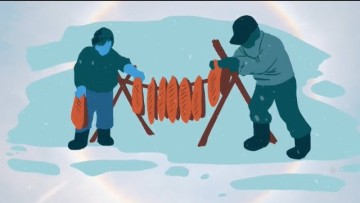
This video highlights Fisheries and Oceans Canada’s Arctic research on Arctic char, including migration, population dynamics, and Indigenous knowledge partnerships

Research scientist Mary Sanborn-Barrie is engaging with the communities of Whale Cove and Arviat in Nunavut as she and her team are mapping the bedrock of the Kivalliq region.