

Table of contents
About the survey
Innovation Science and Economic Development Canada (ISED) maintains close contact with the small business community as part of its monitoring and data collection activities. Since 2009, ISED has managed various surveys on the borrowing activities of small businesses. Two in particular include the Credit Conditions Survey (CCS)Footnote 1 and the larger Survey on Financing and Growth of Small and Medium Enterprises (SFGSME),Footnote 2 which is conducted every three years and also surveys medium-sized businesses. The CCS is implemented in years when the SFGSME is not conducted. These surveys monitor small and medium-sized enterprises (SMEs) to provide key information on small-business-lending conditions to the business community, lenders, policy-makers and academics.
Overview
- In 2024, about 36% of small businesses requested external financing. Around 24% requested trade credit and 9% requested debt financing.
- Debt financing was more often requested by larger firms.
- The approval rate of small businesses was 89% in 2024, down from 91% in 2023. Around 91% of the dollar amount of debt financing requested by businesses was authorized compared with 85% in 2023.
- The interest rate charged to small businesses in 2024 decreased to 7.3% from 9.0% in 2023.
- More small businesses had to pledge collateral in 2024: 66% compared with 46% in 2023.
- Debt financing was primarily intended for working or operating capital (49%) consistent with previous years. Meanwhile, 21% of borrowers aimed to use it for fixed assets, the lowest recorded in the past decade. As well, 17% of borrowers intended to use it for debt consolidation, the highest level in 10 years.
- Around 17% of non-seeking small businesses did not request financing because they considered the cost too high, up from 6% in 2023 and the highest level observed over the past 10 year.
External financing needs
In 2024, 36% of small businesses requested external financing (debt, lease, equity, trade credit, and/or government financing) (Figure 1).
Figure 1: Request rates for external financing

Request rates for external financing
| External financing request rate (%) | |
|---|---|
| 2014 | 51Footnote * |
| 2015 | 31 |
| 2016 | 34 |
| 2017 | 47Footnote * |
| 2018 | 34 |
| 2019 | 39 |
| 2020 | 82Footnote * |
| 2021 | 53 |
| 2022 | 27 |
| 2023 | 49Footnote * |
| 2024 | 36 |
Sources: Innovation, Science and Economic Development Canada, Credit Conditions Survey 2015, 2016, 2018, 2019, 2021, 2022 and 2024; and Statistics Canada, Survey on Financing and Growth of Small and Medium Enterprises 2014, 2017, 2020 and 2023.
For 2024, 1% of small businesses requested government financing (government grants, subsidies, government guaranteed loans, direct loans, no-interest loans or non-repayable contributions) compared with 7% in 2023 (Figure 2). The steep decrease in 2022 occurred as restrictions related to the COVID-19 pandemic were lifted and government support programs were reduced accordingly.
Figure 2: Request rate for government financing

Request rates for government financing
| Government financing request rate (%) | |
|---|---|
| 2017 | 4 |
| 2018 | 4 |
| 2019 | 4 |
| 2020 | 76 |
| 2021 | 42 |
| 2022 | 7 |
| 2023 | 7 |
| 2024 | 1 |
Sources: Innovation, Science and Economic Development Canada, Credit Conditions Survey, 2018, 2019, 2021, 2022 and 2024; and Statistics Canada, Survey on Financing and Growth of Small and Medium Enterprises, 2017, 2020 and 2023.
About 9% of small businesses requested debt financing (mortgages, term loans, lines of credit, and/or credit cards) in 2024, a decrease of 16 percentage points from 2023 (Figure 3) and the lowest value since 2009.Footnote 3 Statistics Canada's Biannual Survey of Suppliers of Business Financing shows that the total value of disbursements and the total number of disbursements decreased by 22% and 38% respectively between 2023 and 2024 for small borrowers.Footnote 4
Figure 3: Request rates by type of external financing
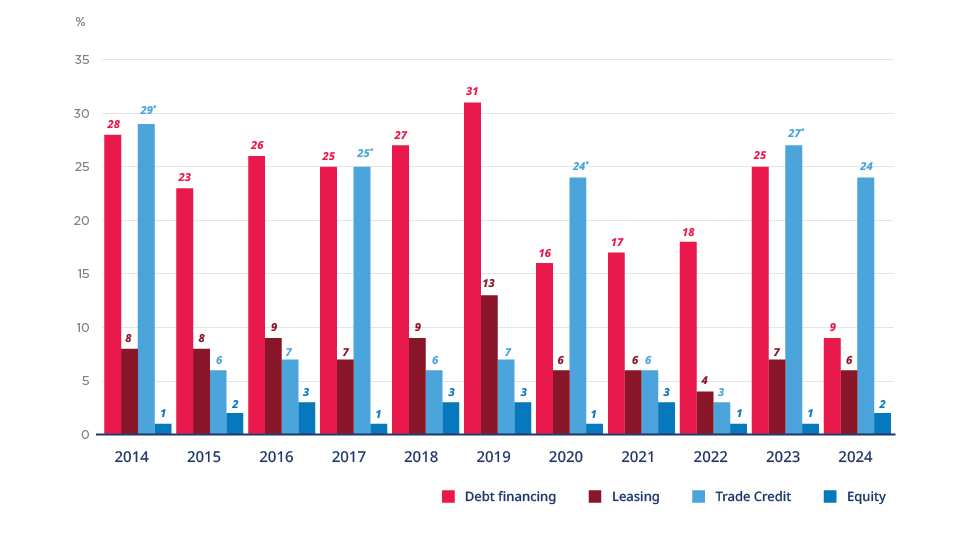
Request rates by type of external financing
| Debt financing | Leasing | Trade Credit | Equity | |
|---|---|---|---|---|
| 2014 | 29% | 8% | 29%Footnote * | 1% |
| 2015 | 23% | 8% | 6% | 2% |
| 2016 | 26% | 9% | 7% | 3% |
| 2017 | 26% | 7% | 26%Footnote * | 1% |
| 2018 | 27% | 9% | 6% | 3% |
| 2019 | 31% | 13% | 7% | 3% |
| 2020 | 16% | 6% | 24%Footnote * | 1% |
| 2021 | 17% | 6% | 6% | 3% |
| 2022 | 18% | 4% | 3% | 1% |
| 2023 | 25% | 7% | 27%Footnote * | 1% |
| 2024 | 9% | 6% | 24% | 2% |
Sources: Innovation, Science and Economic Development Canada, Credit Conditions Survey 2015, 2016, 2018, 2019, 2021, 2022 and 2024; and Statistics Canada, Survey on Financing and Growth of Small and Medium Enterprises 2014, 2017, 2020 and 2023.
Reasons for seeking/not seeking financing
Most small businesses that requested debt financing in 2024 intended to use it to support day-to-day working and operational capital expenditures (49%) or to purchase or maintain fixed assets (21%) (Figure 4).
In 2024, 17% of small businesses that requested debt financing intended to use it to consolidate debt, 12% to purchase or expand a business, 1% to enter a new market, and 1% to support research and development (R&D).
Figure 4: The main reasons small businesses requested debt financing
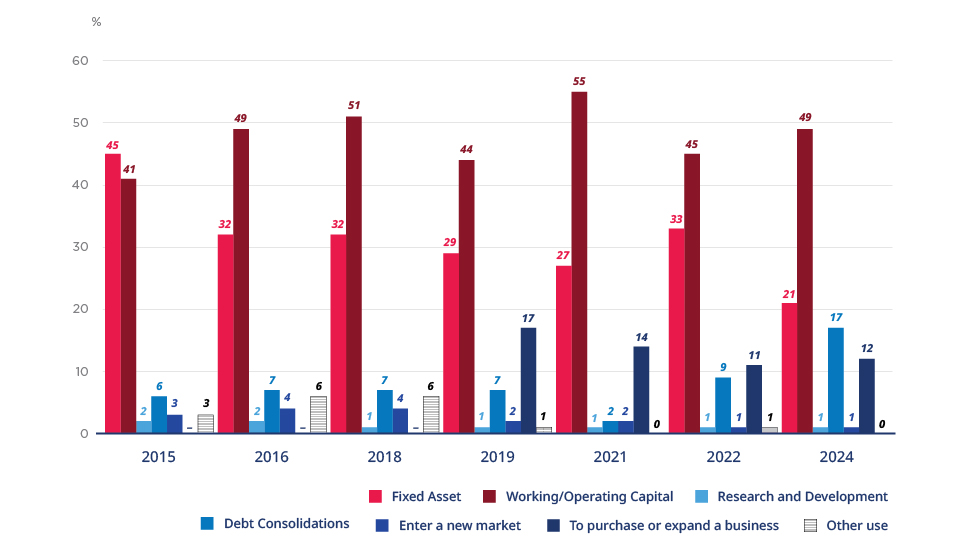
The main reasons small businesses requested financing
| Reason | 2015 | 2016 | 2018 | 2019 | 2021 | 2022 | 2024 |
|---|---|---|---|---|---|---|---|
| Fixed asset | 45% | 32% | 32% | 29% | 27% | 33% | 21% |
| Working/Operational capital | 41% | 49% | 51% | 44% | 55% | 45% | 49% |
| Research and development | 2% | 2% | 1% | 1% | 1% | 1% | 1% |
| Debt Consolidations | 6% | 7% | 7% | 7% | 2% | 9% | 17% |
| Enter a new market | 3% | 4% | 4% | 2% | 2% | 1% | 1% |
| To purchase or expand a business | - | - | - | 17% | 14% | 11% | 12% |
| Other use | 3% | 6% | 6% | 1% | 0% | 1% | 0% |
Source: Innovation, Science and Economic Development Canada, Credit Conditions Survey, 2015, 2016, 2018, 2019, 2021, 2022 and 2024.
In 2024, 79% of small businesses that did not seek external financing did not need financing (Table 1). Around 17% of non-seeking small businesses did not request financing because they considered the cost too high, and 1% thought that their request would be turned down.
| Reason | 2014 (%) | 2015 (%) | 2016 (%) | 2017 (%) | 2018 (%) | 2019 (%) | 2020 (%) | 2021 (%) | 2022 (%) | 2023 (%) | 2024 (%) |
|---|---|---|---|---|---|---|---|---|---|---|---|
| Financing not needed | 88 | 89 | 85 | 91 | 85 | 88 | 87 | 85 | 83 | 81 | 79 |
| Thought request would be turned down | 2 | 3 | 4 | 1 | 4 | 2 | 3 | 4 | 3 | 2 | 1 |
| Applying for financing is too difficult | 2 | 2 | 4 | 2 | 4 | 2 | 1 | 2 | 1 | 2 | 1 |
| Cost of financing too high | 1 | 2 | 2 | 1 | 5 | 2 | 1 | 2 | 4 | 6 | 17 |
|
Sources: Innovation, Science and Economic Development Canada, Credit Conditions Survey, 2015, 2016, 2018, 2019, 2021, 2022 and 2024; and Statistics Canada, Survey on Financing and Growth of Small and Medium Enterprises, 2014, 2017, 2020 and 2023. |
|||||||||||
Access to debt financing
The approval rate for debt financing in 2024 declined to 89% from 91% in 2023. The ratio of total funds authorized-to-requested was 91% in 2024, consistent with previous years (Table 2).
| Year | Request rate (%) | Approval rate (%) | Authorized-to-requested ratio (%) |
|---|---|---|---|
| 2014 | 28 | 81 | 83 |
| 2015 | 23 | 88 | 90 |
| 2016 | 26 | 82 | 86 |
| 2017 | 26 | 87 | 93 |
| 2018 | 27 | 83 | 88 |
| 2019 | 31 | 89 | 89 |
| 2020 | 16 | 89 | 92 |
| 2021 | 17 | 90 | 93 |
| 2022 | 18 | 88 | 91 |
| 2023 | 25 | 91 | 85 |
| 2024 | 9 | 89 | 91 |
|
Sources: Innovation, Science and Economic Development Canada, Credit Conditions Survey, 2015, 2016, 2018, 2019, 2021, 2022 and 2024; and Statistics Canada, Survey on Financing and Growth of Small and Medium Enterprises, 2014, 2017, 2020 and 2023. |
|||
Interest rates
The lending conditions environment changed significantly between 2022 and 2024 and price conditions tightened during that period. In order to curb inflation, the Bank of Canada started to tighten its monetary policy in the beginning of 2022 and increased the policy interest rate from 0.25% to 5% in 2023. The weekly prime rate, which represents the rate at which banks lend to the most creditworthy borrowers, also significantly increased from 2.45% in March 2022 to 7.20% in July 2023.
As a result, price pressures eased and the Consumer Price Index (CPI) was roughly under 4% year over year by the end of 2023. The Bank of Canada reduced its policy interest rate in June 2024 from 5% to 4.75% and continued to reduce it over the year. It ended up at 3.25% in December 2024. The CPI settled at 1.8% year over year in December 2024. The average interest rate on debt financing reached 7.3% in 2024, a 1.7 percentage point decrease from 9.0% in 2023 (Table 3). Over the same period, the prime rate decreased by 0.1 percentage points to 6.8%. The risk premium, a measure of the lender's risk perception, decreased by 1.6 percentage points to 0.5%, the lowest level since 2019.
| Interest rate | 2014 (%) | 2015 (%) | 2016 (%) | 2017 (%) | 2018 (%) | 2019 (%) | 2020 (%) | 2021 (%) | 2022 (%) | 2023 (%) | 2024 (%) |
|---|---|---|---|---|---|---|---|---|---|---|---|
| Interest rate, average | 5.2 | 5.1 | 5.3 | 5.4 | 5.7 | 5.3 | 4.8 | 4.1 | 6.2 | 9.0 | 7.3 |
| Interest rate, prime rate | 3.0 | 2.8 | 2.7 | 2.9 | 3.6 | 4.0 | 2.8 | 2.5 | 4.1 | 6.9 | 6.8 |
| Risk premium | 2.2 | 2.3 | 2.6 | 2.5 | 2.1 | 1.4 | 2.0 | 1.7 | 2.1 | 2.1 | 0.5 |
|
Note: Interest rates charged on credit cards are excluded. Sources: Innovation, Science and Economic Development Canada, Credit Conditions Survey, 2015, 2016, 2018, 2019, 2021, 2022 and 2024; Statistics Canada, Survey on Financing and Growth of Small and Medium Enterprises, 2014, 2017, 2020 and 2023; and Bank of Canada. |
|||||||||||
Collateral rates
About 66% of small businesses were required to pledge collateral in 2024, an increase from 46% in 2023 (Figure 5).
Figure 5: Collateral rates for debt financing

Collateral rates for debt financing
| Percentage | |
|---|---|
| 2014 | 65 |
| 2015 | 82 |
| 2016 | 63 |
| 2017 | 64 |
| 2018 | 55 |
| 2019 | 63 |
| 2020 | 62 |
| 2021 | 58 |
| 2022 | 62 |
| 2023 | 46 |
| 2024 | 66 |
Sources: Innovation, Science and Economic Development Canada, Credit Conditions Survey, 2015, 2016, 2018, 2019, 2021, 2022 and 2024; and Statistics Canada, Survey on Financing and Growth of Small and Medium Enterprises, 2014, 2017, 2020 and 2023.
Access to debt financing by type of business
Debt financing request rates positively correlate to size of business (Table 4). In 2024, 7% of businesses with 1 to 4 employees requested debt financing compared with 14% of businesses with 5 to 19 employees and 17% of businesses with 20 to 99 employees.
Approval rates were highest among businesses with 5 to 19 employees and with 20 to 99 employees in 2024 with 93%. About 84% of business debt-financing requests with 1 to 4 employees were approved.
| Request rate (%) | Approval rate (%) | |
|---|---|---|
| All small businesses (1 to 99 employees) | 9 | 89 |
| Employment size | ||
| 1 to 4 employees | 7 | 84 |
| 5 to 19 employees | 14 | 93 |
| 20 to 99 employees | 17 | 93 |
| Export | ||
| Exporter | 17 | 85 |
| Non-exporter | 19 | 95 |
| Age of business | ||
| 2 years old or younger | 29 | 53 |
| 3 to 10 years old | 9 | 91 |
| 11 to 20 years old | 7 | 86 |
| More than 20 years old | 9 | 94 |
| Innovation activities developed or introduced | ||
| Innovator | 15 | 94 |
| Non-innovator | 6 | 88 |
|
Source: Innovation, Science and Economic Development Canada, Credit Conditions Survey, 2024. |
||
The debt financing request rate was highest for start-ups (2 years old or less). Twenty-nine percent of start-ups requested debt financing in 2024, compared with 9% for businesses that are more than 20 years old. The average approval rate for start-ups (53%) was 41 percentage points lower than for older businesses (94%).
Small business innovators were more likely to request financing than non-innovators (15% versus 6%) in 2024. The approval rate for innovators was higher than for non-innovators (94% versus 88%). Exporters and non-exporters had a similar request rate: 17% for exporters and 19% for non-exporters. The approval rate for exporters was 85% in comparison with 95% for non-exporters.
Financial glossary of credit conditions survey
- Approval Rate
- The ratio between the number of firms approved (fully or partially) for financing and the number of firms that requested financing.
- Authorized-to-Requested Rate
- The ratio between the total amount of loans authorized by lenders and the total amount of loans requested by borrowers.
- Business Risk Premium
- The business risk premium is the difference between the average small business interest rate and the business prime rate (the rate charged to the most creditworthy borrowers).
- Collateral
- An asset pledged by a borrower to a lender, usually in return for a loan. The lender has the right to seize the collateral if the borrower defaults on the obligation.
- Collateral Rate
- The percentage of firms required to provide collateral to secure their loans.
- Debt Financing
- A type of financing used to collect funds through the form of borrowing debt such as non-residential mortgages, term loans, lines of credit, and/or credit cards.
- Equity Financing
- A type of financing used to collect funds by selling equity such as shares/ownership of the business entities.
- External Financing
- The phase of financing used to describe funds that business entities obtain from outside their business; the funds can be obtained through various forms/sources such as debt, lease, equity, trade credit, and government financing.
- Financing
- The act of providing or raising funds for business activities, making purchases, or investing.
- Lease Financing
- A type of financing used to collect funds through the form of a lease.
- Line of Credit
- An arrangement through which a financial institution extends an amount of credit to a business entity.
- Mortgage
- A debt instrument secured by the collateral of a specified real estate property that the borrower is obliged to pay back with a predetermined set of payments.
- Price and Non-Price Conditions
- A financing condition measured by pricing factors such as loan rates, mortgage rates, and credit card rates; and a financing condition measured by non-pricing factors such as collateral rates, leasing terms, and trade credit payment and discount days.
- Term Loan
- A monetary loan that is repaid following a specific repayment schedule and a fixed or floating interest rate.
- Trade Credit
- An agreement where a business entity can obtain and/or consume goods and services in advance and pay the suppliers at a later date.
- Request Rate
- The ratio between the number of firms that requested financing and the total number of firms.