

Innovative Solutions Canada: Annual Report 2022–23 [PDF - 4.70 MB]
Table of contents
- Executive summary
- Historical statistics
- 2022-23 Performance
- Highlights
- Our impacts
- Making it happen with our partners
- Our funding streams
- Success stories
- Pathway to Commercialization
- Supporting government priorities
- Quantum in action: how three innovative companies are paving the way
- A few notable innovators we helped
- Annex A
Executive summary
The Government of Canada is the single largest purchaser of goods and services, with an annual buy of $22 billion. Our program, Innovative Solutions Canada (ISC), leverages that purchasing power to help Canadian innovators start, grow and get to market. ISC was launched in 2017, and in 2018, the Build in Canada Innovation Program was consolidated into ISC. The program's annual budget for innovation spending is approximately $147.6 million.
The program consists of three components, which provide funding opportunities from early research and development (R&D) to commercial procurements. The Challenge Stream focuses on early-stage R&D; the Testing Stream focuses on later-stage R&D prototype testing. We are also piloting and developing a Pathway to commercialization for SME innovators who participate in our program to have an opportunity to sell their market-ready innovation to Government of Canada (GC) organizations after having successfully completed their R&D or testing projects. Government of Canada organizations that have a need for innovations qualified under the Pathway to commercialization will be able to procure these innovations depending on individual departments' budget considerations.
In 2022-2023, 131 grants and contracts, totalling approximately $79.7 million, were awarded to Canadian companies. The first Pathway to Commercialization contract was also awarded. Participation in the program remained constant, with eight departments spending 90% or more of their annual allotment. In addition, 32 federal organizations tested innovative prototypes. Funded projects touched priority areas for government, including environment and a circular economy (25%), digital, artificial intelligence and enabling technologies (17%), health (11%) and military (10%) innovations. 2022-2023 also marks year two of the implementation of the National Quantum Strategy (NQS). The ramp up of ISC's component of the NQS resulted in 13 contracts awarded (up from five in 2021-2022) in the sector of quantum and robotics. Finally, the program continues to engage and attract diverse companies with a vast majority of its applicant companies reporting some form of ownership by one or more underrepresented groups.
This report highlights the activities and accomplishments of ISC between April 1, 2022 and March 31, 2023 (fiscal year 2022-23), and shares some stories from Canadian innovators who have successfully leveraged the program.
Historical statistics
Below you will find data that highlights ISC's historical performance, which includes data since the program's implementation in 2017 as well as historical figures going back to the Testing Stream's origin as the Build in Canada Innovation Program.
Challenge Stream by the numbers (since 2017):
- 368 awards for early-stage innovations
- Over $135M in funded projects
Testing Stream by the numbers (since 2010):
- 716 awards for late-stage innovations
- Over $385M in funded projects
| Province | Award value | # of awards |
|---|---|---|
| Alberta | $35,976,164 | 87 |
| British Columbia | $70,049,864 | 162 |
| Manitoba | $6,071,543 | 13 |
| New Brunswick | $13,215,530 | 28 |
| Newfoundland and Labrador | $17,003,046 | 26 |
| Nova Scotia | $32,836,449 | 68 |
| Ontario | $224,319,470 | 457 |
| Prince Edward Island | $3,525,322 | 7 |
| Québec | $113,048,607 | 225 |
| Saskatchewan | $4,772,747 | 10 |
| Yukon | $607,621 | 1 |
| Grand Total | $521,426,362 | 1084 |
Over 1000 projects funded worth over $520M
2022-23 Performance
- Funded 131 projects (values at approx. $79.7M)
- 58 early-stage R&D projects funded (valued at approx. $29.9M)
- 73 late-stage prototype testing projects funded (valued at approx. $49.8M)
Program enhancements in 2022-2023 resulted in a higher match rate between innovations and testing departments and increased program effectiveness for innovators and partners compared to past years. Initial analysis of 2023-2024 data shows that these enhancements continue to have a positive effect on program performance.
We worked with our departmental colleagues to increase participation in both funding streams, we awarded our first contract under our pathway to commercialization program feature, and we supported the National Quantum Strategy by funding projects in quantum and robotics.
Below, you'll find some data specific to fiscal year 2022–2023.
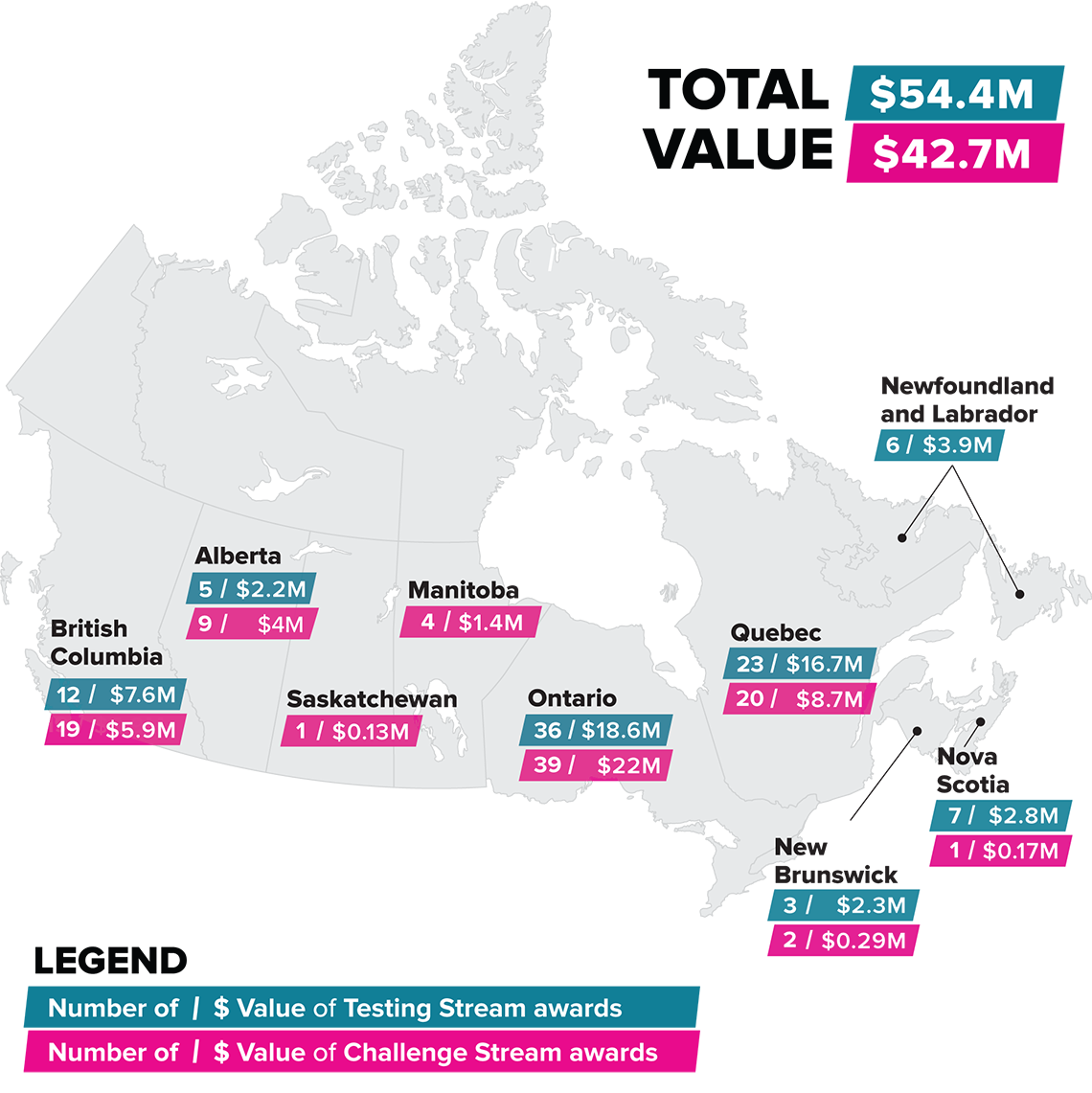
The map below shows the geographic dispersal of ISC supported businesses across the country with awards issued in eight of the ten provinces.
Total value of funding across Canada
The map below shows the geographic dispersal of ISC supported businesses across the country with awards issued in eight of the ten provinces.
Highlights
- Awarded our first contract under our Pathway to Commercialization
- Added 10 Canadian SMEs to our Pathway to Commercialization eligibility list
- Awarded 13 contracts in support of the National Quantum Strategy (5x more than in 2021-2022)
- Consistent participation in our Challenge Stream 21 federal departments launched early-stage R&D challenges
- Increased opportunities and testing partners, giving innovators access to the very best test sites for their innovations:
- 30 federal departments
- 2 Crown corporations
Our impacts
Economic
The $79.7 million in funding provided to companies in 2022-2023 is expected to generate an economic impact of approximately $240 million, and result in the following cumulative outcomes related to ISC fundingFootnote 1 :
- 4 FTE jobs sustained/year per $1 million of ISC funding provided
- $3.1 million impact on GDP per $1 million of ISC funding provided
- $1.40 in tax return per $1 of ISC Testing Stream funding provided
Equity, diversity and inclusion
As a program, we strive to encourage participation from underrepresented groups such as women, Indigenous, youth, disabled individuals, 2SLGBTQI+ persons and others. Through our program design and our outreach to innovators across Canada, we are committed to helping more underrepresented innovators apply to the program, and more specifically receive funding.
Below are some statistics from 2022:
- 85% of applicants self-identified from underrepresented groups.
- 77% of all applicants (that self-identified) identified some form of ownership in the company
- 95% of funding went to companies owned in part by underrepresented groups.
Two women help Canadian immigrants and refugees prepare for job Interviews
Testing Stream: Call for Innovative Digital Prototypes
To help Canadian immigrants and refugees prepare for the job market, Immigration, Refugees and Citizenship Canada (IRCC) awarded a contract to Virtro Technology Inc. to develop a job simulation platform designed to support Afghan and Ukrainian refugees as they arrived in Canada. This proud, women-led company partnered with IRCC and the Immigration and Economic Council of British Colombia (principal third party) to develop a self-paced learning platform, BeConfident, which enabled refugees to test their readiness for the Canadian job market through virtual mock interviews. Thanks to this tool, immigrants and refugees were better prepared and more confident in tackling job interviews, demonstrating how artificial intelligence can be at the service of human beings.
Making it happen with our partners
Innovation, Science and Economic Development Canada (ISED) works with Canadians in all areas of the economy and in all parts of the country to improve conditions for investment, enhance Canada's innovation performance, increase Canada's share of global trade and build a fair, efficient and competitive marketplace.
To deliver the program, ISC works in close collaboration with its service delivery partners at Public Services and Procurement Canada (PSPC) and the National Research Council.
Public Sector organizations provide early stage funding and procurement opportunities, identify needs and market gaps to drive challenges, and test innovations.
- Innovation, Science, and Economic Development Canada leads program delivery by setting the program's policy direction, and is responsible for program operations.
- Public Services and Procurement Canada supports program delivery through dedicated procurement teams, who manage the procurement processes for all ISC contract-based funding opportunities.
- The National Research Council Canada provides expert technical and industrial expertise to support a range of program activities.
- Government of Canada departments and agencies 21 federal government departments must contribute 1% of their 2015-2016 R&D and procurement budgets towards the program. In addition to the 21 core partner departments, there are a number of other public sector organizations that have participated in the program, including:
- 48 federal organizations
- 55 provincial/municipal organizations
- 18 academic organizations
Our funding streams
Our Challenge Stream and Testing Stream help small/medium-sized businesses (SMEs) overcome technology testing and development hurdles so that they can grow, scale, and get to market while also improving government operations.
Below is an overview of our two funding streams and their core components:
Challenge Stream
Uses a competitive process to meet specific government needs
- Early-stage research and development (technology readiness levels 1 to 6)
- Receive up to $2.3M to prove your concept and build your prototype
- Challenge-based competitions
Testing Stream
Uses a competitive process to fund testing of prototypes in real-life settings.
- Late-stage prototype testing (technology readiness levels 7 to 9)
- Up to $1.1M to test non-military innovations, and up to $2.3M to test military innovations.
- Open and theme-based calls for proposals
Success stories
Challenge Stream: Sustainable Alternatives to Plastic Packaging
In support of Canada's Zero Plastic Waste Initiative, Environment and Climate Change Canada has launched a number of ISC Challenges, including a challenge to develop sustainable alternatives to plastic packaging. Through this challenge, Magemi Mining Inc. received an award to produce a graphene-reinforced recycled paper with high-performance properties that is a sustainable alternative to plastic packaging. The innovation can also be used to produce strong and reusable paper products.
After receiving its award, Magemi Mining Inc. was contacted by the Canadian Tire Corporation to collaborate on their circular economy strategy The company also reached out to Tim Hortons to partner on their sustainability initiatives for their bagel and sandwiches paper wrappers and donut boxes. The company is conducting ongoing work with both companies to tailor the product to their specific needs (preliminary phases).
Testing Stream: Call for Innovative Ocean Technology Prototypes
In response to a call for innovative ocean tech prototypes, MarineLabs Data Systems was awarded a contract in 2022 to provides access to 360 degree real time views of the ocean conditions through images from sensors along the coastlines. This weather awareness technology is the first scalable end to end ocean camera data product.
The CoastAware BuoyCam was deployed in 16 beta testing locations along Canadian coastlines, in both the Atlantic and Pacific regions, and will stay in place until January 2024. Attempts at a similar technology have so far relied on expensive and hard-to-maintain floating buoys that are difficult to deploy, according to the company's CEO. The self-contained, solar-powered units improve the way search and rescue, harbour masters and vessel pilots understand current weather conditions.
Pathway to Commercialization
ISC has continued to implement the interim approach to the Pathway to Commercialization (PTC), where innovators who are successful in the ISC program may sell their market-ready innovation to federal organizations. We continue to refine the parameters, the process, and the procurement tools that may be leveraged in this phase.
In 2022-2023, the first PTC contract was awarded, and 10 companies qualified under this program feature:
- IMRSV
- Spexi Geospatial
- Kraken Robotics
- Trident Pump Inc.
- Rockport Networks Inc.
- Niricson Software Inc.
- Ova Gestion Conseil
- Zighra Inc.
- Agilicus Incorporated
- NuEnergy.ai
Spexi: The first business that benefited from the Pathway to Commercialization
Testing Stream: Pathway to Commercialization
Railroads are older than Canada. This makes it especially important to have the proper tools and technology to test railroads corridors to maintain them and keep them as safe as possible. That's why Natural Resources Canada (NRCAN) and Transport Canada (TC) were looking to prove the usefulness of Remote Piloted Aircraft Systems (RPAS) in vital rail corridors to collect information relevant to the maintenance and safety of these corridors (e.g. geological and rail infrastructure changes). They needed to find a technology that could provide more rigour, speed and accuracy.
They turned to Spexi Geospatial Inc., a Delta, BC-based business that specializes in scalable RPAS, to create an innovative solution to increase the reliability of remote data collection, storage and accessibility.
Spexi was awarded a first testing contract in the summer of 2021, where testing on railway ground hazards was conducted at the Transport Canada Innovation Center. The innovation exceeded expectations, while undergoing rigorous testing, including tests along the rail line from Thompson to Churchill in northern Manitoba, where subarctic climates are unpredictable and it's difficult to find useful rendering of data in environments with low internet bandwidth. The technology proved to be exceptional and where there were shortfalls, Spexi was quick to address them. The technology was tested over two years and by spring 2023, they were awarded the first contract under the Pathway to Commercialization.
Both NRCAN and TC were extremely satisfied with the results of the innovation provided by Spexi Geospatial Inc.; their innovation led to significantly safer RPAS flights and decreased the monetary and time-related costs of pilot training.
This model for success demonstrates what happens when departments share a common need and a company finds the right solution to meet and sometimes even exceed expectations.
Supporting government priorities
In 2022-2023, we aligned our funding opportunities to the following government priorities:
- Environment and climate change: 25% of projects
- Digital and enabling technologies: 17% of projects
- Health and medical: 11% of projects
- Military: 10% of projects
- Safety and security: 9% of projects
- Quantum: 10% of projects
- Other: 18% of projects (advanced manufacturing, autonomous vehicles and drones, cybersecurity, infrastructure, instrumentation and hardware systems, optics, robotics)
Playing our part to support quantum
Budget 2021 announced an initial $360 million commitment to launch a new National Quantum Strategy (NQS) aimed at building on Canada's significant strength in quantum research; growing Canadian quantum-ready technologies, companies and talent; and solidifying Canada's global leadership in this innovative field.
ISC was identified as part of the NQS under the commercialization pillar to move quantum solutions toward the marketplace by matching Government of Canada clients with Canadian SMEs that are developing early-stage R&D, or testing late-stage R&D.
2022-23 Highlights of quantum funding opportunities supported:
- 5 unique quantum early-stage challenges launched
- 1 call for innovative quantum prototypes was launched
- 15 total awards to Canadian SMEs
- $6M in funding provided to quantum-related projects
Quantum in action: How three innovative companies are paving the way
Since the National Quantum Strategy has been launched, ISC has funded several companies to advance quantum research and facilitate the development of innovative products. From a key management system to a dilution refrigerator and kinetic inductance detectors, the companies behind these inventions are paving the way in quantum research, development and commercialization.
Cutting edge security through a quantum-enabling key management system
Testing Stream: Call for Innovative Quantum Communication Prototypes
Through a $1,060,360 funding opportunity from our program, Quantum Bridge Information Technologies developed a quantum-enabling key management system that performs both quantum key distribution through security hubs paired with quantum-safe security keys. This model allows for scalable, decentralized and symmetric key management services that can be used for either encryption or authentication to protect anything from a single mobile device to a full system network.
A dilution refrigerator that facilitates laboratory work while reducing costs
Testing Stream: Call for Innovative Quantum Dilution Refrigeration Prototypes
Enabled through a contract worth $653,902, Zero Point Cryogenics has developed an ultra-compact table-top dilution refrigerator that fits into almost any existing laboratory facility, making it the only known process that allows for continuous operations at a low temperature (below 100 millikelvins) and enables quantum properties to be studied and controlled. A breakthrough in size, its intuitive touch-screen display and one button cool-down and warm-up procedures mean that an expert is no longer needed to run the system, and a sizable facility is no longer needed to house it. All these features remove significant barriers to entry that will enable quantum technologies to become much more accessible, practical and widely adopted.
Pioneering new solutions for the most accurate astronomical data
Testing Stream: Call for Innovative Quantum Computing Prototypes
Kinetic Inductance Detectors (KIDs) are superconducting quantum sensors that are used to measure and collect high-sensitivity astronomical data in frequencies ranging from the far-infrared to x-rays. T0.Technology Inc.'s challenge was to develop an innovation that could operate large array of KIDS. Backed by $1,327,848 in funding from ISC, the company rose to the occasion to produce the only innovation currently available on the market to operate large array of KIDS. They did this by developing hardware that includes individual electronic modules and a backplane assembly that is capable of operating independently or alongside other modules.
A few notable innovators we helped
Kraken Robotics
Testing Stream: Call for Innovative Prototypes
Kraken Robotics, headquartered in Mount Pearl, is a marine technology company that specializes in advanced mine countermeasures and mine hunting solutions. Having worked with Kraken Robotics before on robotic technology, the Navy sought the expertise of the company in creating a robot with an advanced underwater sonar system. With the instrumental support of ISC's funding, Kraken Robotics has cultivated an international presence, secured long-lasting partnerships and strengthened its commitment to delivering high-quality technology.
e2IP Technologies
Challenge Stream: Engineered Surfaces Challenge
e2ip Technologies, a Montreal-based company, specializes in control panels and recently participated in the Engineered Surfaces challenge sponsored by ISED. This challenge aimed to address radio frequency and WiFi interference on building materials. e2ip's innovative solution involves creating thin, semi-transparent structures capable of reflecting and diffusing radio waves without requiring small antennas or an external power source.
Recognizing the challenges of small businesses in accessing resources for research and development, E2ip sought support from Innovative Solutions Canada (ISC). They progressed from Phase 1 to Phase 2 through the Challenge Stream, collaborating with experts to validate their technology's feasibility. Their efforts were rewarded with a Best Innovation in Smart Cities Award from CES 2021 Innovation Awards.
Funding and collaborating with the Government of Canada was crucial for their success.
Annex A
The following table shows awards issued in 2022-2023. The first nineteen organizations listed were mandated to participate in the ISC program. The last ten organizations are voluntary participants. For the CS, Challenges launched by specific organizations led to a number of awards, with the total value specified in the fourth column. For the TS, ISC coordinates CFPs that lead to awards, by matching companies to interested organizations. The total value per organization for new TS awards is found in the last column. Note that awards can lead to multi-year contacts and grants, so the values listed below may have led to spending in 2022-23 and beyond.
| Department | Challenge Stream | Testing Stream | |||
|---|---|---|---|---|---|
| Number of challenges launched | Number of awards | Award value | Number of awards | Award value | |
| Federal departments mandated to participate in ISC | |||||
| Department of National Defence | 2 | 8 | $5,865,142 | 16 | $14,495,417 |
| Public Services and Procurement Canada | 1 | - | - | 3 | $1,453,113 |
| Shared Services Canada | - | 3 | $3,357,156 | 4 | $1,902,297 |
| National Research Council of Canada | 3 | 9 | $4,718,692 | 11 | $8,079,445 |
| Agriculture and Agri-Food Canada | - | 10 | $1,500,000 | 3 | $1,620,987 |
| Natural Resources Canada | - | 4 | $523,036 | 4 | $2,459,057 |
| Employment and Social Development | - | 1 | $1,116,819 | - | - |
| Royal Canadian Mounted Police | - | 1 | $149,255 | 3 | $1,368,914 |
| Environment and Climate Change Canada | 1 | 4 | $1,448,412 | 2 | $540,221 |
| Fisheries and Oceans Canada | - | - | - | 4 | $1,747,978 |
| Health Canada | - | - | - | 1 | $147,062 |
| Canada Border Services Agency | - | - | - | 1 | $382,450 |
| Canadian Space Agency | 3 | 2 | $2,224,796 | 1 | $541,882 |
| Public Health Agency of Canada | 1 | 3 | $450,000 | - | - |
| Global Affairs Canada | - | 4 | $1,499,288 | 1 | $86,360 |
| Transport Canada | - | 3 | $2,966,046 | 6 | $5,716,314 |
| Innovation, Science and Economic Development Canada | 2 | 3 | $1,292,000 | - | - |
| Canadian Food Inspection Agency | 1 | 1 | $500,000 | 1 | $215,494 |
| Indigenous Services Canada | - | - | - | 1 | $1,375,704 |
| Other participating departments | |||||
| Communication Security Establishment | - | 2 | $2,250,662 | - | - |
| Parks Canada | - | - | - | 2 | $919,006 |
| Canadian Coast Guard | - | - | - | 2 | $2,512,434 |
| Infrastructure Canada | - | - | - | 1 | $409,032 |
| Atlantic Canada Opportunities Agency | - | - | - | 1 | $438,182 |
| Canada Revenue Agency | - | - | - | 1 | $172,500 |
| Royal Canadian Navy | - | - | - | 1 | $1,374,804 |
| Immigration, Refugees and Citizenship Canada | - | - | - | 1 | $348,450 |
| Prairies Economic Development Canada | - | - | - | 1 | $919,743 |
| Veterans Affairs Canada | - | - | - | 1 | $578,597 |
The following table shows actual spending per mandated organization against their set-aside 1% of 2015-16 procurement and intramural R&D. This spending may relate to new awards, shown in the previous table, as well as multi-year awards from previous FYs. Out of 21 GC organizations with a mandated goal for spending with the ISC programs, eight reached 90% or higher of their set-aside amount. However, the total is only 34.8% of the overall set-aside amount of the 21 organizations.
| Department | Departmental Challenge Stream set aside 1 % of 2015-16 procurement + intramural R&D | Departmental spending 2022-23 | ||
|---|---|---|---|---|
| Challenge Stream | Transfer to Testing Stream (up to 30%) | 2022-23 Total | ||
| Department of National Defence (DND) | $65,000,000 | $4,708,372 | $6,231,570 | $10,939,942 |
| Public Services and Procurement Canada (PSPC) | $8,800,000 | $496,607 | $212,137 | $708,745 |
| Shared Services Canada (SSC) | $7,600,000 | $5,415,405 | $1,296,307 | $6,711,712 |
| National Research Council Canada (NRC) | $5,500,000 | $3,473,785 | $1,469,660 | $4,943,446 |
| Agriculture and Agri-Food Canada (AAFC) | $3,900,000 | $904,981 | $170,000 | $1,074,981 |
| Natural Resources Canada (NRCan) | $2,600,000 | $523,036 | $780,000 | $1,303,036 |
| Employment and Social Development Canada (ESDC) | $2,200,000 | $207,660 | $0 | $207,660 |
| Royal Canadian Mounted Police (RCMP) | $1,800,000 | $1,386,167 | $518,636 | $1,904,804 |
| Environment and Climate Change Canada (ECCC) | $1,600,000 | $1,024,148 | $0 | $1,024,148 |
| Department of Fisheries and Oceans – Canadian Coast Guard (DFO-CCG) | $1,500,000 | $977,203 | $399,532 | $1,376,736 |
| Health Canada (HC) | $1,400,000 | $2,160,428 | $0 | $2,160,428 |
| Correctional Services Canada (CSC) | $1,400,000 | $1,441,627 | $5,750 | $1,447,377 |
| Canada Border Services Agency (CBSA) | $1,400,000 | $642,150 | $1,069 | $643,219 |
| Canadian Space Agency (CSA) | $1,300,000 | $358,297 | $0 | $358,297 |
| Public Health Agency of Canada (PHAC) | $1,300,000 | $997,080 | $0 | $997,080 |
| Global Affairs Canada (GAC) | $1,300,000 | $503,399 | $0 | $503,399 |
| Transport Canada (TC) | $1,300,000 | $0 | $0 | $0 |
| Innovation, Science, & Economic Development (ISED) | $1,300,000 | $1,200,000 | $0 | $1,200,000 |
| Canadian Food Inspection Agency (CFIA) | $1,300,000 | $1,310,494.00 | $0 | $1,310,494.00 |
| Crown Indigenous Relations and Northern Affairs (CIRNA) | $800,000 | $0 | $0 | $0 |
| Indigenous Services Canada | $500,000 | $663,046 | $149,808 | $812,854 |
| Total | $113,800,000 | $28,393,886 | $11,234,471 | $39,628,356 |