
Table of contents
Welcome to Innovation, Science and Economic Development Canada (ISED) Deputy!
On behalf of the over 5000 employees at ISED and more than 16,000 personnel from our portfolio partners, congratulations on your appointment! You will be leading an organization steeped in history, bursting with variety, and filled with (we believe) fantastic people.
Let's begin with your team. Every day, thousands of talented Canadians come to work at ISED throughout the country. They come for the challenge of identifying, creating, and supporting innovative initiatives and leading edge policies that make a real difference in people's lives and help shape Canada's economic future. ISED is a superb place to work but don't just take our word for it. In 2019, your new department was selected as one of Canada's Top 100 Employers, the NCR's Top Employers, and Canada's Best Diversity Employers – the triple crown. Joining such winning organizations as Suncor and Shopify, ISED is recognized as offering a wide variety of unique career opportunities while prioritizing professional development in a collaborative, inclusive, and respectful work environment for all. ISED continues to pioneer innovative workplace initiatives such as the Digital Lounge, our drop-in PayHub, Inclusion Symposiums, and a dedicated ISED Ombudsman for Mental Health and Employee Well-Being to promote a healthy workplace.
A long tradition, but certainly not traditional. The last several years have been an exciting time at ISED. We gained a new name. We welcomed more Ministers. And, we are leading the charge to make Canada recognized as an innovative and globally competitive economy. The data-driven, digital economy is here and ISED is at the forefront. The Innovation and Skills Plan, an ambitious redesign of our micro-economic policy framework, is leading the charge. Recognizing that innovation and skills are the core drivers of economic growth, the Government has committed REDACTED for innovation and skills programming and REDACTED for science at ISED in this mandate alone.
ISED has a mandate that spans the country, the globe, and beyond. Our ambition is to transform the entire Canadian economy. From bringing high-speed internet to all Canadians to offering support for firms of all sizes to grow and export to markets around the world, ISED is there. Through initiatives such as Superclusters and the Economic Strategy Tables, we are fostering a culture of collaboration and innovation that builds strong partnerships between businesses, academics and government counterparts at all levels. Moreover, as economic growth and creation of good jobs requires innovation and engagement across the country, ISED's regional presence and programming builds upon local strengths to support regional growth. Finally, trust and privacy are imperative for Canadians to fully participate and benefit from the digital economy. That is why ISED recently launched Canada's Digital Charter. This principled approach will not only protect Canadians' privacy and personal data but also leverage Canada's unique talents in order to shape an innovative and people-centred digital economy.
We are already seeing significant progress through the Innovation and Skills Plan. CanCode has supported over a million students in gaining the digital skills needed for the jobs of the future. Business-led Innovation Superclusters are expected to create ecosystems, produce anchor firms, and pool access to cutting-edge research and highly skilled talent. There remains, however, a lot more to be done. With the expected slowing economy and impending transition to a new mandate, we look forward to your leadership and direction as we continue to push the boundaries and build a nation of innovators.
The following package is designed to provide you with an overview of our diverse work and we look forward to briefing you on specific issues and files in the coming days and weeks. We wish you the very best as you embark on this great adventure, and know that we stand ready to help advance the Government's mandate and support your vision as we go beyond 2020.
Sincerely,
The ISED Team
Section 1: getting to know your department & the portfolio
The state of the economy
Overview
- After leading the G7 with 3.0% growth in 2017, Canada's economy slowed to just under 2.0% in 2018. It is expected to slow considerably to just 1.3% this year before returning to a 2.0% pace during 2020-21.
- Employment growth has been strong over the last two years, as Canada's unemployment rate reached a 40-year low of 5.4% in May, which has started to translate into wage growth.
- Trade protectionism, skills disruption and the digital economy are factors that will increasingly impact the economic outlook of Canada.
Global economic growth
Global economic growth is expected to slow from the 3.7% registered in 2018 to 3.0% in 2020 before picking up slightly to 3.2% the following year. This broad-based slowdown in economic activity, in addition to a moderation in both trade and business investment, was largely a reflection of escalating trade conflicts, geopolitical tensions, and related uncertainty (Bank of Canada, July 2019). Recently, there is also growing concern that a global recession could emerge in the near-term, as trade headwinds are aggravating economic slowdowns in some countries, while bond markets are reeling globally (Morgan Stanley, CNBC).
Canadian economic growth
Canada posted solid economic growth in 2017, when real GDP expanded by 3.0%, better than expected and roughly twice the pace of the previous year. Since the end of 2015, economic growth has averaged almost 2.5%, placing Canada among the leaders for the strongest pace of growth in the G7 (2018 Fall Economic Statement).
Recent estimates by the Bank of Canada is for real GDP growth to fall from the 1.9% estimated for 2018 to 1.3% this year. The slowdown in 2019 is largely a reflection of a weak start to the year, reflecting contractions in goods-producing industries, notably oil and gas construction, as well as a decline in residential investment. Growth is expected to average close to potential over the remainder of 2019. Looking further ahead, the Canadian economy is projected to expand at around 2.0% during 2020-21, slightly above potential, as consumption advances moderately, housing recovers, and the combined contribution of exports and business investment improves. (Bank of Canada July 2019).
Real GDP by Country

The most recent edition of the Organisation for Economic Co-operation and Development (OECD) Economic Survey of Canada explains that Canada's economy has recovered from the recent period of weakness attributed to the 2014 energy price slump. In particular, the completion of adjustments has helped commodity-producing industries rebound and begin contributing to economic growth in mid-2016. This transition was aided by sound policies, with monetary policy being eased while fiscal policy provided more stimulus (OECD, 2018).
Following the global economic downturn and financial crisis of 2008, Canada was the first economy among the G-7 to recover to its pre-recession level of real GDP, aided by prudent financial sector regulation and timely fiscal stimulus. Canada's manufacturing sector was hit particularly hard, as its share of the economy contracted by two percentage points between 2007 and 2009. In fact, the manufacturing sector as a whole has yet to recover to its pre-recession level of real GDP, driven by lagging growth in significant industries like motor vehicles and parts, aerospace, petroleum and coal products, paper, primary metals, fabricated metal products, and furniture. Meanwhile, the goods-producing and primary sectors surpassed their pre-recession levels within a couple of years of the downturn, while the services sector briefly stalled in 2009 before returning to healthy growth.
Real GDP: Manufacturing and Services Sectors

Private consumption was the major driver of economic growth in 2017, accounting for 1.9 percentage points of the 3.0% growth in total real GDP (OECD, 2018 and Bank of Canada, 2018). Looking ahead, consumer spending is projected to grow moderately during 2020-21, as households are expected to be cautious about their spending decisions in the face of elevated debt levels. The outlook for consumption and residential investment, which is expected to post modest growth following two years of decline, will be supported by strong employment and sustained wage gains (Bank of Canada, July 2019).
Productivity growth
The improved global economic growth performance over this past year (and forecasts of 3.8% in 2018 and 3.9% in 2019) is largely a result of monetary and fiscal policy, with self-sustaining economic growth yet to be achieved (OECD, 2018). As such, productivity growth will be an important factor affecting economic growth and prosperity in Canada going forward. But productivity growth continues lag behind, slowing down among advanced economies since the early 2000s, with particular sluggishness following the global financial crisis. For Canada, multifactor productivity rose a modest 0.1% in 2016, contributing to a 0.5% rise in labour productivity overall (Statistics Canada, 2018). However, labour productivity has been growing more slowly in Canada than in most OECD countries over the past two decades. The OECD points to productivity-enhancing reforms to sustain the current expansion and to foster inclusive growth, including, for example, enhancing education and skills, boosting competition, and investing in digital infrastructure (OECD, 2018).
Gaps in labour productivity relative to the upper half of countries in the OECD countries

Employment
Canada added 195,800 jobs in 2018, driven entirely by full-time work. However, this was considerably lower than the previous year, when 417,400 jobs were created to represent Canada's strongest year of job creation since 2002. Canada's labour market is off to a strong start in 2019, as 247,500 jobs have already been added, largely on account the 106,500 jobs created in April alone. These results contributed to the unemployment rate falling to 5.4% in May, the lowest level since comparable data became available in 1976 (Statistics Canada, 2019).
Monthly data suggest that wage gains are increasing with the overall strength in the labour market. According to Bank of Canada estimates, wages increased by almost 2.5% in the second quarter of 2019, up from around 2.0% in the first quarter (Bank of Canada, July 2019).
Provincial Unemployment Rates (Seasonally adjusted)

Exports
Canada posted a merchandise trade surplus of $763 million in May, as total exports rose 4.6% to a record $53.1 billion, with widespread gains across most product sections (Statistics Canada, 2019).
Looking ahead, Canadian exports are expected to grow moderately over the near-term, supported by an ongoing expansion of foreign demand. During that time, non-commodity exports are expected to post relatively broad- based growth with the notable exception of the auto sector, due in part to changes to the production mandates of Canadian motor vehicle assemblers. Services exports are expected to continue expanding at a strong pace, leading to further gains in its share of non-commodity exports. Energy exports are expected to be flat this year before posting moderate growth during 2020-21 (Bank of Canada, July 2019).
Global trade tensions are still expected to weigh on Canada's outlook for overall exports, while limited transportation capacity will restrain the expansion of energy exports.
Exports of Good and Services: Energy and Non-Energy

Research and development (R&D)
Business research & development (R&D) and Information and Communications Technology (ICT) investment are seen as key factors to ensure long-term productivity, sustainable economic growth and high living standard for Canadians. However, Canadian businesses are still under-investing in ICT at 50% of US investment in computer software and databases per worker in 2014 (CSLS, 2016). Similarly, Canada's business R&D relative to GDP has declined since the early 2000s and, as a result, Canada now trails most OECD countries (22nd in 2017).
Business enterprise R&D (BERD) as a percentage of GDP, 1992 to 2018

Canada's overall support to business R&D (direct and indirect) declined in the 2009-2016 period in real terms, whereas other countries have maintained or increased their support for business R&D. Canada's rank among OECD countries also fell from 4th in 2009 for its overall support to business R&D to 13th in 2016. Increases in direct support (i.e., R&D grants and contracts) were not substantial enough to off-set the sharp decline in tax credits. While Canada's R&D support is still geared toward tax credits, its overall R&D support mix (indirect-to-direct ratio) is more balanced in 2016 compared to 2009.
Direct and Indirect Support for R&D (as a % of GDP)

Data-driven economy and skills
Digital adoption and embracing new technology-enabled business practices are believed to fuel productivity, economic growth, and international competitiveness. Yet, Canadian firms are slow adopters of new technology (e.g., 21st in OECD for e-commerce, OECD 2017). This is particularly challenging in an era of increasing global competition for leadership in digital and data-driven domains.
The Canadian economy is also facing large shifts in employment and skills as the world becomes increasingly digitalized, with automation expected to replace 9% jobs over the next 10-20 years and create 2.4 million jobs over the next 4 years alone (RBC, 2018). These new jobs and tasks will require a different mix of skills, which will have large implications for the workforce. Canada has a good foundation for knowledge and a well-educated population, ranking 2nd in the OECD for 25 to 34 year-olds with postsecondary degrees and 2nd for business upskilling of high-skilled employees. However, many new jobs will be in the ICT field, for which Canada is ranked 24th for ICT graduates' representation in all tertiary graduates (OECD, 2017). As automation takes over many tasks, new mixes of skills will be in demand, with more emphasis on problem solving, as well as analytical, digital and interpersonal skills across all occupations.
Tax competitiveness
The US implemented tax reforms at the beginning of last year (January 2018) aimed at improving the competitiveness of the American tax regime, which included lowering corporate tax rates, and removing a long-standing structural incentives for US–based multinationals to invest abroad and defer the repatriation of foreign profits. In response, Canada sought to mitigate the erosion its previous tax advantage relative to the US by recently introducing new tax incentives designed to encourage investment and support technology adoption. Specific measures included allowing the full cost of machinery and equipment used in manufacturing and processing of goods to be written off immediately for tax purposes, allowing specified clean energy equipment to be eligible for an immediate full write-off of the entire cost, and implementing an accelerated capital cost allowance to allow businesses of all sizes to claim a larger deduction for the depreciation of their capital investments (Fall Economic Statement, 2018).
International Marginal Effective Tax Rate (METR) Comparisons, G7 and the OECD Average, 2019

In a recent update, Finance Canada estimated Canada's tax competitiveness relative to some of our closest competitors. It showed that Canada's average marginal effective tax rate is the lowest among G- 7 nations and below the average for OECD countries. Canada also has an overall tax rate that is significantly lower than that of the US, with an average tax advantage of 4.6 percentage points (Department of Finance, 2019).
Trade and protectionism
Given that Canada is a small open economy that is highly integrated with that of the US, the recently signed CUSMA has reduced trade policy uncertainty and the associated drag on business investment to some extent, even though ratification is still pending (Bank of Canada, Global Affairs Canada). Also, Canadian non-energy exports should receive a boost from the recent removal of US steel and aluminium tariffs (Bank of Canada, 2019, Global Affairs Canada). However, the Bank of Canada still estimates that trade policy uncertainty will dampen Canadian exports by around 1.5% by the end of 2021, as the US and China have not yet managed to reach an agreement on their trade dispute, which is contributing to a broad-based slowdown of global economic activity and a moderation in the growth of both trade and business investment (Bank of Canada, July 2019).
Updated August 2019
Global outlook and recession risks
Overview
Most forecasters generally agree that global economic growth will slow this year. While this is consistent with earlier forecasts, a new development is growing concern about the possible emergence of a global recession in the near-term, as trade headwinds are aggravating economic slowdowns in some countries, and bond markets are reeling globally. We also provide short summaries of economic outlooks for large economies and regions (e.g., the US, Europe, China, and Canada).
Global outlook
The latest forecasts released project that global economic growth will ease in 2019 and 2020, with some downgrading their earlier projections. In particular, forecasts by the Bank of Canada, IMF, and the OECD call for global economic growth to slow from around 3.6% in 2018 to closer to 3.0% in 2019, before improving slightly the following year (see Table). Global growth has already slowed sharply over the past year, particularly in the latter half of 2018, with only a slight improvement in the first quarter of 2019. This weakness is largely a reflection of deep recessions in some emerging-market economies and widespread weakness in industrial sectors. Thus far, most of the slowdown has been concentrated in the manufacturing sector, though the service sector has also softened in recent months.
| - | 2018 | 2019 Forecast | 2020 Forecast |
|---|---|---|---|
| Bank of Canada (July 2019) | 3.7% | 3.0% | 3.2% |
| IMF (July 2019) | 3.6% | 3.2% | 3.5% |
| OECD (May 2019) | 3.5% | 3.2% | 3.4% |
Forecasters have identified a number of factors that may have contributed to the recent downward revisions and represent significant risks going forward, including the possible emergence of a global recession. Among the most cited are the ongoing trade tensions between the US and China, which have weighed on global business sentiment and economic activity. There are concerns that a further escalation of this situation could lower foreign demand to the point of disrupting global value chains and reducing commodity prices. Another key risk being considered by forecasters is the uncertainty surrounding the final outcome of Brexit, as a no-deal separation between the UK and Europe, which would likely be disruptive and generate negative cross-border spillovers, remains a distinct possibility. There is also the possibility that a faster-than-expected deceleration of economic growth in China could further weaken growth prospects. Past experience has demonstrated that concerns about the performance of China's economy have the ability to trigger abrupt, wide-reaching sell-offs in financial and commodity markets, which puts significant pressure on China's trading partners, commodity exporters, and other emerging markets.
United States (US) outlook
GDP growth in the US is projected to moderate from nearly 3.0% in 2018 to below 2.0% in 2020, as the temporary boost provided by the Tax Cuts and Jobs Act (TCJA) and increased federal government spending continue to fade. The US economy managed to rebound from a weak fourth quarter to advance 3.1% in the first quarter of 2019, before falling closer to 2.0% in the second quarter. The strong first quarter growth was supported by net exports and inventories, which have been volatile in the face of trade actions, while domestic demand was softer than expected and tariffs contributed to weaker imports. These developments suggest that momentum will likely slow over the remainder of the year. If that is the case, then US economy may have already joined in the slowdown that is underway in Europe, China and a number of other strategically important countries, after managing robust growth while other economies faltered in the second half of 2018.
The notion that a recession could emerge in the US in the near-term is gaining some traction. For instance, the Federal Reserve Bank of New York has developed a recession-probability tracker based on yield curves, which puts the chance of a recession emerging over the 12-month period preceding next July at 31.48%, slightly lower than the preceding month, but still the second-highest level on record since July 2008. The Federal Reserve Bank of Cleveland obtained a similar result in its own analysis of yield curves, which put the probability of the economy being in recession by next July at 35.4%, down slightly from 37.8% in June, but still among the highest levels on recent record (see Graph). It should be noted that these results do not consider the inversion of the yield curve in mid-August, which is widely accepted as a harbinger of possible recession. This occurred because market traders rushed to buy longer-term government bonds, which drove down the 10-year bond yields to the point that they fell below those of three-month bills.
The National Association for Business Economists (NABE) recently surveyed 300 of its members and found that nearly three-quarters of them believe that the US will enter into a recession by the end of 2021. Specifically, 2% expect a recession to begin this year, 38% call for one to commence in 2020, while 34% expected one the following year. In the previous survey, conducted in February, a similar proportion of economists (77%) expressed the view that a recession would emerge by 2021. However, the main difference between the two surveys is that more economists now expect the recession to begin later than they did in February. Even if a recession does not occur in the foreseeable future, a slowdown in US economic growth could have a significant impact on the global economy, as it has served as an important driver of growth during a period when other major economies had slowed.
Probability of Recession Calculated from the Yield Curve

Euro area
In Europe, business sentiment continues to be dampened by headwinds from political and trade uncertainties, with industrial production being hit particularly hard. Economic growth is projected to remain weak over the near-term, as fading intra-area trade growth, high political uncertainty, and moderating confidence suggest that weakness in demand might persist. In Germany, a broad-based deterioration in recent monthly indicators has increased the likelihood of a recession. In particular, multiple setbacks have contributed to four consecutive quarterly declines in industrial production, and an escalation of the US-China trade war could further exacerbate the economy's weaknesses. Furthermore, a deep slump in Germany's manufacturing sector has increasingly spread disruption in supply chains throughout Europe. In Italy, preliminary data indicate that growth was flat in the second quarter, which is fuelling speculation of a return to recession after the economy managed to edge up 0.1% in the first quarter, the only instance of positive growth realized in the last five quarters. Additionally, fresh political uncertainty could weaken an already fragile economic outlook. Meanwhile, risks associated with Brexit continue to inhibit investment in the UK, as the unprecedented uncertainty associated with possibility of a no-deal separation has weighed on the UK economy. Of note, a recent Bank of England survey has revealed that business confidence has continued to worsen and investment intentions are at their lowest point since January 2010.
China
There is a consensus among forecasters that China's economy is set to gradually slow from the 6.6% estimated for 2018 to around 6.0% by 2020, as the negative effects of escalating tariffs and weakening external demand have added pressure to an economy that is already in the midst of a structural slowdown and in need of regulatory strengthening to rein in a high dependency on debt. If the slowdown turns out to be more pronounced than expected, there could be significant reverberations throughout the global economy given China's strong trade linkages around the world. According to the OECD, a decline of 2 percentage points in the growth rate of domestic demand in China over a two-year period would lower global GDP growth by close to 0.4 percentage points in the first year, with the impact being relatively more severe in Japan, commodity-producing economies, and other economies in East Asia. Furthermore, spillovers from a slowdown in China would be larger if monetary policymakers around the world were not able to react properly.
Canada
In Canada, there is a consensus that the economy is entering into a period of slower growth. GDP growth is expected to decline from just under 2.0% in 2018 to 1.3% this year, as global trade conflicts and related uncertainty are weighing on business sentiment and holding back economic activity. Looking further ahead, economic growth is forecast to strengthen to slightly above potential in 2020 and 2021, reflecting a moderate expansion in consumption, a recovery in housing, and an improvement in the combined contribution of exports and business investment.
Probability of Recession in Canada

To this point, there has been little discussion of a recession in Canada. Scotiabank's recession probability model suggested that the likelihood of a recession occurring over the 2019-20 period is low but rising. It explains that the yield curve inverted in March, as three-month T-bills ended the month at 1.67% while the 10-year government bond rate was 1.62%. However, the fact that consumer confidence grew each month from January to March suggests that conditions for a recession are still benign. Based on these factors, Scotiabank's model-implied probability to of a recession emerging in Canada in 2020 was 11%. That said, if Canadian consumer confidence were to start deteriorating in the coming months, the probability of a recession would rise.
Updated August 2019
Ministerial mandates overview
ISED is a department mandated to foster a growing, competitive and knowledge-based Canadian economy. The larger ISED portfolio contains 16 agencies and supports four Ministerial mandates. ISED works toward a policy agenda that focusses around three pillars: efficient marketplace regulation; science, technology and innovation; and, support for business.
In order to provide support as you step in to your role as Deputy Minister within this wide-ranging portfolio, below you will find a brief overview of key Ministerial initiatives.
The Honourable Navdeep Singh Bains
Minister of Innovation, Science and Economic Development

Since 2016 and the election of a new government, ISED has led the development of an integrated, whole of government Innovation and Skills Plan (ISP) for Canada. While Canada's economic growth has kept pace with other G7 countries, it is accepted that we are entering into a period of slow economic global growth – and ISED's role in developing innovation policies and programs will be central to ensuring Canada remains competitive. Traditionally, we have addressed slower productivity through strong macro-economic frameworks supported by tax incentives that promote innovation. The ISP was developed to establish a balance of indirect and direct supports, and focus on ecosystems and the benefits they create through new initiatives such as Innovation Superclusters, the Economic Strategy Tables, and the Strategic Innovation fund. These initiatives make up a significant re-imagining of innovation programming that builds on strong collaboration with the private sector to drive growth.
The next phase of the ISP will be to fully realize a competitive, data-driven, digital economy accessible to all Canadians across the whole of the country. As the innovation ecosystem shifts to one that is built on intangible assets like intellectual property and data, ISED is committed to developing strategies that continue to foster advancements in areas including artificial intelligence, advanced manufacturing, and technology adoption; all of which have significant economic and social benefits. Embracing digital and data-driven technologies provides an opportunity to push the boundaries of what is possible. This push for change, however, must be underpinned by a sense of trust and transparency between citizens, companies, and governments. That is why ISED's policy thinking in the digital and data sphere will continue to be not only innovative, but also people-centered and inclusive.
The Honourable Kirsty Duncan
Minister of Science and Sport

Work in support of Minister Duncan's mandate is being undertaken at ISED to create a more inclusive research ecosystem while renewing emphasis on the importance of sound science advice and evidence-informed decision-making. In Budget 2018, we saw the single largest investment in fundamental research in Canada's history of almost $4 billion including funding to renew federal labs and provide needed infrastructure. In 2017, Dr. Mona Nemer was also appointed as our Chief Science Advisor (CSA).
Recent Budget investments have provided funding to support graduate students, to stabilize the Canadian Foundation for Innovation, and to support the implementation of a Digital Research Infrastructure Strategy (DRI). The strategy will help ensure researchers across all disciplines in Canada's academic community have access to the tools they need to harness big data and conduct world-class research. Budget 2019 also proposed the establishment of a Strategic Science Fund to support third-party science and research organizations. It will operate using a principles-based framework for allocating federal funding that utilizes competitive, transparent processes. ISED is continuing its work to advance the design of the Fund, through a review of the third-party organizations in collaboration with several federal departments and agencies, as well as TPOs, the CSA and the Canadian Research Coordinating Committee.
The Council on Science and Innovation (CSI) is currently being established as an independent advisory body mandated to provide ISED with expert advice on policy issues related to science and innovation. This council replaces the Science, Technology and Innovation Council (STIC) as a more transparent body. The CSI's advice will support the Government of Canada's efforts to strengthen the science and research ecosystem and stimulate innovation across the country's economy.
The Honourable Mary Ng
Minister of Small Business and Export Promotion

ISED work in support of Minister Ng's mandate is focused on support to Small and medium-sized enterprises (SMEs) in order for them to become globally competitive exporters. The government of Canada's recent restructuring of its innovation programming supports SMEs across the full innovation continuum, and the ISED innovation platform acts as the single-window access point for business.
From basic and applied R&D, through commercialization, market development, and finally scale-up and market expansion, Canadian businesses have access to a number of initiatives. ISED works with portfolio partners and other government departments to deliver investments and programs like the Strategic Innovation Fund (SIF), the NRC's Industrial Research Assistance Program (NRC-IRAP), regionally tailored innovation programming delivered by the Regional Development Agencies (RDAs), and assistance from the Canadian Trade Commissioner Service. These initiatives represent a whole-of- government approach designed to help SMEs develop new ideas, grow their business, and access new markets.
This commitment to SMEs is borne out through programs such as the Venture Capital Catalyst Initiative (VCCI), which will increase late-stage Venture Capital available to Canadian entrepreneurs, through a federal investment to support innovative Canadian companies. In addition, the Export Diversification Strategy led by Global Affairs Canada, is supported by ISED with a commitment to inclusive growth for SMEs through initiatives like the Women's Entrepreneurship Strategy.
The Government has taken a focused approach to start-ups and scale-ups, but work remains in order to help SMEs maximize their export potential, adopt digital technologies, and attract a highly skilled workforce.
The Honourable Mélanie Joly
Minister of Tourism, Official Languages and La Francophonie

Work on Minister Joly's mandate is divided between ISED and Canadian Heritage. Her primary support at ISED is provided through the office of Deputy Minister Guylaine Roy.
Minister Joly's main initiative being developed out of ISED is the Federal Tourism Growth Strategy. This strategy is based in developing the supply side of tourism offerings across Canada and aims to drive growth in rural areas as well as urban centres, as opposed to the traditional focus of increasing tourism demand. The Strategy is centered around three initiatives: the Canadian Experiences Fund (administered by the Regional Development Agencies), which has already commenced funding projects across the country; and two remaining initiatives under development, a new Economic Strategy Table dedicated to the visitor economy, and the establishment of Regional Tourism Investment Groups. These groups will be co-led by Destination Canada (a Crown corporation within the ISED portfolio) and the Regional Development Agencies, designed to bring together partners from all levels of government in order to better align investments in tourism products across the federal government, and across jurisdictions, and to attract more private investment to the sector.
Associated Ministers
The Honourable Bernadette Jordan
Minister of Rural Economic Development

Minister Jordan is primarily supported by Infrastructure Canada. ISED supports the Minister on the coordination and delivery of broadband programming in rural and remote areas through such initiatives as the Connect to Innovate program.
The Honourable Dominic Leblanc
Minister of Intergovernmental and Northern Affairs and Internal Trade

Minister LeBlanc is primarily supported by the Privy Council Office. In support of Minister LeBlanc, ISED continues to provide policy support to advance ongoing internal trade negotiations including providing resources to PCO.
The Honourable Bill Morneau assumed responsibilities related to intergovernmental affairs and internal trade while Minister LeBlanc is on a temporary leave of absence.
Building a prosperous and innovative Canada: ISED overview
Mission
ISED's mission is to foster a growing, competitive and knowledge-based Canadian economy.
Core responsibilities:
Efficient marketplace regulation
Improve competitive intensity of Canadian industries and reinforce framework policies and institutions to anticipate and respond to global economic shifts.
- Regulation
- Standards
- Alignment
Science, technology and innovation
Enhance innovation performance including adoptions and commercialization of new technologies, innovation management capacity, and support industry-research collaboration.
- R&D
- Partnerships
- Basic science
Support for business
Support businesses to think and act globally, grow, take on risk and participate in global supply chains.
- Global value chain access
- Financing
- Tools to compete
ISED portfolio
- The Honourable Navdeep Singh Bains, Minister of Innovation, Science and Economic Development
- The Honourable Kirsty Duncan, Minister of Science and Sport
- The Honourable Mary Ng, Minister of Small Business and Export Promotion
- The Honourable Mélanie Joly, Minister of Tourism, Official Languages and La Francophonie
- Simon Kennedy, Deputy Minister, Innovation, Science and Economic Development Canada
- David McGovern, Associate Deputy Minister, Innovation, Science and Economic Development Canada
- Paul Thompson, Associate Deputy Minister, Innovation, Science and Economic Development Canada
- Guylaine Roy, Deputy Minister of Tourism, Official Languages and La Francophonie
Associated ministers
- The Honourable Bernadette Jordan, Minister of Rural Economic Development (Primary support through Infrastructure Canada)
- The Honourable Dominic LeBlanc, Minister of Intergovernmental and Northern Affairs and Internal Trade (Primary Support by PCO)
Note: Minister of Finance, Bill Morneau, has temporarily assumed responsibilities related to intergovernmental affairs and internal trade while Minister LeBlanc is taking a leave of absence for health reasons.
| Department/agency | Full Time Equivalent (FTE) | Budget |
|---|---|---|
| ISED | 5,226 | $3,124M |
| FEDNOR (within ISED) | 69 | $63M |
| Atlantic Canada Opportunities Agency (ACOA) | 578 | $343M |
| Western Economic Diversification Canada (WD) | 300 | $305M |
| Statistics Canada (STC) | 6,067 | $616M |
| Canadian Space Agency (CSA) | 695 | $329M |
| Canadian Economic Development for Quebec Regions (CED) | 342 | $325M |
| Federal Economic Development Agency for Southern Ontario (FEDDEV) | 240 | $262M |
| Canadian Northern Economic Development Agency (CANNOR) | 74 | $65M |
| Natural Sciences and Engineering Research Council (NSERC) | 456 | $1,332M |
| National Research Council (NRC) | 4,036 | $1,187M |
| Social Sciences and Humanities Research Council of Canada (SSHRC) | 288 | $923M |
| Business Development Bank of Canada (BDC) | 2,420 | $612M |
| Destination Canada (DC) | 113 | $101M |
| Standards Council of Canada (SCC) | 121 | $18M |
| Copyright Board Canada (CB) | 26 | $4M |
| Competition Tribunal (Resources within Administrative Tribunals Support Service of Canada (ATSSC) under Minister of Justice) |
- | - |
Affiliated organizations
- Canada Foundation for Innovation
- Council of Canadian Academies
- Pierre Elliott Trudeau Foundation
- Science, Technology & Innovation Council
- Sustainable Development Technology Canada
- Genome Canada
- Canadian Institute for Advanced Research
Operational context:
Canada can no longer rely on previous drivers of growth:
- Rising labour force participation
- North American trade
- High commodity prices
Sustained economic upturn may be illusive
Bank of Canada gross domestic product (GDP) projections:
- 2017: 3%
- 2018-2020: 2%
Productivity growth decline
- 1980-2000: 1.7%
- 2000-2017: 1%
Resource commodities prices
Oil price shock: from US$113 per barrel West Texas intermediate (WTI) April 2011 to US$26 in February 2016.
Standing at US$50 as of November 2018.
Accelerating technological disruption
63% of companies face high levels of disruption
Transitioning to a clean growth economy
Global cleantech activity is expected to exceed $2.5T by 2022
Demographic shifts
For the first time, high income countries have more people aged 65+ than under 15
Globalization
Canada's merchandise exports rose by 5.7% in 2017, reaching $546.5B
The innovation policy context in Canada
A recognition that a new approach was needed
Canada has:
- A talented workforce
- 1st in the OECD in 2017 for 25 to 64 year olds holding a tertiary degree at 56.7%
- World-class research
- 4th in the world on citation impact from 1996 to 2017
- Clusters of AI leadership – Montreal, Toronto, Edmonton
- Access to venture capital
- 3rd in the OECD for venture capital investment as a percentage of GDP
- VC investment increased from $1.9B over 365 deals in 2013 to $3.7 billion over 610 deals in 2018
- Strong domestic business environment
- Competitive tax system
- Only G7 country with free trade agreements to the other 6
But…
- Skill gaps remain
- 41% of Canadian firms could not find the skills they needed in 2018
- Low rates of commercialization
- Canada ranked 19th in the OECD for triadic patent families per capita in 2016, 31st for trademark applications in 2017
- Business R&D continues to decline – falling from 1.25% of GDP in 2001 to 0.81% in 2018
- Stubborn scale-up problem
- Large firms comprise just 0.3% of all firms in Canada
- The top 100 firms in Canada accounted for 61% of exports in 2014 – the 5th most concentrated in the OECD
- Canadian firms struggle to diversify their exports – 73.9% of merchandise exports go to the U.S.
- Declining productivity
- Annual productivity growth declined from 1.7% per year between 1980 and 2000 to 1% between 2000 and 2017
- Canadian manufacturers' productivity dropped from 88% of the US in 1987 to 68.4% in 2014
Canada's Innovation and Skills Plan
Building Canada's innovation ecosystem

Science underpins innovation
Positioning Canada as a world leader in scientific discoveries, propelling research & technological advancements that serve all Canadians
$4 Billion
- Encouraging youth to pursue science, technology, engineering, and mathematics (STEM)
- Supporting Canadian researchers and attracting top-tier researchers to Canada
- Investing in the tools and facilities necessary for performing world-leading research
Intellectual Property Strategy
Helping Canadians unlock the value of their discoveries
Building innovation ecosystems
Creation of 50,000 jobs and grow Canada's economy by $50B over 10 years
Overview
In Budget 2017, the Government committed $950 million over five years to strengthen Canada's most promising clusters. Industry partners in the superclusters must match federal contributions dollar for dollar.
Industry-led, membership-based organization of innovation partners including large firms, SMES, and academic and research institution.
Each supercluster is represented by an industry-led, not-for-profit organization that acts as a central organizing body responsible for executing the supercluster strategy to achieve the objectives of the ISI.
Bridging the gap from idea, to commercialization, to growing globally-minded firms

Canada's five superclusters
Digital Technology
British Columbia Funding of $153M
Protein Industries
Prairie Provinces Funding of $153M
Advanced Manufacturing
Ontario Funding of $230M
SCALE.AI
Quebec Funding of $230M
Ocean
Atlantic Canada Funding of $153M
Simplified suite of business innovation programs
Funding for innovation programing increased but the number of innovation programs reduced by 2/3
Four flagship programs:

New models for industry-government collaboration
Economic strategy tables
- Advanced manufacturing
- Agri-Food
- Health & bio-sciences
- Clean technology
- Digital industries
- Resources of the future
- Tourism
Ambitious growth targets, identifying bottlenecks and building a roadmap to achieve goals
- Skills and talent development, collaboration, attraction
- Agile regulations for a world class system for Canada
- Technology adoption to support business in digital economy
- Digital infrastructure investments to boost productivity and unlock priority sectors
- Own the podium through scale up of high growth potential companies into anchor firms
- Build a globally recognized Brand, Canada as a culture of innovation
Driving Canada's competitiveness

A Digital Charter for Canadians
Why?
Digital technologies are changing the nature of work
- 14% of jobs at risk of automation and 30% face major changes in tasks in 15-20 years
Digital technologies are changing the nature of competition in the global economy which is creating new opportunities
- Disruptive technologies economic impact between US$14 to $33 trillion a year by 2025
But also presenting new threats
- Individuals data (data)
- Businesses (competitiveness)
- Governments (security)
National Digital and Data Consultations
- 6 Digital Innovation Leaders
- 30 roundtables
- More than 550 participants
- More than 1,900 online interactions
Future of work
- Digital skills / literacy
- Upskilling and reskilling
- Access to talent
- Diversity and accessibility
- Changing labour models
Trust and privacy
- Data trust and control
- Clear and responsive marketplace frameworks
- Putting data to use for Canadians
- Security
Unleashing innovation
- Connectivity
- Technology adoption
- Building partnerships
10 principles
- Universal access
- Safety and security
- Control and consent
- Transparency, portability and interoperability
- Open and modern digital government
- A level playing field
- Data and digital for good
- Strong democracy
- Free from hate and violent extremism
- Strong enforcement and real accountability
The Charter in action
Marketplace
- Strengthening privacy in the digital age
- Intellectual Property Strategy
- Protecting democracy
- National Cyber Security Strategy
- Directive on Open Government
- Letter to the Commissioner of Competition
- Modernizing Canada's Privacy Act
Citizens
- High-speed internet
- CanCode
- Canadian Digital Service
- Connect to Innovate
- Connecting Families
- Computers for Schools
- Accessibility Technology Program
- Digital Literacy Exchange
- Skills Boost
- Future Skills
Business
- Global Skills Strategy
- Economic Strategy Tables
- Pan-Canadian AI Strategy
- Innovation Superclusters
- Innovative Solutions Canada
- Smart Cities Challenge
- Strategic Innovation Fund
- Canadian Data Governance Standardization Collaborative
International collaboration
- Advisory Council on AI
- International Panel on AI
- OECD Going Digital
- Christchurch Call to Action
- Centre for the Fourth Industrial Revolution
Towards better outcomes
Success to date in implementing the Innovation and Skills Plan
- Experimentation with new direct programming that is business-led, solutions oriented
- Emphasis on people & skills
- Multi-year approach with mutually reinforcing programs
- Simplify federal government supports for innovators across sectors
Moving forward
Economic Strategy Tables
Implementation
- Regulation
- Growing global markets
- Digital
- Skills and talent
Regulatory Review
Regulations for innovation and competitiveness
Regional Growth Strategies
Build on each region's unique strengths
Canada's Digital Charter
Build a foundation of trust for Canadians in the digital sphere
Departmental overview annex
Innovation, Science and Economic Development Departmental Structure
Simon Kennedy, Deputy Minister
Guylaine Roy, Deputy Minister
David McGovern, Associate Deputy Minister
Paul Thompson, Associate Deputy Minister
Strategy and Innovation Policy Sector (SIPS)
Budget: $135M
Full time equivalents (FTEs): 358
Lisa Setlakwe, Senior Assistant Deputy Minister
Strategy, Research and Results Branch
Responsible for the government's microeconomic policy agenda, the federal budget, the Innovation and Skills Plan, Canada's Digital Charter (with MFPB), strategy, policy integration, economic research and analysis, delivery and results, Statistics Canada portfolio relationship, organisation for Economic Cooperation and Development grants program, GBA+, and the data office.
Director General (DG): Erin Lynch
External and Trade Policy Branch
Responsible for establishing a formal structure to support federal-provincial-territorial policy and portfolio analysis and coordination; international and Canada–U.S. relations and trade policy; support for domestic and international artificial intelligence initiatives; and regional liaison.
DG: Jordan Zed
Telecom and Digital Policy Branch
Responsible for the Telecommunications Act; broadband, wireless and Internet policy; and international telecom agreements and treaty binding organizations.
DG: Pamela Miller
Marketplace Framework Policy Branch
Responsible for corporate governance, competition, bankruptcy and insolvency, intellectual property, Standards Council of Canada relationship, Canada's Digital Charter (with SRRB), privacy (including Personal Information Protection and Electronic Documents Act), and anti-spam (including Canadian Anti-Spam Legislation).
DG: Mark Schaan
Federal Economic Development Agency for Northern Ontario (FedNor)
Responsible for FedNor, the Government of Canada's economic development organization for Northern Ontario.
DG: Aime Dimatteo
Regional offices
Responsible for intelligence gathering, and acting as a public-face on behalf of ISED in the regions.
Regional Executive Directors:
- Atlantic: Surita Maddox
- Ontario: Mark Lehman
- Pacific: Doug Kinsey
- Prairie and Northern Regions: Lorne Anderson
- Quebec: Julie Insley
Industry Sector (IS)
Budget: $46 million
FTEs: 287
Mitch Davies
Senior Assistant Deputy Minister
Mary Gregory
Assistant Deputy Minister
Industrial and Technological Benefits Branch
Through defence and coast guard procurements, application of the Industrial and Technological Benefits Policy to generate economic benefits for Canada.
DG: Stephanie Tanton (acting)
Aerospace, Defence and Marine Branch
Space, defence, marine and aerospace policy development, as well as business intelligence and analysis.
DG: Sharon Irwin (acting)
Automotive, Transportation and Digital Technologies Branch
Automotive and digital technologies policy development, as well as business intelligence and analysis;
Lead departmental efforts to attract foreign investment to Canada working with Invest in Canada.
DG: Charles Vincent
Manufacturing and Life Sciences Branch
Policy development, and business intelligence and analysis for a wide range of sectors, including manufacturing, food processing, life sciences and consumer products.
DG: Sheryl Groeneweg
Economic Strategy Tables and Skills Branch
Supports the Economic Strategy Tables towards economic growth and innovation in key sectors, and coordinates departmental efforts in helping industry to find, develop and retain talent, including the establishment of Skills Hubs with industry Chief Executive Officers (CEO).
DG: Benoit Tessier
Investment Review Division
Administers the Investment Canada Act and advises on investment policy.
DG: Patricia Brady
Tourism Branch
Federal tourism policy development and integration; policy liaison with Destination Canada.
DG: Brigitte Joly
Digital Transformation Service Sector (DTSS)
Budget: $433 million
FTEs: 512
Dan Boulet
Acting Assistant Deputy Minister
Chief Digital Officer
Chief Information Office
- Provides leadership and oversight for Innovation, Science and Economic Development's (ISED) complex IM/IT landscape, with a focus on supporting the digital services transformation agenda, workplace technology modernization
- IT support modernization through the Digital Office Program and ongoing operations of IM/IT to keep ISED's business supported, secure, and reliable.
Chief Information Officer: Daniel Boulet
Digital Design Branch
- Leads digital transition and culture change across ISED and drives digital transformation for services for business across government through the design and evolution of the Department's multi-year digital service strategy and digital roadmap.
- Also drives the work of ISED's Digital Innovation Lab located at Bayview Yards, a part of the Canadian Innovation Ecosystem, and supports digital services agenda.
- Responsible for ISED's digital transformation agenda, digital services, the Department's digital strategy and digital roadmap, and goals/objectives of the Digital Innovation Lab.
DG: Vidya Shankar Narayan
Also responsible for the adoption of digital technology, digital process, digital mindset and culture at ISED to spur digital innovation in the successful delivery of our strategic priorities.
Innovation Canada Sector
Budget: $992M
FTEs: 233
Andrea Johnston
Assistant Deputy Minister
Performance and Partnerships
Responsible for performance measurement, governance and delivery of the IP Centre of Expertise.
DG: Joanne Khouryati
Innovation Experience
Responsible for delivery of Innovation Canada's new platform (innovation.canada.ca), the Accelerated Growth Service, and BizPaL, which simplify and streamline the processes that innovators use to access support, permits and licenses from across government to start and grow their businesses.
DG: Stephan Bélanger
Strategic Innovation Fund
Delivery of the Strategic Innovation Fund, which supports innovation projects across all industrial and technology sectors that help position Canada to prosper in the global knowledge-based economy.
DG: Colette Kaminsky
Innovation Superclusters Initiative
Delivery of the Innovation Superclusters Initiative, which pulls together large firms, innovative small and medium- sized enterprises, and post-secondary and industry-relevant research institutions, business leaders to build business-led innovation superclusters at scale.
DG: Jennifer Miller
Innovative Solutions Canada
Delivery of Innovative Solutions Canada, a research & development program that supports the growth and commercialization efforts of companies by issuing government challenges and facilitating the testing of prototypes.
DG: Robert Smith
Also shares responsibility for the Clean Growth Hub with Natural Resources Canada, a whole-of-government initiative focused on supporting clean technology companies and projects, improving federal program coordination, and enabling tracking and reporting on clean technology results across government
Science and Research Sector (SRS)
Budget: $939M
FTEs: 120
Nipun Vats
Assistant Deputy Minister
Science Policy
Leads on intramural science; renewal of federal science infrastructure; development of integrated and horizontal science and research policy agenda and engagement with 20 science-based departments agencies specific policy areas, including environmental policy, clean technology policy and antimicrobial resistance; international and intergovernmental relations; liaison with the National Research Council of Canada; trend analysis on science and on research and development expenditures and activities; and identifying and developing roadmaps for key science issues and provide science and research policy, program and investment advice to the Deputy Minister and Minister.
DG: Marie-Hélène Légaré
Science Programs and Partnerships
Responsible for relations with post-secondary research communities, including both universities and colleges;
Advising on the work of the Natural Sciences and Engineering Research Council of Canada and the Social Sciences and Humanities Research Council of Canada
Advising on policies and funding related to third-party research organizations;
Managing contribution agreements
Developing new approaches to digital research infrastructure.
DG: Michelle Gravelle
Clean Technology and Clean Growth Branch
Responsible for domestic, intergovernmental, and international clean technology and clean growth policy
Manages ISED's contribution to the federal Clean Technology Data Strategy
Conducts industry analysis and research, including circular economy, standards and regulations,
Departmental lead for Sustainable Development; manages contribution agreement with Sustainable Development Technology Canada
Advises on clean technology financial initiatives, including working with the Business Development Bank of Canada and Export Development Canada on clean technology project finance. Led by Andrew Noseworthy, Assistant Deputy Minister Clean Technologies, Innovation, Science and Economic Development Canada, and Federal Co-Chair, First Ministers' Meeting Working Group on Clean Technology, Innovation and Jobs.
DG: Elaine Hood
Also responsible for the Science, Technology and Innovation Council Secretariat and implementing the Post-Secondary Institutions Strategic Investment Fund
Spectrum and Telecommunications Sector (STS)
Budget: $109M
FTEs: 700
Eric Dagenais
Senior Assistant Deputy Minister
Fiona Gilfillan
Assistant Deputy Minister
Note: Fiona Gilfillan has been designated by the attorney general to take on the role as the crown's deponent in a major litigation process. Fiona will continue to play a leadership role in the management of STS to the extent that her duties for the court case allow.
Communications Research Centre Canada
Federal government's primary laboratory for research and development in advanced telecommunications with a focus on wireless. Solves spectrum challenges to maximize the economic and social benefits from radio frequency spectrum; supports other government departments in resolving critical wireless communications issues.
President: Jean Luc Bérubé
Engineering, Planning and Standards Branch
Develops technical standards, regulations and band plans; regulates telecommunications terminal and wireless equipment; works to improve the security of the national telecommunications and information infrastructure against cyber-attack.
DG: Martin Proulx
Spectrum Licensing Policy Branch
Develops spectrum licensing policies; conducts spectrum auctions; works with auction consultants on the development of sophisticated software and bidder training; monitors international developments; reviews spectrum regulation best practices and metrics to ensure ongoing effort and improvement.
DG: Adam Scott
Spectrum Management Operations Branch
Develops spectrum management regulatory and operational policies and procedures; authorizes and manages radio spectrum (excluding satellite services); investigates radio-communications interference across the country; updates legislative and regulatory instruments as required.
DG: Susan Hart
Connecting Canada Branch
Delivers contribution programs to increase high-speed broadband coverage, improve security, access and affordability, enhance digital skills and literacy, and provide Internet access to technology keeping Canadians at the leading edge of the digital economy.
DG: Krista Campbell
Small Business and Marketplace Services (SBMS)
Budget: $175M
FTEs: 830
Frances Mcrae
Assistant Deputy Minister
Small Business Branch
Responsible for horizontal policy coordination on small business related matters, advancing inclusive entrepreneurship to increase the economic participation of underrepresented groups such as women (through the Government of Canada's Women Entrepreneurship Strategy), Indigenous Canadians and others; developing policies and programs to foster vibrant start-up and scale-up ecosystems; implementing financing policies and programs such as implementation of new venture capital programming and the Canada Small Business Financing Program; Oversight of the Business Development Bank of Canada's relationship with the government; coordinating ISED's role in advancing social innovation and social finance for Canada; coordinating consumer protection policies through the Office of Consumer Affairs; and advancing policies supporting co- operatives. Office of Consumer Affairs is no longer a branch the functions (consumer policy) were realigned under the Small Business Branch.
DG: Etienne-René Massie
Corporations Canada
Federal incorporation and post-incorporation services; creating policies and regulations that allow small, medium and large corporations, entrepreneurs and not-for-profit organizations to perform corporate transactions easily and efficiently.
DG: Ray Edwards
Measurement Canada
Oversees the legislative and regulatory frameworks governing trade measurement in Canada, supporting a fair and competitive marketplace by ensuring the accuracy and reliability of financial transactions involving measurement.
The agency develops and enforces the laws for marketplace transactions; approves and certifies measurement technologies; investigates complaints of suspected inaccurate measurement; oversees private sector organizations recognized to perform inspections; and monitors marketplace accuracy performance.
President: Diane Allan
Office of the Superintendent of Bankruptcy Canada
Special operating agency; the Superintendent of Bankruptcy is a Governor in Council appointee with independent and quasi-judicial authorities; regulates and oversees the insolvency system in Canada; contributes to an efficient marketplace by maintaining the integrity of the national insolvency system, thereby strengthening confidence of investors, creditors and the public in the Canadian economy.
Superintendent of Bankruptcy: Elisabeth Lang
Corporate Management Sector (CMS)
Budget: $42M
FTEs: 388
Simon Brault
Acting Assistant Deputy Minister
Corporate Facilities and Security Branch
Ensures that ISED employees can work in a safe, secure environment and have the accommodations they need. The branch ensures the safety and protection of the department's employees, safe-guards information and assets from compromise, and ensures continuity of departmental operations and services during security events, disruptions and emergencies.
DG: Juan-Luis Vasquez
Corporate Finance, Systems and Procurement Branch
Manages contracts and materiel assets, oversees the department's financial operations, establishes and implements financial policies and systems, and provides quality assurance and internal control functions.
DG: Simon Brault
Corporate Planning and Governance Branch
Provides advice to senior management and the Department's Chief Financial Officer on the strategic alignment of programs (and internal services) and reports on whether they are collectively achieving intended results. It coordinates ISED's enterprise business management process and management governance model, drafts parliamentary reporting and supports the Department with Centres of Expertise in Risk and Performance Management.
DG: Marc Morin
Human Resources Branch
Supports employees and the department by providing direction and services in support of diversity, mental health, talent management, workforce planning, classification, staffing, occupational health and safety, training, compensation, as well as labour relations and employee assistance programs.
DG: Jean-Philippe Lapointe
The Resource Planning and Investment Branch
Manages ISED's financial resources and provides expert advice on the design, implementation and monitoring of ISED's Grants and Contributions programs.
DG: Michelle Baron
Canadian Intellectual Property Office (CIPO)
Budget: $202M
FTEs: 1,078
Johanne Bélisle
Commissioner of Patents, Registrar of Trademarks and Chief Executive Officer
Patents Branch
Administration of the patent system under the Patent Act, including the substantive examination of applications and the granting of patents in Canada.
CIPO is also an International Searching Authority (ISA) and International Preliminary Examining Authority (IPEA) under the Patent Cooperation Treaty administered by the World Intellectual Property Organization.
DG: Virginie Ethier
Trademarks and Industrial Designs Branch
Administration and registration of trademarks, geographical indications, official marks, industrial designs, and copyrights under the Trademarks Act, the Copyright Act and the Industrial Designs Act.
DG: Mesmin Pierre
Business Services Branch
Delivery of Intellectual Property (IP) Awareness and Education Program to Canadian innovators and businesses; service excellence strategy; client service centre; marketing and communications.
DG: Darlene Carreau
Programs Branch
Implementation of international IP treaties and the CIPO IT Modernization initiative.
DG: Martin Cloutier
Trademarks Opposition Board
By delegated authority, the Trademarks Opposition Board (TMOB) acts on behalf of the Registrar with respect to two types of proceedings: opposition proceedings and expungement proceedings.
Chairperson: Annie Crousset
Patent Appeal Board
An advisory body which conducts independent reviews, provides recommendations and advises the Commissioner when making quasi-judicial decisions which principally concern the review of rejected patent applications.
Chairperson: Marcel Brisebois (acting)
Audit and Evaluation Branch (AEB)
Budget: $5M
FTEs: 33
Dawn Lumley-Myllari
Director General and Chief Audit Executive
Provides independent, professional and quality audit and evaluation services, founded on sound values and ethics, to support informed decision-making and enhanced performance and accountability.
Fulfills ISED's obligations under Treasury Board's (TB) policies, directives and standards on internal audit and Policy on Results for evaluation.
Internal Audit Directorate
Develops and implements risk-based audit plans and performs assurance and advisory engagements to provide senior management with independent assurance regarding governance, risk management and control processes.
Evaluation Directorate
Develops and implements a multi-year evaluation plan to provide objective, evidence-based assessments of Departmental program spending focusing on relevance and performance.
Evaluation results are used to: inform decisions around program resources, improvements and renewal; support Treasury Board submissions and Memoranda to Cabinet; and contribute to corporate reporting (e.g., Departmental Results Report).
Practice Management Directorate
Supports audit and evaluation functions, Department Audit Committee (DAC) and Performance Measurement and Evaluation Committee (PMEC); Directs development and implementation of practice standards and audit quality assurance regime; Acts as a liaison with External Audit Agencies (e.g. Office of the Auditor General, Office of the Comptroller General).
Communications and Marketing Branch (CMB)
Budget: $14M
FTEs: 140
Kelly Acton
Director General of Communications
One voice to Canadians
Connects ISED and Ministers (Bains, Duncan, Joly, Ng, Jordan, Leblanc/Morneau) with the Canadian public and supports communications for 17 portfolio partners. Through over 400 ministerial events annually and hundreds of media contributions, CMB reaches national, regional, local and commercial specific audiences through our digital channels, including web and social media, television, radio and print. CMB actively seeks to break through a competitive environment with proactive, targeted media, marketing and online strategies.
Frontline service to Canadian businesses
A trusted source of information that businesses, investors and researchers rely on. Informs Canadians about government programs and services to start, grow and help businesses compete in a global economy.
Intelligence gathering and strategic insight
A key strategic partner in ISED program success, from the gathering of Public Opinion Research and other evidence to support decision-making, through consultation, to the first public announcement, and through ongoing promotion for the lifecycle of the program.
Actively monitors the 24/7 media cycle and micro targets specific demographics and subsets of the population, and gathers information from stakeholders such as civil society, PTs, municipalities, Indigenous organizations, global partners, post-secondary institutions and professional associations.
Driving an innovative, collaborative internal culture
Works with all of ISED's 7 sectors to shape and steward a compelling ISED brand that reflects an organization with innovation in its name.
Fosters a more agile, inclusive and equipped ISED to deliver on the department's broad policy, program, regulatory, legislative and service mandate.
Ombudsman, Mental Health and Employee Well-Being
Budget: $1.5m
FTEs: 12
Mario Baril
Ombudsman
Ombudsman confidential services
In alignment with the Public Service Renewal Agenda of an agile, equipped and inclusive workforce, and the values of promoting a healthy and productive work environment, the Ombudsman for Mental Health and Employee Well-Being offers a safe, confidential and impartial environment to employees to have informal conversations on workplace issues, including harassment and mental health. The Ombudsman creates a venue to explore options for resolving workplace issues, including harassment, through informal processes.
The Office of the Ombudsman provides resources, tools and support to all employees of ISED, in order to maintain a highly productive and healthy workplace.
Canadian Innovation Centre for Mental Health in the Workplace
In order to support and equip employees with tools and share best practices in the management of highly productive employees and teams, the Centre works on building capacity and changing culture in the area of mental health and employee well-being.
The Centre delivers workshop with keynote speakers in the area of mental health, wellness, diversity and inclusion in alignment with the National Standard for Psychological Health and Safety in the Workplace.
The Centre also provides a forum for HR practitioners, HR experts and mental health champions to share best practices and innovative solutions in the area of mental health in the workplace. More than 200 events have been delivered last fiscal year, reaching out to more than 8,000 public servants across Canada.
Conflict Prevention and Early Resolution
The team of conflict prevention practitioners provides consultations, coaching, facilitated discussions/mediation, group interventions and training to ISED employees in an impartial and confidential manner.
Conflict Prevention and Early Resolution develops and implement initiatives to promote a collaborative workplace culture. This unit is also responsible for the management and promotion of the Employee Assistance Program.
Portfolio overview annex
A simplified suite of programs across the ISED portfolio
An ecosystem approach, realigned to meet the needs of innovators

Regional Development Agencies (RDAs)

Text version
Regional Development Agencies
- CanNor serves the Yukon, North West Territories, and Nunavut
- WD serves British Columbia, Alberta and Saskatchewan
- FedNor serves Northern Ontario
- FedDev Ontario serves Southern Ontario
- CED serves Quebec
- ACOA serves New Brunswick, Nova Scotia, Prince Edward Island, Newfoundland and Labrador
RDAs make strategic risk capital investments in companies through repayable contributions that help drive innovation, grow companies and help them export. RDAs were integrated into the ISED portfolio in 2015, they adopted a common set of priorities, while continuing to deliver the services and programs tailored to the specific needs of communities in each region.
The RDAs recently announced Regional Economic Growth through Innovation, a nationally coordinated, regionally tailored program focused on business productivity/scale up and regional innovation ecosystems. The nationally consistent program ensures that all Canadian businesses have the same access to necessary supports.
In addition to the RDAs, ISED has five regional offices that provide regional intelligence, support and coordination.
Atlantic Canada Opportunities Agency (ACOA)
Budget: $315.6M (2019-20 Main Estimates)
FTEs: 578
Headquarters: Moncton, NB
Francis McGuire
President
Mandate
To increase opportunity for economic development in Atlantic Canada and, more particularly, to enhance the growth of earned incomes and employment opportunities in that region.
Governance
The President is appointed by the Governor in Council and is responsible for the administration of the Agency's operations and its employees.
Major Activities
- Support the government's economic priorities
- Develop relevant policies and programs
- Deliver programs to firms and communities
- Advocate for the interests of Atlantic Canada
- Support federal-provincial collaboration
Priorities
ACOA has organized itself around priority files (food, tourism, advanced manufacturing, ocean, startup ecosystem, immigration, indigenous economic development, clean growth, access to national programs, and program simplification) to improve the region's competitiveness in strategic sectors and address key business challenges.
The Atlantic Growth Strategy is a pan-Atlantic, federal- provincial initiative that focuses on joint priorities including: skilled workforce/immigration; innovation; trade and investment; clean growth and climate change; and infrastructure.
ACOA has made the issue of skills and labour shortages in Atlantic Canada a priority by working at better understanding the issue, developing policy options, and by engaging internal and external stakeholders.
Enabling legislation: Atlantic Canada Opportunities Agency Act
Canada Economic Development for Quebec Regions (CED)
Manon Brassard
President
Budget: $322M (2019-20 Main Estimates)
FTEs: 342
Headquarters: Montreal, QC
Mandate
CED promotes the long-term economic development of the regions of Quebec by giving special attention to those where slow economic growth is prevalent or opportunities for productive employment are inadequate
Governance
The President is appointed by the Governor in Council and is responsible for the administration of the Agency's operations and its employees.
Major activities
Foster regional economic growth through innovation by supporting business scale-up and productivity, as well as the development of regional innovation ecosystems.
Strengthen the vitality of collectivities by supporting engagement towards economic diversification, promoting and developing regional assets and attractiveness (e.g., tourism) and delivering programs in Quebec.
Priorities
Supporting innovation and clean tech, growth and exports, entrepreneurial talent and economic diversification
Focusing on improving client experience, implementing our digital strategy and developing a culture of innovation
The Regional Economic Growth through Innovation program offers a simplified suite of innovation programming, designed to better meet the needs of clients and stakeholders.
Leading the Federal Strategy on Innovation and Growth for the Quebec Regions (launched in November 2018)
Enabling legislation: Economic Development Agency of Canada for the Regions of Quebec Act
Federal Economic Development Agency for Southern Ontario (FedDev Ontario)
James Meddings
President
Budget: $261M
FTEs: 240
Headquarters: Waterloo, ON with regional offices in Toronto, Peterborough and Ottawa
Mandate
To strengthen regional capacity for innovation, economic development and growth by making targeted investments to stimulate economic growth, create jobs and drive innovation in Canada's most populous region.. Budget 2019 announced that FedDev would be made permanent.
Governance
The President is appointed by the Governor in Council and is responsible for the administration of the Agency's operations and its employees.
Major activities
The Agency's activities are focused on supporting the Innovation and Skills Plan, fostering inclusive growth, and advancing the interests of the region.
The Regional Economic Growth through Innovation program offers a simplified suite of innovation programming, designed to better meet the needs of clients and stakeholders.
In addition to its core programming, FedDev plays an important role as a federal delivery agent for national programs, such as the Community Futures Program, Women Entrepreneurship Strategy, Steel and Aluminum Initiative and the Canadian Experiences Fund.
A Regional Growth Strategy has been developed after consultations across the province. It offers insights from stakeholders on futures areas of focus as we work towards building a stronger southern Ontario
FedDev also provides services to businesses and entrepreneurs and acts as a convenor for southern Ontario stakeholders
Federal Economic Development Agency For Northern Ontario (FEDNOR)
Lisa Setlakwe
Assistant Deputy Minister
Budget: $59.17M (2019-20 Main Estimates)
FTEs: 83
Headquarters: Sudbury, ON
Mandate
FedNor is the Government of Canada's economic development organization for Northern Ontario that promotes economic development and diversification, job creation and sustainable, self-reliant communities.
Governance
The Deputy Minister of ISED is also the Deputy Minister of FedNor. Lisa Setlakwe is responsible for FedNor as Assistant Deputy Minister, Strategy and Innovation Policy Sector.
Major activities
FedNor promotes economic growth through the delivery of regional and national grants and contributions programs
FedNor focuses on outreach and collaboration efforts that engage local community leaders and stakeholders. It also plays an advocacy role on behalf of Northern Ontario at the national level.
FedNor relies on its relationships with provincial and federal partners, municipalities, post-secondary institutions, business associations, community economic development organizations, and the not-for-profit sector to deliver on its mandate.
Priority areas
Launched in 2018, the Prosperity and Growth Strategy for Northern Ontario is the Government of Canada's targeted approach to regional economic development that supports the Innovation and Skills Plan and builds on collaborations with government and community partners.
Enabling legislation: Department of Industry Act
Canadian Northern Economic Development Agency (CanNor)
Paula Isaak
President
Budget: $65M (2019-20 Main Estimates)
FTEs: 98
Headquarters: Iqaluit, NU
Mandate
CanNor works in the territories to support the conditions for a sustainable, diversified and innovative economy in collaboration with Northerners/Indigenous people, businesses, organizations, other federal departments and other levels of government.
Governance
The President is appointed by the Governor in Council and is responsible for the administration of the Agency's operations and its employees.
Major activities
Delivering a suite of grant and contribution programming which fosters economic and business development including targeting foundational barriers to fueling growth in the territories such as economic infrastructure deficit and skills gap.
CanNor coordinates federal participation in the territorial environmental review processes and maintains the Crown consultation record for major projects. South of the 60th parallel, this responsibility is held by Natural Resources Canada.
CanNor delivers Indigenous-targeted economic development programming. South of 60, this programming is delivered by Indigenous Services Canada.
Pilimmaksaivik (Federal Center of Excellence for Inuit Employment in Nunavut) at CanNor serves as the "central coordinating office" to provide a whole-of-government, integrated Government of Canada response to Inuit employment development needs for federal departments with offices in Nunavut.
Priority
Implementing the Pan-Territorial Growth Strategy: a roadmap to guide the Agency over the next 5 years through four interrelated areas of action: skilled workforce, infrastructure investment and development, resource development and diversification and innovation.
Western Economic Diversification Canada (WD)
Dylan Jones
Deputy Minister
Region: British Columbia, Alberta, Saskatchewan, Manitoba
Budget: $305M (2019-20 Main Estimates)
FTEs: 300
Headquarters: Edmonton, Alberta
Mandate
WD was established to promote the development and diversification of the economy of western Canada and to advance the interests of the west in national economic policy, program and project development and implementation.
Governance
The President is appointed by the Governor in Council and is responsible for the administration of the Agency's operations and its employees.
Priorities
Grow West: The Western Canada Growth Strategy sets priorities for diversification, trade, skills, and communities. The strategy includes key federal actions across a range of federal departments who will each move solutions forward and ensure a vibrant future for the West.
WD will help innovative western clusters to scale-up and capture global markets, such as clean technology, life sciences, value-added agriculture, and advanced manufacturing.
WD will help build an economy that is empowering and inclusive, in particular to women, Indigenous Peoples and youth.
Major activities
WD produces results for western Canadians through investment programs, assisting communities, client services, and policy, advocacy, and coordination activities.
The department delivers new programs in the West such as the Regional Economic Growth through Innovation initiative and the Women Entrepreneurship Strategy.
WD also supports businesses and communities through existing grants and contributions programming and other actions.
Enabling legislation: Western Economic Diversification Act
Overview of portfolio organizations
In addition to the Regional Development Agencies, the ISED Portfolio is made up of the following organizations
Departmental Corporations and other Agencies have a relationship to the Ministers which is operationally similar to Government departments with some important exceptions. For example, the Granting Councils (Natural Sciences and Engineering Research Council of Canada and Social Sciences and Humanities Research Council of Canada) make research funding decisions based on the outcomes of independent peer review processes.
- Canadian Space Agency (CSA)
- Statistics Canada (STC)
- National Research Council Canada (NRC)
- Natural Sciences and Engineering Research Council of Canada (NSERC)
- Social Sciences and Humanities Research Council of Canada SSHRC)
- Sustainable Development Technology Canada (SDTC), an arm's-length foundation
Crown Corporations are arms-length from Government and are governed by a Board of Directors appointed by the Governor in Council on the recommendation of the Ministers of ISED.
- Business Development Bank of Canada (BDC)
- Destination Canada (DC)
- Standards Council of Canada (SCC)
Quasi-Judicial Tribunals are arms-length decision-making bodies, established through legislation, which operate independently from government.
- Copyright Board of Canada (CB)
- Competition Tribunal (CT)
Finally, the ISED portfolio includes the following affiliated organizations:
- Canada Foundation for Innovation (CFI)
- Genome Canada
- Sustainable Development Technology Canada (SDTC)
- Pierre Elliott Trudeau Foundation (PET)
- Council of Canadian Academies (CCA)
Canadian Space Agency (CSA)
Sylvain Laporte
President
Budget: $329M (2019-20 Main Estimates)
FTEs: 695
Headquarters: St-Hubert, QC
Mandate
- The CSA promotes the peaceful use and development of space, advances our knowledge of space through science, and ensures that space science and technology provide social and economic benefits for Canadians.
Governance
- The President of the CSA is appointed by the Governor in Council, on the recommendation of the Minister of ISED, and is responsible for CSA's day- to-day operations.
- A Space Advisory Board provides advice to the Minister of ISED on Canada's long-term priorities for space; including outreach and consultation to encourage a growing and sustainable space sector in the long term that:
- inspires Canadians and attracts talent; contributes to scientific advancement and the development of emerging technologies; and, supports companies to scale-up.
Major activities
- Assist the Minister to coordinate the space policies and programs of the Government of Canada;
- The Space Strategy for Canada looks to develop the country's space program, add jobs and benefit Canadians;
- Plan, direct, manage and implement programs and projects relating to scientific or industrial space research and development and the application of space technology;
- Promote the transfer and diffusion of space technology to and throughout Canadian industry; and
- Encourage commercial exploitation of space capabilities, technology, facilities and systems.
Enabling legislation: Canadian Space Agency Act
Statistics Canada (STC)
Anil Arora
Chief Statistician
Teresa Scassa
Chairperson, Canadian Statistics Advisory Council
Budget: $616M (2019-20 Main Estimates)
FTEs: 6,067
Headquarters: Ottawa, ON
Mandate
- STC has two main objectives:
- to provide statistical information and analysis about Canada's economic and social structure; and
- to promote sound statistical standards and practices
Governance
- The Chief Statistician advises on statistical programs of departments and agencies, supervises the administration of the Statistics Canada Act, and is responsible for STC's day-to-day operations and staff.
- The new Modernization Management Committee focuses on the governance and planning of the modernization initiative.
Major activities
- Bill C-36
- An Act to amend the Statistics Act, received Royal Assent on December 12, 2017. The amendments formalize the agency's independence and ensure the ongoing impartiality and objectivity of the national statistical system.
- Economic and Environmental Statistics
- Through this program, STC creates a comprehensive source of information on the entire spectrum of Canada's economy.
- Socio-economic Statistics
- Through this program, STC provides integrated information and relevant analysis on the social and socio-economic characteristics of individuals, families and households, as well as on the major factors that affect their well-being.
- Censuses
- Through these programs, STC provides information on changes in the Canadian population, in demographic characteristics, and in the agricultural sector.
- Modernization Initiative
-
Through this initiative, STC is laying the foundation to meet the evolving information needs of a data driven society through a whole-of- government approach to:
- Increasing access to data and microdata to drive innovation and inclusion,
- Mobilizing data using STC's expertise as a world-leading data steward, and
- Increasing data literacy and statistical capacity building.
- Data Lead for Sustainable Development Goals (SDG)
- STC is playing a leading role in coordinating and reporting on the global SDGs outlined in the Federal Sustainable Development Strategy. This includes the launch of an SDG data portal.
- Gender-based Analysis Plus (GBA+)
- STC provides sex-disaggregated data and analyses on a broad range of social and economic subjects to support GBA+, and will create a new Centre for Gender, Diversity and Inclusion Statistics that will act as a data hub to support evidence-based policy and decision making.
- Indigenous Statistical Capacity Development Initiative
-
Through this initiative, STC will undertake engagement and outreach with Indigenous Peoples and organizations to support the development and management of indigenous data.
Enabling legislation: Statistics Act, Corporations Returns Act, Corporations Returns Regulations
National Research Council Canada (NRC)
Iain Stewart
President
Dr. Douglas Muzyka
Chairperson
Budget: $1.18B (2019-20 Main Estimates)
FTEs: 4, 036
Headquarters: Ottawa, ON
Mandate
- As part of its science and innovation responsibility, the NRC fulfills three core roles: 1) Advance scientific and technological; 2) Support the growth of business innovation; and 3) Provide science-based policy solutions to address government priority areas. In support of these roles, it collaborates with, and provides government, business and research communities with access to scientific and technological infrastructure and expertise, and technical and innovation advisory services.
Governance
- The President, Chairperson and members of Council are appointed by the Governor in Council, on the recommendation of the Minister of ISED and the Minister of Science. The Minister of ISED and Minister of Science provide strategic direction to the NRC President. The President is responsible for the NRC's day-to-day operations.
- The NRC Council reviews the strategic directions, oversees the performance of the organization and provides a challenge function with respect to the work of the President and senior management. Members bring an independent perspective based upon knowledge and expertise in fields of importance to the NRC's mandate.
Major activities
- The NRC is the Government of Canada's largest performer of research and technology development. The NRC works in collaboration with industry, governments and academia to maximize Canada's overall R&D investment.
- It provides a national network of experts and facilities, and focuses on science and innovation excellence in diverse areas such as engineering, life sciences, quantum technology, measurement science and standards and metrology, astronomy, and emerging and disruptive technologies.
- With a presence in every province, the NRC combines its strong national foundation with international linkages to help Canada grow in productivity and remain globally competitive.
- The NRC is establishing a new platform of collaborative R&D programs that supports the achievement of the Innovation and Skills Plan, and convenes researchers and scientists to work together to address government priority areas (such as the new Superclusters) and to tackle critical public policy challenges using disruptive technologies.
- The NRC Industrial Research Assistance Program (IRAP) provides funding and innovation advice to thousands of small and medium-sized enterprises each year in Canada. IRAP offers effective support for incubators, accelerators, and innovators, helping Canadian firms to compete successfully in domestic and export markets. IRAP is renowned for successfully supporting high growth firms compete internationally.
Enabling legislation: National Research Council Act
Natural Sciences and Engineering Research Council of Canada (NSERC)
Dr. Digvir S. Jayas
Interim President until Oct. 1
Alejandro Adem
President as of Oct. 1
Budget: $1.332B (2019-20 Main Estimates)
FTEs: 456
Headquarters: Ottawa, ON
Mandate
- NSERC promotes and supports post-secondary research and innovation in the natural sciences and engineering by funding researchers, students, and research and development partnerships with industry.
Governance
- The President and members of NSERC's Council are appointed by the Governor in Council, on the recommendation of the Minister of Science. The Council is chaired by a Vice- President elected from among the Council members (subject to Governor in Council approval). The President is the Chief Executive Officer and is responsible for NSERC's day-to-day operations. Funding decisions are approved by the President on the basis of recommendations made by peer review committees.
Major activities
- NSERC administers a suite of programs that foster a science and engineering culture in Canada; support a new generation of highly qualified personnel; build a diversified and competitive research base in Canada; strengthen the dynamic between discovery and innovation; and support international linkages the norm in Canada's research ecosystem.
- NSERC invests in university discovery research to create world-firsts in knowledge, to build the foundation for innovation. In addition, NSERC connects industry with the researchers and knowledge that are within our universities and colleges, fueling R&D and leading to firsts in the marketplace.
- NSERC supports more than 12,000 professors and over 34,000 students and postdoctoral fellows, and collaborates with 3,700 partners from industry, non-profits, government and other organizations.
Enabling legislation: Natural Sciences and Engineering Research Council Act
Social Sciences and Humanities Research Council of Canada (SSHRC)
Dr. Ted Hewitt
President
Budget: $923M (2019-20 Main Estimate)
FTEs: 288
Headquarters: Ottawa, ON
Mandate
- The Social Sciences and Humanities Research Council of Canada (SSHRC) is the federal research funding agency that promotes and supports postsecondary-based research and research training in the social sciences and humanities.
Governance
- The President and members of SSHRC's governing council are appointed by the Governor in Council, on the recommendation of the Minister of Science. The Council is chaired by a Vice-president elected from among the council members (subject to Governor in Council approval). The Council reports to Parliament through the Minister of Science. The President is the Chief Executive Officer and is responsible for SSHRC's day-to-day operations. Funding decisions are approved by the President on the basis of recommendations from a peer review committees composed of external experts.
Major activities
- SSHRC-funded research enhances our understanding of modern social, cultural, technological, environmental, economic and wellness issues. SSHRC plays a unique role within Canada's science, technology and innovation system by awarding grants and scholarships, on the basis of excellence, to researchers, students and fellows who work as individuals, in small teams and in formal partnerships with partners from all sectors to advance and mobilize knowledge in the social sciences and humanities.
- On behalf of the three federal granting agencies (NSERC, SSHRC and the Health Portfolio's Canadian Institutes of Health Research (CIHR)), SSHRC administers significant tri-agency programs: the Canada Research Chairs Program, the Canada 150 Research Chairs Program, the Canada Excellence Research Chairs Program, the Canada First Research Excellence Fund, the New Frontiers in Research Fund and the Research Support Fund.
- $407.8M of SSHRC's grants budget is dedicated to the tri- agency Research Support Fund, which provides funding to Canada's post-secondary institutions to help cover the indirect costs incurred by institutions to support the research activities funded by the three agencies. Although this is a tri-agency program, its entire budget flows through SSHRC.
- SSHRC supports more than 20,400 researchers and 4,650 students directly, and also supports more than 200 research project partnerships
Enabling legislation: Social Sciences and Humanities Research Council Act
Business Development Bank of Canada (BDC)
Michael Denham
President & CEO
Mike Pedersen
Chairperson
Offices: 123
FTEs: 2,300
Headquarters: Montreal, QC
2018-19 Annual Operating Budget: $601M
Mandate
- The Business Development Bank of Canada (BDC) supports Canadian entrepreneurship with a focus on small and medium- sized enterprises, serving over 60,000 entrepreneurs across Canada. Mandated to be a complementary lender in the market, BDC's loans and investments are intended to supplement or complete services available from commercial financial institutions.
- While it has a public policy role, it also has a commercial requirement to earn a return on equity equal or greater to the government's average long-term cost of capital. Thus, BDC's loans are priced to risk. Its operations are funded out of retained earnings and share capital.
Governance
- The Chairperson, the Board of Directors and the President and CEO are appointed by the Governor in Council, on the recommendation of its Designated Minister, currently the Minister of Small Business and Export Promotion. The President and CEO, on behalf of the Board, oversees BDC's day-to- day operations.
- The BDC Act includes authorities for the Designated Minister to assign programs to the BDC based on shareholder priorities. BDC now has three such programs: the Venture Capital Action Plan, its successor the Venture Capital Catalyst Initiative, and BDC's Cleantech Scale Up Initiative. These are reported separately from BDC's other operations.
- As per the BDC Act, the Designated Minister, in consultation with the Minister of Finance, must conduct a legislative review every ten years. The next legislative review is scheduled to begin in 2020 and will cover fiscal years 2010-2011 to 2019- 2020.
Major activities
- Financing
- Secured loans and specialized solutions; Working capital to give entrepreneurs cash to expand their businesses and invest in technology; Loans for commercial real estate, to buy new or used equipment, and for other business needs; Securitisation in asset-backed securities markets.
- Capital
- Growth and transition capital. Pure equity and hybrid instruments such as subordinate loans that incorporate elements of debt and equity to support growth and ownership transition; Direct and indirect venture capital (VC) investments with a focus on high-potential firms.
- Advisory
-
Customized business consulting services; BDC's Growth Driver Program; Accelerated Growth Service.
Enabling legislation: Business Development Bank of Canada Act (1995, last amended December 14, 2017)
Destination Canada (DC)
David Goldstein
President & CEO
Note: The President & CEO's order in council appointment is in effect until December 1, 2019
Ben Cowan-Dewar
Chairperson
Budget: $101M (2019-20 Main Estimates)
FTEs: 113 (in 2018)
Headquarters: Vancouver, BC
Mandate
- Destination Canada (DC) sustains a vibrant and profitable Canadian tourism industry; markets Canada as a desirable tourist destination; supports a cooperative relationship between the private sector and the governments of Canada, the provinces and the territories with respect to Canadian tourism; and, provides information about Canadian tourism to the private sector and to the governments of Canada, the provinces and the territories.
Governance
- The President, Chairperson, and directors of the Board of DC are appointed by the Governor in Council, on the recommendation of the Minister responsible for Tourism. The President is responsible for DC's day-to-day operations. The Canadian Tourism Commission Act identifies the Deputy Minister of ISED as ex-officio director.
Major activities
- Conduct research on tourism trends and market opportunities, and market Canada as a tourism destination in the Americas (United States and Mexico), Europe (United Kingdom, Germany and France), Asia (China, India, South Korea and Japan) and Australia, to grow tourism export revenues by targeting markets where the Canada brand plays a leadership role. DC's regional structure allows it to adjust its marketing programs to reflect changing market conditions, and to capitalize on new marketing opportunities as they arise.
Enabling legislation: Canadian Tourism Commission Act (2001)
Standards Council of Canada (SCC)
Chantal Guay
CEO
Kathy Milsom
Chairperson
Budget: $18M (2019-20 Main Estimates)
FTEs: 121
Headquarters: Ottawa, ON
Mandate
- The Standards Council of Canada (SCC) promotes efficient and effective voluntary standardization by developing strategies aimed at fostering quality, performance and technological innovation in Canadian goods and services. In this, SCC contributes to growing the Canadian economy while enhancing the well-being and safety of Canadians.
- SCC coordinates Canada's international participation in standardization activities and oversees Canada's national standardization network. From Standards Development Organizations to certification bodies, and from governments to industry to consumers, this network is strongest when all stakeholders work together.
Governance
- The Chairperson, Council Members and the CEO of SCC are appointed by the Governor in Council on the recommendation of the Minister of ISED. The Council has oversight for the operations of SCC. The CEO has responsibility for SCC's day-to-day operations.
Major activities
- Operate accreditation programs for the creation and verification of voluntary standards;
- Engage targeted stakeholders to strengthen Canada's standardization network;
- Deliver standardization solutions that are essential to the priorities of governments and industry; and
- Maximize the benefits of standards and accreditation nationally, regionally and internationally to advance Canada's competitiveness and well-being.
Enabling legislation: Standards Council of Canada Act
Competition Bureau
Matthew Boswell
Commissioner of Competition
Budget: $58 Million (2019-2020 Bureau Annual Plan)
FTEs: 373
Headquarters: Gatineau
Mandate
- The Competition Bureau, as an independent law enforcement agency, ensures that Canadian businesses and consumers prosper in a competitive and innovative marketplace.
Governance
- The Commissioner of Competition is appointed by the Governor in Council, on the recommendation of the Minister of ISED, and is responsible for administration and enforcement of the Competition Act, the Consumer Packaging and Labelling Act (except as it relates to food), the Textile Labelling Act and the Precious Metals Marking Act.
Major activities
- The Competition Bureau protects Canadian markets through vigorous enforcement, promotion and outreach activities. Competitive markets allow Canadians to benefit from lower prices, more innovative products and services and higher quality goods.
- Enforcement activity includes investigating cartels, abuse of dominance, deceptive marketing, and reviewing mergers. Priority cases include those that are consumer-focused and build trust in the digital economy, such as the Bureau's recent action against Ticketmaster.
- Promotion work allows the Bureau to assess an industry through a "competition lens" to highlight issues that may restrict competition. During period of rapid technological change, regulation can inhibit innovation and new business models from challenging the status quo. The Bureau provides pragmatic advice to municipalities, provinces and government agencies on issues that affect Canadians in their day-to-day lives, including telecommunications, financial services and ride- sharing.
- Outreach builds connections with both partners, stakeholders and Canadians across the country and abroad. The Bureau is championing research and international dialogue on the link between competition and gender at the OECD, along with the development of an enforcement toolkit Fraud Prevention efforts empower Canadians to recognize, reject and report signs of fraud so their hard-earned money isn't stolen by scammers.
Enabling legislation: Competition Act, Consumer Packaging and Labelling Act (except as it relates to food), Textile Labelling Act, and Precious Metals Marking Act
Copyright Board of Canada (CB)
Nathalie Théberge
Vice-Chair & CEO
Mr. Justice Robert A. Blair
Chairperson
Budget: $4M (2019-20 Main Estimates)
FTEs: 26
Headquarters: Ottawa, ON
Mandate
- The Copyright Board of Canada (CB) is a quasi-judicial tribunal that is at arms-length from government, which establishes, either mandatorily or at the request of an interested party, the royalties to be paid for the use of copyrighted works when the administration of such works is entrusted to a copyright collective society. The key objective of the Board is to set royalties which are fair and equitable to both copyright owners and users of copyrighted works. This also includes setting fair and equitable terms and conditions so as to permit the use of published works for which the owner of the copyright cannot be located.
Governance
- The members of the Board, including a Chairperson and a Vice-Chairperson are appointed by the Governor in Council on
- recommendation of the Minister of ISED. The Chairperson must be a judge, either sitting or retired, of a superior or district court.
- The Chairperson directs the work of the Board. The Vice-Chairperson is responsible for CB's day-to-day operations.
Major activities
- Certify tariffs for copyrighted works;
- Set the terms and conditions of a licence between a user and a collective society, when they cannot agree on these terms;
- Rule on applications for non-exclusive licences, when the copyright owner cannot be located; and
- Act as a repository for licence agreements reached between collective societies and users of their repertoire.
Enabling legislation: Section 66 of the Copyright Act
Competition Tribunal (CT)
Mr. Justice Denis Gascon
Chairman of the Tribunal
Resources under the Minister of Justice
Headquarters: Ottawa, ON
Mandate
- The Competition Tribunal (CT) is a quasi-judicial tribunal, arms- length from government that was created in 1986 by the Competition Tribunal Act. Its mandate is to hear applications and to issue orders related to the civil reviewable matters set out in Parts VII.1 and VIII of the Competition Act. It also hears references filed pursuant to section 124.2 of the Competition Act.
- Matters before the Tribunal are usually of national interest and large in scope and complexity, and can involve significant financial stakes and directly impact on the competitiveness of private enterprise and industry.
- All proceedings before the Tribunal are dealt with as informally and expeditiously as the circumstances and considerations of fairness permit.
Governance
- The Competition Tribunal consists of not more than six members from among the judges of the Federal Court, including the Chairperson, appointed by the Governor in Council on the recommendation of the Minister of Justice, and not more than eight lay members appointed by the Governor in Council on the recommendation of the Minister of ISED.
- The Tribunal is supported by a Secretariat which provides all administrative, financial and human resources support required for the proper conduct of the Competition Tribunal's business. The Secretariat is also the repository for the filing of applications and documents, as well as issuing documents and orders for all cases brought before the Tribunal. The Secretariat is part of the Administrative Tribunal Support Service of Canada (ATSSC), a portfolio of the Minister of Justice.
Major activities
- Part VII.1 (sections 74.01 to 74.19) of the Competition Act deals with deceptive marketing practices.
- Part VIII (sections 75 to 107) deals with restrictive trade practices including refusal to supply, price maintenance, exclusive dealing, tied selling, market restriction, abuse of dominant position, delivered pricing, foreign judgments and laws, foreign suppliers, specialization agreements, and mergers.
- New proceedings can be initiated by the Commissioner of Competition or private parties (with leave).
Enabling legislation: Competition Tribunal Act and Competition Act
Sustainable Development Technology Canada (SDTC)
Leah Lawrence
President & CEO
Annette Verschuren
Chair
Budget: $105M (2019-20 Main Estimates)
FTEs: 50
Headquarters: Ottawa, ON
Mandate
- Sustainable Development Technology Canada (SDTC) is an arm's-length foundation created by the Government of Canada to promote sustainable development and support projects that develop and demonstrate new technologies to address issues related to climate change, air quality, and clean water and soil. SDTC invests in Canadian companies that, through their innovative technologies, contribute positively to Canada by creating quality jobs, driving economic growth and protecting the environment.
Governance
- SDTC is governed by a 15-member Board of Directors with overall responsibility for stewardship and strategic direction. One Chair and six Directors are appointed by the Governor in Council on the recommendation of the Minister of ISED, and the remaining eight by the Members of SDTC.
Major activities
- Fund cleantech projects and coaching entrepreneurs to support their path to success.
- Mission is to act as a catalyst and convenor for the cleantech ecosystem in Canada.
- Help entrepreneurs turn great ideas into great opportunities, advancing Canadian cleantech in both national and global arenas.
Enabling legislation: Canada Foundation for Sustainable Development Technology Act
Annex: Key legislation and regulation
Departmental legislation
Parliament has provided the Minister with legislative tools to, among other things, provide financial assistance, establish commissions, grant licences, approve foreign investments and appoint officials. These tools are found in the Department of Industry Act, which establishes the Department, and grants the Minister a broad array of powers, duties and functions that are that are put into practice through subject-specific legislation (and their regulations). The Department supports the Minister's roles by proposing policies and amendments to these Acts and their regulations, as appropriate, to address changing priorities and policies, issues, and to implement the Government's mandate.
Marketplace and trade
- Competition Act
- Investment Canada Act
- Bankruptcy and Insolvency Act
- Canada Business Corporations Act
- Canada Small Business Financing Act
- Companies' Creditors Arrangement Act
- Agreement on Internal Trade Implementation Act
- Boards of Trade Act
- Canada Cooperatives Act
- Canada Corporations Act
- Canada Not-for-profit Corporations Act
- Electricity and Gas Inspection Act
- Government Corporations Operation Act
- Weights and Measures Act
- Winding-up and Restructuring Act (Part I only)
Intellectual property
- Copyright Act
- Patent Act
- Industrial Design Act
- Trade-marks Act
- Integrated Circuit Topography Act
- Olympic and Paralympic Marks Act
- Public Servants Inventions Act
- Timber Marking Act
Telecommunications and privacy
- Radiocommunication Act
- Telecommunications Act
- Personal Information Protection and Electronic Documents Act
- Canada's Anti-spam Law
Consumer legislation
- Bills of Exchange Act (Part V: Consumer Bills and Notes)
- Consumer Packaging and Labelling Act
- Precious Metals Marking Act
- Textile Labelling Act
Registrar general functions
- Public Documents Act
- Public Officers Act
- Seals Act
- Trade Unions Act
Emergency management
- Emergency Management Act
Budget outlook annex
ISED's resources support 3 core responsibilities in the Departmental Results Framework (DRF)
2019-20 Budget: $3,186.5M
Note: Total Budget includes respendable revenues
People, Skills and Communities
$453.6M (14%)
Ensures Canada has a highly skilled workforce that is equipped for jobs in an innovative and high-growth economy. Canadian communities are connected to and use digital infrastructure. Canada's entrepreneurs represent all segments of Canadian society.
Science, Technology, Research and Commercialization
$935.8M (30%)
Ensures world-leading superclusters are grown in Canada. Canadian businesses invest more in research and development (R&D). Canada has world leading-research capacity.
Companies, Investment and Growth
$1,505.7M (47%)
Ensures Canada becomes a global leader in clean technologies. Canadian companies are globally competitive and achieve high growth. Canada is a location and destination of choice for investment, growth and tourism. Canadian innovators have simplified access to tools and support.
Internal Services
$198.4M (6%)
These resources support the management of the department, including finance, human resources, information technology, etc.
Budget Implementation
$93.1M (3%)
These resources support the implementation of Budget 2019 measures that will eventually be folded into the regular votes under the DRF.
ISED's total budget of $3,186.5M supports 5,295 employees

Text version
| Allocated to | Budget |
|---|---|
| Total ISED Budget | $3,186.5 M |
| Grants & Contributions (incl. Statutory) | $2.27 B |
| Respendable Revenues | $319.5 M |
| Capital | $6.7 M |
| Employee Benefit Plans | $58.3 M |
| Operating | $442.1 M |
| Budget Implementation Vote | $93.1 M |
| Total Operating Budget | $442.1 M |
| Salary Expenses* | $313.5 M |
| Non-Salary | $128.5 M |
* Salary expenses account for 71% of ISED's operating budget, with a workforce of 3,640 employees. There are also 1,655 employees (30%) that are paid by the revenue stream.
Operating vote
For expenses incurred in the course of delivering program outputs, such as personnel costs, office supplies, repair and maintenance, consulting fees, operating leases, etc.
Capital vote
For the acquisition or development of capital assets (when capital expenditures exceed $5 million.)
Grants and contributions vote
For transfers of money (as a grant or a contribution) to an individual, an organization or another government.
Respendable revenue
Inflow of cash or receivables from the sale of goods or the rendering of services.
Employee benefit plans
For expenses such as superannuation, Canada Pension Plan, and severance pay, that are not incurred directly by ISED.
Budget implementation vote
Funding for initiatives announced in Budget 2019.
Departmental financial situation
Operating budget

Text version
| Year | Permanent | Temporary | Total |
|---|---|---|---|
| 2014-15 | $329.3 M | $1.4 M | $330.7 M |
| 2015-16 | $330.4 M | $5.8 M | $336.2 M |
| 2016-17 | $336.7 M | $6.2 M | $342.9 M |
| 2017-18 | $334.2 M | $22.3 M | $356.5 M |
| 2018-19 | $346.1 M | $44.5 M | $390.6 M |
| 2019-20 | $357.4 M | $84.6 M | $442.1 M |
| 2020-21 | $355.2 M | $72.9 M | $428.0 M |
| 2021-22 | $354.6 M | $58.8 M | $413.4 M |
| 2022-23 | $354.6 M | $11.3 M | $365.8 M |
- Although the department's budget seems to have increased in the last few years, it is largely composed of temporary funding dedicated to specific initiatives.
- ISED's permanent budget has remained relatively stable over the years at approximately $355M.
- The increase in 2018-19 is mainly due to collective agreement funding.
Grants & contributions budget
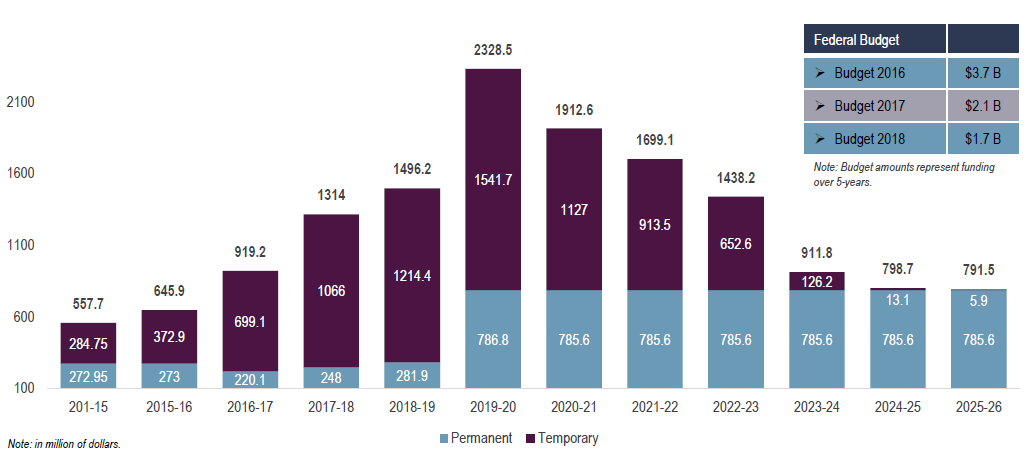
Text version
| Year | Permanent | Temporary | Total |
|---|---|---|---|
| 2014-15 | $272.95 M | $284.75 M | $557.7 M |
| 2015-16 | $273 M | $372.9 M | $645.9 M |
| 2016-17 | $220.1 M | $699.1 M | $919.2 M |
| 2017-18 | $248 M | $1066 M | $1314 M |
| 2018-19 | $281.9 M | $1214.4 M | $1496.2 M |
| 2019-20 | $786.8 M | $1541.7 M | $2328.5 M |
| 2020-21 | $785.6 M | $1127 M | $1912.6 M |
| 2021-22 | $785.6 M | $913.5 M | $1699.1 M |
| 2022-23 | $785.6 M | $652.6 M | $1438.2 M |
| 2023-24 | $785.6 M | $126.2 M | $911.8 M |
| 2024-25 | $785.6 M | $13.1 M | $798.7 M |
| 2025-26 | $785.6 M | $5.9 M | $791.5 M |
| Year | Budget |
|---|---|
| Budget 2016 | $3.7 B |
| Budget 2017 | $2.1 B |
| Budget 2018 | $1.7 B |
Note: Budget amounts represent funding over 5 years.
- ISED's permanent budget has long remained below $275M. This budget now stands at $786M as a result of funding received permanently during the last three Federal Budgets.
- Over 2/3 of the budget is already committed.
Note: excludes statutory.
Overview of ISED's respendable revenues
ISED has the authority to re-spend collected revenues to defray the related expenditures of a specific activity or service. This authority is granted annually by Parliament.
In 2019-20, the department's respendable revenue authority totals $319.5M

Text version
| Activities and services | Respendable revenue |
|---|---|
| Bankruptcy & Insolvency | $43.6 M |
| Corporations Canada | $10.1 M |
| Competition Bureau | $15.1 M |
| Communications Research Centre | $12.5 M |
| Internal Support Services to OGDs | $36.0 M |
| Canadian Intellectual Property Office | $202.2 M |
- Bankruptcy & Insolvency (100%)
- Corporations Canada (100%)
- Competition Bureau, for mergers (31%)
- Communications Research Center, for research and campus tenants
- Internal Support Services to OGDs, mostly IT services (100%)
- Canadian Intellectual Property Office (100%)
Overview of ISED's non-respendable revenues
ISED is an important contributor to the Consolidated Revenue Fund (CRF)
There are various sources of revenues generated by ISED:
- Spectrum auction revenues.
- Receipts from repayable contribution agreements in the benefit phase:
- Defence Industry Productivity Program (DIPP)
- Technology Partnership Canada (TPC)
- Strategic Aerospace and Defence (SADI) Initiative
- Other legacy programs
- Spectrum Management revenues from radio and spectrum licences.
- Canada Small Business Financing Program (CSBFA) registration and administration fees.
- Other revenues for Intellectual Property licences and royalties, fines, miscellaneous fees and return on investment (BDC dividends).

Text version
| Source | 2016-17 | 2017-18 | 2018-19 | 2019-20 |
|---|---|---|---|---|
| Spectrum Management | $285 M | $288 M | $285 M | $285 M |
| Legacy Programs | $365 M | $352 M | $392 M | $133 M |
| Spectrum Auctions | $836 M | $835 M | $741 M | $420 M |
| CSBFA | $50 M | $61 M | $61 M | $61 M |
| Others | $125 M | $69 M | $133 M | $74 M |
Governance at ISED
Overview
ISED's governance committees have been established to guide policy decisions as well as to provide corporate oversight. These committees have remained flexible as the ISED portfolio has expanded over the last mandate. Although the central anchor Committee at ISED is the Departmental Management Committee (DMC), an additional Portfolio Heads Committee has been established. This Committee is chaired by the DM of ISED, and is scheduled as required with the portfolio heads, and provides an opportunity to encourage horizontal information flow as well as to discuss the ongoing implementation of the Innovation and Skills Plan and broad issues of interest to the portfolio. The Senior ADM of the Strategic and Innovation Policy Sector also holds weekly calls with her RDA counterparts to ensure policy cohesion across the regional footprint of the ISED portfolio.
The other internal Committees that act as feeders to the broader issues-based DMC have increasingly focused areas of interest, be they policy, management, evaluation, or program-based. These Committees act as important fora for senior managers at ISED to discuss departmental initiatives, programs, and investment decisions; they provide an opportunity for frank discussion around oversight, guidance and strategic advice, as well as the larger questions surrounding the policy and corporate directions the Department will follow.
These Committees are designed around the decision-making processes they support, and are therefore designed to be adaptable to the changing nature of Departmental requirements and structure. We look forward to tailoring these governance structures to meet your needs.
Departmental Management Committee (DMC)
DMC is the senior decision-making committee in the department, and its objective is to advance the ISED mandate and priorities by ensuring the Department has an effective, coherent suite of policies, programs and management practices in place.
DMC is primarily an open Committee, except when the Chair (ISED DM) chooses to hold in camera sessions. The Committee often invites guest speakers who provide insight and knowledge on a range of issues pertinent to the mandate, such as micro and macroeconomic trends, REDACTED, and long-term economic impacts of social and technological changes.
DMC ensures that ISED's priorities, plans, projects, initiatives, activities and resources are well- integrated and align with Government priorities, while equipping Senior management with the information they need to enact the Committee decisions within their own organizations.
DMC meets weekly, and is supported by a number of other committees, including:
1. Resource Management Committee (RMC)
RMC, chaired by the Associate DM, is the senior management Committee at ISED principally occupied with corporate stewardship. This Committee is responsible for oversight on investments and resource allocation.
RMC is supported by the Investment Oversight Committee (IOC) and the Digital Services Oversight Committee (DSOC). The IOC is chaired by the CFO and is responsible for providing assurance that proposals for large investments, via financial assistance programs, major purchases or large projects, represent a sound use of resources for the Department. DSOC is chaired by the Associate DM and provides strategic advice and recommendations to ensure that ISED's digital improvement initiatives are coordinated and departmental services leverage digital technologies.
2. Director General Policy Committee (DGPC)
DGPC is responsible for informing DMC policy discussions and supporting sound decision-making to ensure that ISED has a coherent policy agenda and well-designed policies, programs and services. To achieve this objective, DGPC is mandated to discuss, provide guidance, and develop ideas and options on the policy agenda prior to review by the DMC.
DGPC provides a forum to ensure that policy initiatives benefit from consultation and collaboration, and are consistent with the Department's overall policy agenda. DGPC serves as the discussion forum for departmental exercises that feed into the Federal Budget, Speech from the Throne, medium term planning and transition efforts. Further, it maintains a linkage to the Department's research agenda to ensure alignment of policy and research priorities.
3. Director General Management Advisory Committee (DGMAC)
DGMAC is responsible for reviewing and providing recommendations on corporate strategies, policies, plans and initiatives affecting the management of the Department and the stewardship of its resources – its people, finances, information, systems, services and assets – prior to their review by the Departmental Management Committee.
DGPC partners with DGMAC via joint meetings and other mechanisms to ensure ongoing alignment of the policy and management agendas. The Chairs are members of both committees, and are permanent observers of the Departmental Management Committee.
4. Corporate and ad hoc committees
Alongside these oversight and guidance committees, ISED has a suite of corporate committees, at all levels of management, designed to support our corporate, HR, evaluation and service delivery strategies, as is common practice for most federal government departments. These Committees include:
- Corporate Services Network
- Departmental Audit Committee
- Labour-Management Consultation Committees
- Performance Measurement and Evaluation Committee (PMEC)
- Litigation Committee
There also exists a number of ad hoc committees designed to either support ISED-specific functions and structures (i.e., Regulators Table, RDA Committee, Portfolio Heads) or our employees throughout their career at ISED, such as InterConnex (for young professionals), the ISED Inclusiveness Committee, the Managers' Community, and the Mental Health Network.
ISED governance structure

Proposed stakeholder engagement plan
Overview
Advancing ISED's mandate is based on a partnership-driven approach, engaging widely with stakeholders across the innovation continuum to better understand the challenges that businesses and innovators face and in developing solutions (and buy-in) to address them. This approach includes: playing a convening role across government on key horizontal priorities; regular engagement with key stakeholders at both the Departmental and Ministerial level; participation in key international fora and events; collaboration with P/Ts; national consultations on innovation and digital frameworks; and business-led solutions such as Superclusters and Economic Strategy Tables to build ecosystems and partner with business on advancing Canada's competitiveness.
Please find below some suggested early engagements for you in the first few months of your mandate. ISED officials are available to support you as required with stakeholder engagement and provide further recommendations on key early outreach.
| Timing | Activity | Purpose |
|---|---|---|
| Early September |
|
Introduction meetings with your management team, employees, and portfolio colleagues. Regular governance meetings which you may wish to continue include:
|
| Beginning in September |
|
Introduction meetings with key stakeholders and to provide an opportunity for engagement on MTP thinking. Could be individual meetings with Presidents or roundtable style meetings. Other interested DMs could also be invited to join discussions. |
| Beginning in September | REDACTED | Introduction meetings with key stakeholders and to provide an opportunity for engagement on MTP thinking. Could be individual meetings or roundtable style meetings with CEOs/ Chairs/ DMs. |
| September 23-25 | REDACTED | REDACTED |
| September and October (and beyond) | REDACTED |
Weekly meetings would provide the opportunity for regular MTP/transition engagements with the ISED management team, as well as planning to support an incoming government. Key external speakers could be invited to stimulate thinking. A forward agenda and list of speakers can be provided under separate cover. |
| Fall |
Possible meetings with key stakeholders, for example:
|
Introduction meetings with key stakeholders and to provide an opportunity for engagement on MTP thinking. Could be individual meetings with Presidents or roundtable style meetings. A comprehensive list can be provided under a separate cover. |
| October | DM Committee of Economic Trends and Policies (you co-chair this table with JF Tremblay) | Opportunity for engagement with DM community on key economic priority areas. Forward agenda to follow under separate cover. Meetings normally held every two months, about six annually. |
| November and December |
Possible DM international engagements:
|
REDACTED |
| November and December | REDACTED | REDACTED |
| Early 2020 | Regional visits | ISED's five regional offices and RDA portfolio partners can develop regional agendas for engagement with key organizations/stakeholders. |
| 2020 | Key International and Domestic Events |
A list of key domestic and international engagement and speaking opportunities can be provided separately. For example:
|
Suggested readings
Government of Canada reports
- Building a Nation of Innovators
https://www.ic.gc.ca/eic/site/062.nsf/eng/h_00105.html - Canada's Digital Charter: Trust in a digital world
https://www.ic.gc.ca/eic/site/062.nsf/eng/h_00108.html - High-Speed Access for All : Canada's Connectivity Strategy
https://www.ic.gc.ca/eic/site/139.nsf/eng/h_00002.html - Tracking Progress and Results Portal: The Innovation and Skills Plan
https://www.ic.gc.ca/eic/site/062.nsf/eng/h_00083.html - Report from Canada's Economic Strategy Tables: Seizing opportunities for growth
https://www.ic.gc.ca/eic/site/098.nsf/eng/00027.html - SME Profile: Canadian Start-Ups — A perspective based upon the 2014 Survey on Financing and Growth of Small and Medium Enterprises, September 2018
http://www.ic.gc.ca/eic/site/061.nsf/eng/home - Canada's Fundamental Science Review Report (Naylor Report)
http://www.sciencereview.ca/eic/site/059.nsf/vwapj/ScienceReview_April2017-rv.pdf/$file/ScienceReview_April2017-rv.pdf
External reports
- OECD Going Digital Project – Going Digital: Shaping Policies, Improving Lives
Organisation for Economic Co-operation and Development, 2019
https://www.oecd.org/going-digital/going-digital-shaping-policies-improving-lives- 9789264312012-en.htm - The Return of the Policy that Shall Not Be Named: Principles of Industrial Policy
International Monetary Fund, 2019
https://www.imf.org/~/media/Files/Publications/WP/2019/WPIEA2019074.ashx - Twenty-five years of digitization: Ten insights into how to play it right
McKinsey Global Institute, 2019
https://www.mckinsey.com/~/media/mckinsey/business%20functions/mckinsey%20digital/our% 20insights/twenty- five%20years%20of%20digitization%20ten%20insights%20into%20how%20to%20play%20it%2 0right/mgi-briefing-note-twenty-five-years-of-digitization-may-2019.ashx - Science Culture: Where Canada Stands
Council of Canadian Academies, 2014
https://cca-reports.ca/wp-content/uploads/2019/05/FullReport-Science-Culture.pdf - Competing in a Global Innovation Economy: The Current State of R&D in Canada
Council of Canadian Academies, 2018
https://cca-reports.ca/wp- content/uploads/2018/09/Competing_in_a_Global_Innovation_Economy_FullReport_EN.pdf - A New North Star Canadian Competitiveness in an Intangibles Economy
Public Policy Forum, 2019
https://ppforum.ca/publications/a-new-north-star/ - The Competitive Edge: A Policymaker's Guide to Developing a National Strategy
Information Technology and Innovation Foundation, 2017
https://itif.org/publications/2017/12/06/competitive-edge-policymakers-guide-national-strategy - Globalization in transition: The future of trade and value chains
McKinsey Global Institute, 2019
https://www.mckinsey.com/featured-insights/innovation-and-growth/globalization-in-transition- the-future-of-trade-and-value-chains - Rebooting Canada's competition regime for the digital economy
Mowat Centre, 2019
https://munkschool.utoronto.ca/mowatcentre/new-rules-for-the- game/?utm_source=Mowat+News&utm_campaign=257427e87c-EMAIL_CAMPAIGN_2019_05_21_07_00&utm_medium=email&utm_term=0_03ce814c86-257427e87c-417529409 - A Failure to Scale: Are we Creating Financially Unattractive Companies?
Impact Centre, University of Toronto, 2017
https://www.impactcentre.ca/wp-content/uploads/2015/05/Velocity-Impact-Brief.pdf
Selection of ISED research papers
Full versions are available upon request.
Innovation excellence and program assessments
- Firm Economic Performance and Assistance from the Centres of Excellence for Commercialization and Research Program (CECR) by Ryan Kelly ISED. Summary published in CECR Evaluation Final Report (NSERC 2018).
The CECR program is designed to help firms commercialize innovation by providing access to research expertise and equipment, building regional clusters, mentorship, and financial support. The program has been popular with over 20 active centres offering varying forms of assistance to different types of firms. This research assessed whether the assistance from the CECR program is associated with stronger economic performance, and whether these potential performance premiums vary by centre. Results suggest that, on the short term, firms assisted by a Centre within the CECR program achieve faster growth, and are able to maintain a stronger focus on R&D. These results are consistent with CECR-assisted firms having better commercialization performance relative to otherwise similar firms. While the results suggest that CECR-assisted firms significantly outperform otherwise similar firms, much of the difference is driven by the poor performance of the control group as opposed to a strong performance by CECR-assisted firms. Finally no statistically significant differences were found across different types of CECR centres, for instance, no differences were seen when comparing Centres that focus on different technologies, or that operate under different business models. - Innovation Performance of Angel-Backed Firms: Evidence From A Tax-Credit Program by Ryan Kelly and Hankook Kim, ISED (forthcoming, Nov 2019)
As part of the financing ecosystem for innovative start-ups, angel financing plays a critical role in bridging the financing gap at the very early part of the firm growth cycle by helping firms to develop and refine their new technologies before being viable for venture capital investment. Using a newly constructed dataset linking angel investment information from a tax-credit program in British Columbia to Statistics Canada datasets, we estimate the impact of angel investment on firm performance (compared to a control group that mirrors the angel-backed firms). Our results show the angel-backed firms experience significantly higher growth rates in performance metrics related to innovation such as research and development (R&D) expenditures and wages than their non- angel-backed counterparts. Further, we find that angel investors target innovation-oriented firms with nearly 60% of the angel-backed firms being R&D performers at the time of the investment. In metrics related to firm size such as employment, sales and gross profits, our results similarly show the angel-backed firms experience higher growth rates than those that are not angel-backed. Overall, we provide empirical evidence highlighting the role angel investors play not only in financing operations, but also in shaping the innovation performance of young start-ups. - Direct and Indirect Support to Business R&D by Charles Bérubé and Pierre Therrien, ISED (forthcoming, Nov 2019)
While there is a considerable amount of international experience with direct and indirect support to business R&D, few studies directly compare these two instruments. Using a matching procedure, this paper provides evidence that, after controlling for total federal amount of R&D financial support, firms receiving both direct and indirect government support perform better than the control group of firms receiving only indirect support. In particular, three and five years after receiving the support, growth of employment, R&D employment, sales, profit and wages were significantly higher for firms using both instruments. Those firms were also significantly more innovative than their counterparts. With the current low direct government R&D support to business (when compared internationally) and the additional positive economic and innovation performance when firms uses both direct and indirect government R&D support, our results support a stepwise approach to gradually increase the level of direct R&D support available.
Trade, productivity and competitiveness
- Canada's Exporters and Importers: Concentration, Foreign Ownership, and Productivity by Ram Acharya, ISED (published in Canadian Public Policy 2016, Vanderkamp Prize for the best article in 2016 in Canadian Public Policy)
Using firm level data in Canada from 2002 to 2007, I show that trade is highly concentrated, much more than employment. Firms that both export and import are more productive than firms that only export, which are more productive than firms that only import. Foreign-controlled firms are larger, export more per employee, and have higher productivity compared to Canadian-controlled counterparts. The intensity of global value chains is higher for firms that are smaller, have higher numbers of export products and export partner countries, and are under foreign control. The role of new products and new firms is falling for Canada's exporter. - Multinationals and Offshoring: Firm-level Evidence from Canada by Jianmin Tang, ISED, and Ari Van-Assche, HEC Montréal (published in Canadian Public Policy in 2017)
Multinational enterprises (MNEs) have long been recognized as important pillars of Canada's national economy, accounting for the majority of its exports and an important share of its employment. At the same time, there is a widespread perception that MNEs are less rooted in the local economy and are thus more likely to conduct offshoring. In this study, we investigate the latter claim by combining various Canadian firm-level data sets. We find that MNEs (both Canadian and foreign headquartered) are indeed more likely to offshore but suggest that it is not necessarily because they are less rooted in the Canadian economy. We also show different associations between offshoring and firm characteristics (including productivity) depending on the type of offshoring (e.g., intrafirm or interfirm offshoring) and the type of business activity offshored (e.g., certain types of service vs. goods production).
Firm growth and business dynamism
- Dynamic Productivity Profiles of Entrants and Exits: Evidence from Canadian Manufacturing by Huju Liu, Statistics Canada, and Jianmin Tang, ISED (published in Structural Change and Economic Dynamics, 2018)
This paper aims to better understand the productivity dynamics of entrants and exits as well as the factors associated with their productivity performance. In terms of labour productivity, our results show that entrants are still less productive and less efficient after eight years compared to incumbents, but the productivity gap gradually shrinks from 23 percent the year they entered the market to 14 percent after eight years. After controlling for capital intensity and size, new entrants become as efficient as continuing firms at year six and become even more efficient at year eight. Given that most new entrants are still in the SME category six years after entering the market, we interpret the results as the time it took for new entrants to build their capital and to establish as effective competitors to incumbents. The paper also shows that these new entrants can further strengthen their productivity performance by starting or increasing exporting. Exits, on the other hand, are found to be less productive than continuing plants even after controlling for capital intensity, size, export and foreign-ownership, and the gap becomes larger as they get closer to exit. - Product Positioning, Cost Leadership and Firm Economic Performance: Canadian Micro Evidence by Jianmin Tang, ISED, and Zhan Su, Laval University (published in Journal of Centrum Cathedra, 2018)
It has been suggested that to be successful in the current global economy with increased competition and ever changing markets, especially in the post-crisis context, firms need to focus more on innovation in exploring new ideas and designing new products to develop new markets than on cost-cutting strategies to maintain cost leadership in old markets. However, because of the lack of micro data, this conjecture has not been systematically evaluated. This paper aims to fill this important void by studying the economic performance associated with these two different business strategies using Canadian micro data. The research shows that while firms focusing on product innovation are indeed more productive than firms focusing on cost leadership, no difference between the two strategies are seen on profitability measure. - The Fragmentation of Business Activities in Global Value Chains as a Source of Performance for Canadian Enterprises by Julio Rosa, Statistics Canada and Stéphane Jetté, ISED (forthcoming, Nov 2019)
In the context of accelerating world economic integration, enterprises are pressured to engage in more extramural interactions. Hence, enterprises become integrated into value chains that go beyond traditional supply chains. Although there might be a productivity advantage to participate in global value chains (GVC), little is known about the resulting fragmentation effects of business activities on innovation and labour productivity. Using data from the Canadian Survey of Innovation and Business Strategy, it is possible to identify the nature of the GVC activity, i.e., insourcing versus outsourcing activities, activity location (Canada versus abroad), and the functional nature of the activity (production versus support performed abroad). The main result shows that enterprises participating in GVCs are more productive and innovative than non-GVC participants. - Industrial Structure Change and the Widening Canada-U.S. Labour Productivity Gap in the Post-2000 Period by Jianmin Tang, ISED (published in Industrial and Corporate Change 2017)
Canada's deterioration in labour productivity performance in the post-2000 period, especially relative to the United States, has been a major concern for policy makers. From an industrial structure perspective, this paper shows that the faster loss of the manufacturing base in Canada than in the United States and the deterioration in the productivity performance of Canadian large manufacturing firms relative to their U.S. counterparts were the main factors associated with the widening Canada-U.S. labour productivity gap in the post-2000 period. - Exchange Rate as a Determinant of FDI Inflow: Does it Really Matter? Evidence in Canada by Malick Souare, ISED (Bulletin of Economic Research, 2019)
Over the past decades, a striking feature of increased international economic integration has been the growth in foreign direct investment (FDI). One of the many influences on inward FDI activity is the behavior of exchange rates, whose role as a potential determinant of FDI inflows has often been overlooked. This paper first briefly reviews some prevailing theories and empirical evidence on the impacts of both the exchange rate level and volatility on inward foreign investment. Then, using Canadian industry-level panel data, it contributes to the literature by investigating the role of the exchange rate (level, volatility and trend), along with other relevant factors, in attracting inward FDI. The paper finds that, in contrast to the conventional wisdom, dollar appreciations resulted in greater foreign investment into the country. In addition, exchange rate volatility is found to be detrimental to inward FDI. Finally, the quality of the labour force, differentials in labour productivity and costs, and product market regulatory reforms (aimed at enhancing competition) are other significant determinants of inward FDI.
Section 2: moving the mandate
Building a nation of innovators: present and future
Overview
ISED is working toward building a nation of innovators and has made great strides on the ambitious Innovation and Skills Plan, which focuses on:
- People and Skills;
- Building Ecosystems – Science, Technology, and Superclusters;
- Investment, Scale-up, and Growing Companies; and,
- Program Simplification and Reorganization
Background
Through the Innovation and Skills Plan, the Government has taken significant action to position Canada as a world-leader in a changing innovation-driven economy. This partnership approach has put the country on track to become one of the world's most innovative and competitive economies. Over the Government's mandate, the plan has received strong support and is beginning to demonstrate meaningful results. However, innovation is an ongoing journey, and to achieve enduring success, we will need to continue to build on these accomplishments and improve our global competitiveness.
This Plan recognizes that innovation and skills as the core drivers of economic growth and rising standards of living for all. Announced in Budget 2017, the Plan represents the most significant redesign of federal programs to support business throughout the innovation ecosystem. This ecosystem approach emphasizes greater collaboration and strong partnerships between firms, academics and other partners to create a culture of innovation. Collectively, we are bridging the gap from idea, to commercialization, to investment and scale-up.
Key developments
- Since 2016, ISED directed the development of an integrated, whole-of-government plan for Canada. Previously, the traditional course had been to ensure a strong macro- economic framework to promote innovation whereas the redesign is a balance of indirect and direct supports.
- The Plan focuses on ecosystems and the benefits that they create, targeting and tailoring our programming to specific sectors in high-growth areas and aiding firms at different stages of growth and needs.
- Through investments such as the Strategic Innovation Fund, the Industrial Research Assistance Program, and Regional Development Agencies, the Plan takes a client-centric approach to working with firms at every stage of growth to help start-ups and SMEs grow into global leaders. Innovation Canada's digital platform furthers this approach by offering a timely, 'one-stop shop' to match businesses with our programs and services.
- The Superclusters are accelerating the development of large-scale business-led innovation. The initiative encourages industry-driven R&D activities, pools access to leading research, and links larger firms with innovative companies to help them scale-up, attract investment, and create globally competitive hubs.
- Drawing from the recommendations from the Economic Strategy Tables, an industry-led forum to drive Canadian innovation and competitiveness. The recent budget contained significant announcements related to the Tables' reports including a Regulatory Competitiveness Council, an accelerated investment incentive, and high-speed internet access for all.
- Ensuring that businesses have the right pipeline of talent to succeed starts with equipping Canadians with the right tools, skills and experience, and through the establishment of reliable access to global talent. The Plan greatly increased the number of work-integrated learning placements for young Canadians and launched (and then made permanent) the Global Talent Stream to help innovative companies grow, flourish, and create more jobs for Canadians.
Looking ahead
A focus on a data-driven, digital economy will be important to continue to push the boundaries of innovation and spur Canada's economic growth. We heard clearly during the National Digital and Data Consultations last year on how together we can drive innovation, prepare Canadians for the future of work, and ensure they have trust and confidence in how their data is used. Launched in May of this year, the Digital Charter is to guide our whole-of-government approach to building an innovative, people-centred, and inclusive digital economy.
Finally, space exploration represents the very essence of innovation. It inspires all of us to push the limits of what is possible and makes Canadians proud of what we can achieve. The National Space Strategy was launched in March 2019, and together with an investment of $2.05B, we will support future generations of innovators and explorers, and ensure that Canadians are well-positioned to lead in the jobs and industries of tomorrow.
Growing Canadian competitiveness: suite of innovation programming
Canada is competing in a global innovation race
Other countries are focusing on innovation

The Innovation and Skills Plan

Innovation Canada: Comprehensive support for innovation
Innovation Canada overview:
- Created in June 2017 to re-align federal innovation supports and streamline the innovation programming available to Canadian entrepreneurs
- Established as a major redesign of Canada's federal innovation policy and program landscape, representing a significant shift in the delivery of innovation funds
- Client-centred single-window service allowing businesses to easily access federal support
- Acts as the catalyst for building dynamic private-public R&D partnerships
Innovation Canada includes the following programs and initiatives:
- Innovation Superclusters Initiative (ISI)
- Strategic Innovation Fund (SIF)
- Innovative Solutions Canada (ISC)
- Accelerated Growth Service (AGS)
- Innovation Advisors
- Innovation Canada Portal (innovation.canada.ca)
- BizPaL
- Clean Growth Hub (CGH)
The Innovation Canada continuum
Innovation Canada is made up of programs and services that cover a range of innovation activities

Innovation Canada connects partners from across the federal innovation ecosystem to align policy development, program implementation and performance measurement
Innovation Canada & OGDS

Innovation Superclusters Initiative (ISI)
- ISI aims to accelerate the growth and development of large-scale business-led innovation superclusters, building upon Canadian strength, leading to new opportunities for growth
- A $950 million investment in 5 business-led superclusters aimed at creating jobs, advancing research, and building Canada's innovation economy through collaboration of large anchor firms, start-ups, SMEs, post-secondary institutions, and research & government partners:
- Digital Technology Supercluster
- Protein Industries Supercluster
- Advanced Manufacturing Supercluster
- AI-Powered Supply Chains Supercluster – SCALE.AI
- Ocean Supercluster
$50B and 50,000 jobs to be added to Canada's economy over 10 years
13 projects announced to date:
- Digital Technology: 7
- Protein Industries: 1
- SCALE.AI: 4
- Ocean: 1
These projects leverage $63M in ISI and industry investments, and engage:
As of July 18, 2019:
- 32 SMEs
- 19 large firms
- 10 post-secondary institutions
"We are already seeing companies coming together to work on truly transformative technology projects and develop new programs for digital skills in manufacturing — initiatives that have taken off just by introducing businesses to one another. The power of connecting entrepreneurs across industries and technologies is truly remarkable."
Canada's Five Superclusters
Digital Technology
British Columbia (500+ participants)
$153M
Virtual, mixed and augmented reality, data collection and analytics, quantum computing, and genomics and precision health.
Impact:
- $5B GDP over 10 years
- 13,500 jobs
AI-Powered Supply Chains (SCALE.AI)
Quebec (110+ participants)
$230M
Artificial intelligence and supply chain technology.
Impact
- $16.5B GDP over 10 years
- 16,000 jobs
Protein Industries
Prairie provinces (100+ participants)
$153M
Agri-food enabling technologies, including genomics, processing, and IT.
Impact
- $4.5B GDP over 10 years
- 4,500 jobs
Ocean
Atlantic Canada (110+ participants)
$153M
Digital sensors and monitoring, autonomous marine vehicles, energy generation, automation, marine biotechnology and engineering tech.
Impact
- $14B GDP over 10 years
- 3,000 jobs
Advanced Manufacturing
Ontario (130+ participants)
$230M
Internet of Things, machine learning, cybersecurity, additive manufacturing (3D printing).
Impact
- $13.5B GDP over10 years
- 13,500 jobs
Outcomes
- Expected to add 50,000+ jobs and $50B to Canada's economy over next 10 years
- Up to $950M over five years for selected industry-led innovation superclusters
- Industry partners match program contributions dollar for dollar
- Building innovation ecosystems
- Creating new pools of talent
- Attracting anchor firms and international investment
- Conducting multidisciplinary research
- Connecting SMEs to larger firms, integrating value chains
Strategic Innovation Fund (SIF)
Supports innovation projects across all industrial and technology sectors with the aim of establishing Canada as a top destination for businesses to invest, grow and create jobs and prosperity for Canadians
As of July 17, 2019:
- 54 projects worth $1.7B, representing a total investment of $42B
- 60,000+ jobs created or maintained
- $7.5B in secured R&D commitments
- 45% of SIF projects are direct investments in SMEs
- 9.2k committed co-op opportunities (June 19, 2019)
5 different program streams:
- Support R&D. Accelerates commercialization of new products processes and services.
- Facilitate scale up. Anchors and aids in expanding innovative firms in Canada.
- Investment attraction. Attracts and retains large scale investments into Canada.
- Tackle grand innovation challenges. Competitive calls for collaborative industrial R&D and tech demo projects.
- Support to national ecosystems. Invest in strategic, high impact collaborations in areas of Canadian advantage.
SIF success story: Ranovus Inc., Ottawa
- High-growth SME developing cutting-edge energy & connectivity solutions for data centres, that will double data processing capacity while significantly reducing its environmental impact.
- $20M SIF contribution towards a $50M project.
- Ranovus will grow from 34 employees to approximately 600.
Innovative Solutions Canada
Innovative Solutions Canada (ISC) is an R&D program that leverages procurement to support the growth and scale-up of Canadian companies, and positions the Government of Canada as a first customer
Challenge Stream:
Facilitates development of early stage R&D with the potential to address specific challenges identified by federal departments/agencies, as well as marketplace gaps associated with government priorities ($113M annual budget)
- 45 challenges released since program launch
- 40 proof of concept contracts awarded ($150k each)
- 1 proto-type contract awarded ($1M)
- $57.6M in committed challenge funding
Testing Stream:
Facilitates testing of a wide range of late stage R&D associated with government priorities and specific operational requirements ($40M annual budget)
- 409 contracts awarded
- $176M total value of contracts
- 80% commercialization rate for firms
- 36 testing departments
Calls for proposals issued under both streams of the program will be accessible through a digital single window
Challenge Stream success story: CEM Works Inc., Winnipeg
- Developing new technology to make connected vehicles safer in a 5G environment
- Received a $150K grant to develop a proof of concept of its solution
- First company under ISC to receive $1M grant to develop a working proto-type
Testing Stream success story: Sensequake, Montréal
- Development of the 3D-SAM™ seismic sensing system with Natural Resources Canada, Transport Canada and Public Services and Procurement Canada
- Received a $645K ISC contract for testing at 6 laboratory and research buildings in Ontario and British Columbia
- Program participation led to $1.1M in follow-on commercial sales and the creation of 10 STEM jobs
Accelerated Growth Service (AGS)
Provides high-growth firms with single-window access to government programs and services, and assistance from a dedicated team built based on their needs
Led by ISED and jointly-delivered with BDC, EDC, Trade Commissioner Service, NRC-IRAP, regional development agencies and other partners
AGS's clients access a dedicated advisor and a customized plan of programs/ services to address their needs, such as financing, exporting, innovation, and business advice
As of July 4, 2019:
- 547+ high-growth firms served
- $440M in funding unlocked
- 4,040+ services provided
- 40+ external partners
- 30+ Innovation Advisors expected by end of fiscal year
- Over 500 companies served are SMEs
AGS targets Canadian firms with the following characteristics:
- annual revenues of $5 million or more
- a strong management team and a history of growth
- a unique value proposition with a focus on export markets and innovation
AGS success story: LuminULtra, New-Brunswick
Biotech SME that developed & commercialized a DNA-based water quality test. AGS helped bring the commercial solution to market here, and export it to other markets where access to safe water is most needed
"It's not just financial support, but also solid advice, internal expertise and tech savvy that really propelled us forward."
Innovation Advisor service
Expert Innovation Advisors across Canada provide high-potential firms with the assistance needed to make the right connections to move their growth objectives forward
Whether SMEs are creating a new innovative product, process or service, an Innovation Advisor can help them find funding, expertise, facilities and global opportunities
The Service provides free, one-on-one assistance over the phone or in-person and leverages Advisors' industry experience, extensive networks and knowledge to advise clients and guide them to the right connections, programs and services
As of March 30, 2019:
- Nearly 3800 innovative SMEs served across Canada
- Businesses receive a response within 2 business days
- 30+ Innovation Advisors expected by end of fiscal year
Innovation Advisor success story: Hortau, Lévis QC
Agriculture technology SME that developed & commercialized an irrigation control solution to maximize production of high-revenue, sensitive crops, like cranberries
An Innovation Advisor assessed Hortau's needs, building on their success with NRC-IRAP to help them access $5.9 million from Sustainable Development Technology Canada to take their technology and their business to the next level
Innovation.canada.ca
The Innovation Canada portal provides users with a tailored list of business supports including grants, contributions, advisory services, loans & guarantees, and more in less than 2 minutes
Canadian firms working on R&D projects can access a tailored list of government services and programs relevant to their enterprises and be provided with regional and sector specific guidance
New feature allows for innovators to create a business account & receive service notifications
Aimed at improving ease-of-access to business supports & freeing up time for firms to focus on growth and innovation
As of July 4, 2019:
- 1M+ visits since launch (January 2018)
- 1,960 average daily users
- AI integrated to enhance program matching (June 2018)
- 1,300+ government programs & services filtered based on innovator needs
- 50.5% of total visits, associated with companies with less than 100 employees
"#InnovationCanada tool long-time @CdnChamberofCom ask. Big step forward for entrepreneurs seeking one-stop info re gov't support."
BizPaL
A unique collaboration across all levels of government supporting entrepreneurs in finding the required permits and licenses to start and grow their businesses
Collaborative decision-making taken by a steering committee formed of a representative from the federal government, all 13 provinces and territories, one municipality and one First Nation
Includes 1,075 partners from the federal government, all provinces and territories, 1,057 municipalities, and 4 First Nations, including all affiliated departments and ministries
2019 improvements include enhanced search results and formatting for a quicker andmore refined user experience
As of July 4, 2019:
- 497,945 unique visits (2018-2019)
- ≈150,000 permit and licence searches (2018-2019)
- $13M+ saved to businesses (2018-2019)
- 15,000+ permits & licences from all levels of government
- 80% of Canadian population served by BizPaL
"The BizPaL tool will make it easier for small businesses… to access the information they need from all levels of government. As a small business owner, I know how challenging it can be to navigate permit requirements and processes, and BizPaL walks you through it step by step. I'm really pleased that we're now able to offer this service to our community."
Clean Growth Hub (CGH)
Whole-of-government focal point for clean technology focused on supporting companies and projects, coordinating programs and tracking results
Jointly led by ISED and Natural Resources Canada, the Hub's team of experts from across government helps clean technology developers and adopters identify the federal programs and services most relevant to their needs
Under the Clean Technology Data Strategy, the Hub works to enhance federal program coordination and strengthens federal capacity to track clean technology outcomes
Enables systematic information sharing and intergovernmental collaboration with 2 MOUs with the Province of B.C. and Western Economic Diversification
- 1,150+ clients since program launch
- $133M incremental clean technology investments unlocked through project off-ramping
- 78% of businesses accessing services are SMEs
- 73% of surveyed clients followed up on Hub service advice
- 16 participating departments and agencies
- 60+ outreach events
As of July 4, 2019
Success story: Siemens – NB & NS Power Smart Grid
CGH initiated discussions with multiple federal partners to share information and understand strategic benefits of a complex project led by Siemens
The $92.7M project received $35M from SIF and NRCan, supporting up to 241 highly skilled jobs
Project will improve power delivery to communities, better integrate renewable energy into the power grid and reduce future electricity costs for consumers.
ExploreIP: Canada's IP Marketplace
ExploreIP is an online tool that provides access to listings of public sector-owned patents
User-friendly interface makes it easier for businesses to discover and licence new technologies
Provides public sector organizations with new opportunities for commercialization and collaboration
Expected launch date:
- Summer 2019
Economic Strategy Tables set ambitious growth targets
Advanced Manufacturing
Chair: Charles Deguire President & CEO, Kinova Robotics
Growth targets
By 2030, increase manufacturing sales by 50% - to $1 trillion
Increase manufacturing exports by 50% to $540 billion
Agri-Food
Chair: Murad Al-Katib President and CEO, AGT Food and Ingredients
Growth targets
By 2025, increase domestic sales by 27% to $140B and increase exports by 32% to $85B
Clean Technologies
Chair: Audrey Mascarenhas President and CEO, Questor Technology Inc
Growth target
By 2025, Clean technology is one of Canada's top 5 exporting industries, nearly tripling current value to $20B annually
Digital Industries
Chair: Tobias Lütke Founder & CEO, Shopify
Growth target
By 2025, double the number of Canadian digital firms with more than $1B in market capitalization to 26
Health and Biosciences
Chair: Karimah Es Sabar CEO & Partner, Quark Venture
Growth target
By 2025, double exports to $26B double total firms to 1,800 double high-growth firms to 80
Resources of the Future
Chair: Lorraine Mitchelmore Former President & Country Chair, Shell
Growth target
By 2025, grow annual resource exports by $100B to $350B
Support for Economic Strategy Tables recommendations
The Fall Economic Statements and Budget 2019 contained significant announcements related to the Tables' reports
Addressed:
- Regulatory Competitiveness Council
- Centre for Regulatory Innovation
- Accelerated Investment Incentive
- Access to high-speed internet for all Canadians
- Expand the Strategic Innovation Fund
- Increase WIL opportunities across Canada
Areas for consideration
- Skills and talent across sectors
- Technology adoption
- Support for high-growth firms
- Digitalizing access to government services
- Modernize privacy frameworks for a digital era
- Infrastructure
Annex A: making progress on implementation
Progress on Signature Initiatives
Most talented & skilled workforce in the world
People & skills:
CanCode
- Reached 1M+ students & 53,000 teachers
Work-integrated learning
- 84,000 placements a year by 2023/24
- Mitacs -10,000 placements a year by 2021-22 – 8,000 in 2017/18, up 300% since 2014/15
Global Skills Strategy
- REDACTED
Connect to Innovate
- 192 projects selected covering 900+ communities
Develop and adopt new technologies while promoting science excellence to address global challenges
Fundamental research:
New Vision for Science
- 25% increase in support for fundamental research, benefiting 21,000 additional researchers and students a year by 2021/22
Research Infrastructure
- PSIF: 300 projects, $2B allocated, leveraging an additional $3B
- CFI: $1B+ allocated since 2015/16, leveraging an additional $2.3B; providing research tools for 17,500 researchers and 27,000 students
Applied R&D & partnerships:
Innovation Superclusters Initiative
- Agreements with all 5 have been signed; 7 projects announced; all superclusters expected to announce projects by June 2019
- Expected to add 50,000 jobs and $50B to Canada's economy over next 10 years
Intellectual Property Strategy
- Implementing measures under Canada's first-ever IP strategy
Stimulate new investments to grow world-class companies & create middle-class jobs
Commercialization & start-up:
Innovative Solutions Canada
- 42 challenges launched across 14 departments
Women Entrepreneurship Strategy BDC
- $391M loans to 5,500+ clients and $19M in investments in 24 companies
NRC-IRAP
- 11,700 projects started since 2015/16
- Total federal funding of $870M, leveraging an additional $1.4B
Scale-up & going global:
Strategic Innovation Fund
- 44 projects announced as of May 1
- $1.2B allocated to date, leveraging an additional $15.3B
- Expected to create or maintain over 56,000 jobs
RDAs
- $2.2B allocated since 2015-16 for 5000+ projects, leveraging an additional $6.2B
VCCI ($450M)
- Investing in 5 Stream 1 VC funds-of-funds, 7 Stream 2 VC Funds and up to 3 Stream 3 cleantech VC funds
Annex B:
REDACTED
Annex C: Making progress against ambitious targets
People & skills
Key initiatives:
- CanCode
- Mitacs
- Digital Skills for Youth
- Youth Employment Strategy
- Connect to Innovate
- Universal Broadband Fund
- Connecting Families
- Global Skills Strategy
- Skills Boost
Ambitious targets:
- 40% of Canadians are in professional, science and tech-related occupations by 2025
- Progress to date – 2011: 30; 2018: 34%; 2025: 40% (on track)
- Increase coding training availability for students across Canada by 2025, including to 500,000 students by 2019
- Progress to date – Mar 2017: no data; Mar 2018: 265,000; Dec 2018: 1,000,000 (surpassed)
- 100% of Canadian households are on-line by 2025
- Budget 2109 Target: All Canadians have access to 50/10 Mbps by 2030
- Progress to date – 2014: 85%; 2017: 89%; 2025: 100% (on track)
Building ecosystems
Key initiatives:
- Innovative Superclusters Initiative
- National Research Council
- Granting Agencies
- Post-Secondary Strategic Investment Fund
- Canadian Foundation for Innovation
- Digital Research Infrastructure Strategy
Ambitious targets:
- Increase Canadian businesses expenditures in R&D to $30 billion (B) by 2025
- Progress to date – 2006:$16.5B; 2015: no data; 2017: $18B; 2025: $30B (lagging)
- Double the % of companies collaborating with higher education institutes by 2025
- Progress to date – 2017: 3.2%; 2025: 6% (lagging)
Growing companies
Key initiatives:
- Innovative Solutions Canada
- Women Entrepreneurship Strategy
- Venture Capital Catalyst Initiative
- Industrial Research Assistance Program
- Regional Development Agencies
- Strategic Innovation Fund
- Trade Commissioner Service
- Innovation Canada
- Accelerated Growth Service
- Business Development Bank of Canada
- Export Development Canada
Ambitious targets:
- Double the number of high-growth firms in Canada by 2025
- Progress to date – 2011: 11,500; 2013-2015: 14.300; 2025: 28,000 (lagging)
- Double the number of SMEs majority-owned by women to 340,000 by 2025
- Progress to date – 2014: 168,000; 2017: 170,000; 2025: 340,000 (lagging)
- Grow Canadas exports by 30% by 2025
- Fall Economic Statement 2018 Target: Increase Overseas Exports by 50% by 2025
- Progress to date – 2014: $628B; 2018: $706B; 2025: $820B (on track)
- Double the value of Canada's exports of clean technologies by 2025
- Progress to date – 2007: $5.4B; 2015: $7.6B; 2017: $9.0B; 2025$15B (on track)
Note: Indicators generally lag 1-2 years due to data availability.
Canada's digital transformation
Overview
As part of the next steps of the Innovation and Skills Plan, Canada is seeking to advance its leadership in the data-driven digital economy.
In order for innovation to succeed, Canadians must be able to trust that their privacy is protected, that their data will not be misused, and that companies operating in this space communicate in a simple and straightforward manner with their users. To help build trust for Canadians, and promote innovation, ISED led in developing Canada's Digital Charter. The Charter sets out 10 principles to guide the federal government's work in the digital and data-driven economy.
In addition, ISED is leveraging international fora and other programs under the Innovation and Skills Plan to support the digital economy – such as in the field of artificial intelligence.
Background
With the exponential growth of digital technologies and the increasing capability to compute and analyze data, we are seeing transformative effects on the economy. Digital technology is changing our economy and our society: the way we access information, work, and connect with each other.
Data is now a resource that companies deploy to be more productive and to develop better products and services, unleashing a digital revolution around the world with implications for jobs, growth, and privacy.
National Digital And Data Consultations
What has become abundantly clear throughout the implementation of Innovation and Skills Plan is that digital and data-driven transformation will drive Canada's competitiveness.
While Canada has notable strengths in our people, with world-leading talent in crucial platform technologies such as AI and robotics, we are facing increasing global competition for capital investment, top-tier talent, and cutting-edge regulatory advantages.
ISED launched the cross-Canada National Digital and Data Consultations in summer 2018 to discuss these issues with Canadians. These consultations explored three important focal points:
- The future of work and how digital technologies will impact the labour market;
- Unleashing innovation and how to ensure Canadian firms are competitive, adaptable, and capable of adopting digital technologies to spur productivity; and,
- Trust and privacy, specifically how to structure frameworks to support innovation, protect privacy interests, and promote trust in the digital economy among Canadians.
Digital Charter
In response to the national consultations, ISED launched Canada's Digital Charter in May 2019. Recognizing the importance of the digital economy to our prosperity, this principles-based approach is flexible and adaptable to the rapidly evolving norms and pressures of digital transformation.
This approach balances inspiring trust and confidence in the digital economy and ecosystems among Canadians while also allowing for flexible methods of achieving this goal and giving Canadian firms the space to innovate and compete.
Staying firmly outcomes-focused and partnership-driven, this Charter will act as an evergreen reference point for an ongoing dialogue between stakeholders and Government. This will give Canadians a voice in shaping the digital and data norms that affect their lives and their industries, as well as provide a degree of certainty around how to operate within Canada's digital economy.
The Digital Charter lays out the following ten principles:
- Universal Access: All Canadians will have equal opportunity to participate in the digital world and the necessary tools to do so, including access, connectivity, literacy and skills.
- Safety and Security: Canadians will be able to rely on the integrity, authenticity and security of the services they use and should feel safe online.
- Control and Consent: Canadians will have control over what data they are sharing, who is using their personal data and for what purposes, and know that their privacy is protected.
- Transparency, Portability and Interoperability: Canadians will have clear and manageable access to their personal data and should be free to share or transfer it without undue burden.
- Open and Modern Digital Government: Canadians will be able to access modern digital services from the Government of Canada, which are secure and simple to use.
- A Level Playing Field: The Government of Canada will ensure fair competition in the online marketplace to facilitate the growth of Canadian businesses and affirm Canada's leadership on digital and data innovation, while protecting Canadian consumers from market abuses.
- Data and Digital for Good: The Government of Canada will ensure the ethical use of data to create value, promote openness and improve the lives of people—at home and around the world.
- Strong Democracy: The Government of Canada will defend freedom of expression and protect against online threats and disinformation designed to undermine the integrity of elections and democratic institutions.
- Free from Hate and Violent Extremism: Canadians can expect that digital platforms will not foster or disseminate hate, violent extremism or criminal content.
- Strong Enforcement and Real Accountability: There will be clear, meaningful penalties for violations of the laws and regulations that support these principles.
Overall, the goal of the Charter is to build a foundation of trust for Canadians in the digital sphere and provide the framework for continued Canadian leadership in the digital and data-driven economy. This will not only protect Canadians' privacy and personal data but also leverage Canada's unique talents and strengths in order to harness the power of digital transformation.
PIPEDA reform
As part of this work, ISED has launched a PIPEDAreform process via a white paper on key privacy concepts. The Government's proposals for PIPEDAreform reflect extensive consultations with Canadians and all stakeholders, as well as recommendations from Parliamentarians.
Our discussion paper contains specific proposals to expand individuals' control over data and their trust in the digital economy, enable responsible innovation, and enhance enforcement and oversight powers of the Office of the Privacy Commissioner with regard to PIPEDA. These include concepts around modernized consent requirements, transparency in automated decision-making, and improved data mobility.
At the same time, the proposals also seek to create more opportunities to responsibly use data to create new and innovative technologies and business models.
For example, the paper explores concepts such as standard business practices, enabling codes, and providing greater flexibility for data use under certain conditions.
Meaningful oversight is essential to enhancing trust and to balance opportunities for more flexible data use. That is why the paper considers options to expand the enforcement authorities of the Office of the Privacy Commissioner.
Canadian Statistics Advisory Council
Government must embrace digital and data-driven transformation too. We live in a world that is increasingly data-driven. Now more than ever, Government requires the high-quality, timely and relevant statistics produced by Statistics Canada to support evidence-based decision-making.
In June 2019, ISED announced the creation of a new Canadian Statistics Advisory Council. This council will provide the Minister of ISED and the Chief Statistician of Canada with impartial and independent advice on matters concerning the overall quality of Canada's national statistical system, in line with the principles entrenched in Canada's Digital Charter. This will help ensure both that Statistics Canada remains one of the world's top statistical agencies and that the Government is able to draw on the power of big data sets to make evidence-based decisions.
The council is chaired by Dr. Teresa Scassa, Canada Research Chair in Information Law and Policy at the University of Ottawa, and includes luminaries from academia, the private sector, and groups from across civil society.
Members will use their expertise and broad perspectives to advise on a variety of matters, including to identify emerging areas of opportunity and to address issues and challenges. The council will produce an annual report on the state of the national statistical system.
ISED going digitalservice transformation strategy
Government must adapt to digital transformation. Six-in-ten Canadians agree that government policies are not keeping pace with the changes in technology and the digital economy, and business owners are asking for easier and faster interactions with government: in the 2016 report "Taking Care of Business" it was found that 77% of business clients wanted routine government services available online, especially on their smartphones.
The 26th Annual Report to the Prime Minister on the Public Service of Canada, published May 2019, states that "We have embraced the rise of the Internet and digital platforms… our public service must collaborate by default, adopt agile approaches to how we work, and draw in all kinds of voices to help shape our ideas, directions, and decisions."
The Government now has Digital Standards which outline how Government will embrace the digital age. As part of this, the Government has outlined a Data Strategy Roadmap which sets the foundation for the public service to create greater public value from the data it creates, collects, and manages.
Looking forward, the Government has outlined a Digital Policy that outlines an integrated, streamlined management of services, information, data, IT and cyber security to improve government operations and services.
ISED Data Strategy
In November 2018, a Data Strategy Roadmap for the Federal Public Service was released following a whole-of-Government collaboration led by PCO, TBS, and Statistics Canada.
The Clerk of the Privy Council subsequently asked that all departments develop their own customized data strategies with defined roles and responsibilities for data functions.
The ISED Integrated Data Strategy is designed to leverage the data generated from Innovation and Skills Plan investments to determine whether our policies are making a difference and to ensure that we deliver on our robust and horizontal agenda.
The ISED Integrated Data Strategy is being developed following consultations across ISED's sectors and with an eye towards alignment with the Roadmap and will treat data as a strategic asset and ensure that ISED is a leader in leveraging data to continue to improve decision-making for the benefit of Canadians and Canadian businesses.
Competition Bureau letter
The Honourable Navdeep Bains, Minister of ISED, sent a welcome letter in May 2019 to the incoming Commissioner of Competition at the Competition Bureau, Matthew Boswell.
In this letter, Minister Bains stressed that the Government is committed to making Canada a world- leading country for innovation. He noted that at a time when many Canadians are concerned about the rising costs of goods and services, the importance of strong competition policy is central to fueling innovative industries and growth. The Competition Bureau plays a critical role in this pursuit.
Strong and well-enforced competition laws promote a marketplace where innovative new business models, spurred by disruptive ideas and technologies, flourish unimpeded by anti-competitive forces, and in so doing drive even further innovation. The Bureau also has a critical role to play in combatting deceptive marketing, which promotes trust in the digital marketplace, and in advocating for competition, ensuring that government policies and regulations support competition and nurture innovation as much as possible.
The Minister highlighted the need to examine how Government can promote competition and create a healthy environment, especially for our small and medium-sized enterprises, to thrive and innovate.
He further encouraged the incoming Commissioner to examine the potential for market distortions, and for unforeseen disruptions where abuses of market power can occur in the collection, processing, and use of data. The accumulation of data by a few centralized nodes and actors has raised a desire for heightened transparency and control for citizens in the use, processing, and portability of their information. The Competition Bureau has a role to play in fueling trust, innovation, and competitiveness by tackling these issues.
The Minister concluded by asking the Competition Bureau to work with ISED policy leads to consider critical issues such as:
- The impact of digital transformation on competition;
- The emerging issues for competition in data accumulation, transparency, and control;
- The effectiveness of current competition policy tools and marketplace frameworks; and,
- The effectiveness of current investigative and judicial processes.
Artificial intelligence (AI)
The Government of Canada has undertaken a number of key initiatives to grow its domestic AI ecosystem and to maintain its role as a world leader in AI, including investments in innovation and research, strategies for skills development, stakeholder engagement, and programs supporting multisector collaboration in AI.
Artificial intelligence (AI) is a machine-based system that can, for a given set of human-defined objectives, make predictions, recommendations, or decisions influencing real or virtual environments. The AI field encompasses the different applications of AI (e.g., image recognition, language processing, analytics, and robotics) and the algorithms and technologies that underpin these applications.
AI is already commonplace and will play an increasingly important transformational role in economies and societies worldwide. According to McKinsey Global Institute, AI could contribute up to US$13 trillion per year to the global economy by 2030, promising to boost the economies of early adopters through higher business productivity and wealth creation. Governments are mobilizing increasing funds towards AI research to capture the nascent benefits of AI technologies. Many governments are also seized with the importance of national frameworks to guide human-centric development and use of AI.
Due to successful past investments, Canada has a strong foundation in AI R&D, skills and talent, and clusters, as well as a thriving start-up ecosystem. Canada is home to more than 800 AI companies, with the majority concentrated in Ontario (435), British Columbia (147), and Quebec (140). The vast majority of AI firms are developing AI for specific business applications, particularly targeting data rich sectors such as healthcare and finance.
Canada's AI ecosystem is young, but the sector is demonstrating significant momentum. According to PricewaterhouseCoopers, Canada's AI sector received US$266 million in private investment in 2017, with nearly two-thirds of deals made by Canadian investors. According to a MoneyTree Canada report, in 2018 Canadian AI companies raised nearly $550 million in venture capital, based on 43 deals; this VC amount represents a 51 percent increase from 2017, and the fifth consecutive year of deal increases.
Canada is recognized for its leading AI research expertise in deep and reinforcement learning, two high interest approaches for practical applications. Canada is among the top five countries in terms of number of AI experts, with over 1,487 PhD-educated researchers, and is home to three of the "godfathers" of AI's modern development: Yoshua Bengio, Geoffrey Hinton and Richard Sutton.
International leadership in AI
In its 2018 G7 Presidency, Canada advanced a shared vision of AI, first among G7 Innovation Ministers in the form of a Statement on AI, and then among G7 Leaders' in the Charlevoix Common Vision for the Future of AI, culminating in a G7 Multistakeholder Conference on AI. The conference, which took place in December 2018 in Montreal, brought together over 200 AI leaders from across the G7 to discuss how to enable the responsible adoption of AI.
In 2019, Canada participated in the development and adoption of the OECD Recommendation on AI, including the OECD Principles for Trustworthy AI, which serve as the basis for the G20 AI Principles introduced during Japan's 2019 Presidency and endorsed by Leaders.
International Panel on AI: In June 2018, Canada and France announced their intention to create an International Panel on Artificial Intelligence (IPAI). Since then, they have announced its mandate, a preliminary governance structure and a Declaration of 10 shared values which future participants of IPAI will be required to endorse. The 2019 G7 Digital Ministers' Meeting (May 15 in Paris) resulted in expressions of interest in IPAI from Germany, Italy, Japan, the United Kingdom, New Zealand, India and the European Commission. Discussions on the establishment of IPAI will be continued in the G7 Sherpa track in the lead-up to the G7 Leaders' Summit in Biarritz.
The mission of IPAI will be to support and guide the responsible adoption of AI that is human-centric and grounded in human rights, inclusion, diversity, innovation and economic growth. IPAI will be an expertise-based organization dedicated to AI that will bring together many of the greatest AI experts globally to foster international collaboration and coordination on AI policy development and to work over long-term identified topics so that it can become a global reference point on AI.
Key developments
Government of Canada Advisory Council on AI: The Advisory Council on Artificial Intelligence draws on Canada's multi-disciplinary strengths in AI to identify new opportunities in the AI sector, and to make recommendations to the government. The Advisory Council will be a central reference point to inform the government's development of domestic and international AI-related policy. Key issues to be explored include growing Canada's R&D advantage; commercialization and scale-up; skills development; and public awareness and education to build trust.
Pan-Canadian Artificial Intelligence Strategy: The $125 million Pan-Canadian AI Strategy is Canada's flagship strategy to attract and retain AI talent and position Canada as a world-leading destination for companies seeking to innovate through AI technologies. Three Canadian AI institutes play lead roles in the Strategy, which is implemented by the Canadian Institute for Advanced Research (CIFAR): Vector Institute (Toronto), the Montreal Institute for Learning Algorithms – MILA (Montreal), and the Alberta Machine Intelligence Institute – AMII (Edmonton).
Innovation Superclusters Initiative: The Innovation Superclusters Initiative is investing up to $950 million in five industry-led superclusters to accelerate the growth and development of large-scale business-led innovation and create AI-related hubs of global competitive advantage for advanced industries. Two of the five existing clusters in Canada have an AI focus:
SCALE.AI, a Montreal-based AI supply chain supercluster focused on SMEs, has a projected 10-year impact of $16.5 billion in GDP and 16,000 jobs created.
The Digital Technology Supercluster, a BC-based innovation hub with expected AI crossover impacts, has a projected 10-year impact of $15 billion in GDP and 16,000 jobs created.
Strategic Innovation Fund: The $1.26 Strategic Innovation Fund (SIF) is spurring innovation through contributions to firms across Canada's industrial and technology sectors – many leveraging AI and advanced analytics – responding to the blurring of industry boundaries in today's digital economy. SIF's Stream 4 is focused on business-led consortia and networks that are working at the intersection of data and AI digital solutions in the health and biosciences sector.
Innovative Solutions Canada: Dedicating over $100 million to support the scale up and growth of Canada's innovators and entrepreneurs by having the Government act as a first customer. This includes through public challenges issued by departments and agencies seeking AI solutions.
The Digital Nations
The Digital Nations (formerly called the Digital 9 (D9)) is a collaborative network of the world's leading digital governments with a common goal of harnessing digital technology to improve citizens' lives. Member countries share world-class digital practices, collaborate to solve common problems, identify improvements to digital services, and support and champion growing digital economies.
The D9 Charter, signed in November 2018, outlines a mutual commitment to digital development and leadership through nine core principles:
- User needs – the design of public services for the citizen;
- Open standards – a commitment to credible royalty-free open standards to promote interoperability;
- Open source – future government systems, tradecraft, standards and manuals are created as open source and are shareable between members;
- Open markets – in government procurement, create true competition for companies regardless of size, encourage a start-up culture, and promote growth through open markets;
- Open government (transparency) – be a member of the Open Government Partnership and use open licenses to produce and consume open data;
- Connectivity – enable an online population through comprehensive and high-quality digital infrastructure;
- Teach children to code – commitment to offer children the opportunity to learn to code and build the next generation of skills;
- Assisted digital – a commitment to support all its citizens to access digital services; and,
- Commitment to share and learn – all members commit to work together to help solve each other's issues wherever they can
The D9 will be adding a new member and changing their name to the Digital Nations later this year. Canada joined the network in February 2018 at the Ministerial Summit in Wellington, New Zealand, assuming the role of first Secretariat. Based in Ottawa, the Secretariat works on behalf of all members and Canada's engagement is coordinated by TBS.
Canada participates in the networks thematic groups on artificial intelligence, digital identity, and data. In November 2019, Canada will take over as Chair for one year. As Chair, Canada will be responsible for steering the group and for hosting the 7th Ministerial Summit.
The Digital Nations' members are also members of the Open Government Partnership, for which Canada was named co-chair in 2019.
Broadband connectivity and next generation networks
Competition and technological change is driving ongoing private sector investments in network infrastructure. These investments are focused in more urban areas.
The government has legislative and regulatory frameworks to further enable competition and investment. In underserved rural and remote areas, funding programs are also critical to expand access where it is uneconomical for the private sector. This includes ISED's $500 million Connect to Innovate (CTI) program that launched in 2016.
In January 2019, the Prime Minister appointed Canada's first Minister of Rural Economic Development, the Honourable Bernadette Jordan. Her mandate includes leading efforts to increase high-speed broadband in rural Canada. ISED officials are supporting her in this work. On June 27, 2019, Minister Jordan announced High Speed Access for All: Canada's Connectivity Strategy, which outlines Canada's plan to ensure universal access by 2030. This includes high-speed Internet to homes and businesses as well as mobile wireless (cellular) service. Central to the Strategy are Budget 2019 investments, which include $1.7 billion for a top-up for the Connect to Innovate program, a new Universal Broadband Fund, and support for low-Earth orbit (LEO) satellite capacity.
Countries around the world are preparing for the 5th generation of wireless technology (5G). In addition to offering mobile speeds up to 10x faster than today, 5G is expected to improve access for support new wireless application in industries, improve access in rural areas, promote new business models and use cases, including autonomous vehicles, Internet of Things (IoT) devices, and smart cities. The massive amount of connected devices will require access to more spectrum (the airwaves critical for wireless services) and innovative ways of maximizing efficient use.
Access to existing infrastructure like telephone poles and wireless towers is also important for building out these networks. These issues are among those being considered by regulatory review by the Canadian Radio-television and Telecommunications Commission (CRTC) and an ongoing review of the Telecommunications Act and Radiocommunication Act.
Key developments
- Project announcements for the CTI top-up are continuing over the summer. Design and preparation of the Universal Broadband Fund is underway for launch in the next mandate.
- On July 24, 2019, the Government of Canada announced a Memorandum of Understanding with Telesat to work towards securing satellite capacity over Canada from its LEO satellite constellation.
- ISED collaborates with other departments such as Infrastructure Canada (INFC), the CRTC, and the Canada Infrastructure Bank, on rural access. A Deputy-level committee has been established to oversee this work. You will be assuming the role of Co-Chair. INFC's Deputy is the other co-chair.
- In 2018, ISED published a Spectrum Outlook which outlines ISED's plans to address issues related to access to spectrum. ISED will take into consideration technology and spectrum management developments when consulting on future spectrum releases.
- Timely access to mid-band (3500 mmWave and 3800) is key to the deployment of 5G and to improve services for rural and urban Canadians.
Looking ahead
REDACTED
Canada's key economic sectors: setting the stage
Overview
Canadian and global industries are facing a moment of profound change, but also of tremendous opportunity. New technologies are emerging at an unprecedented rate, opening the door for the development of novel products, processes, and business models. The skills to grow competitive, globally oriented industries are changing, pointing to new opportunities to develop Canadian talent to help solve global challenges. Amidst this change, social and political shifts are playing out on the international stage, impacting the way Canadian industries do business with the world.
Background
ISED has undertaken a number of activities, in terms of outreach, collaboration and support to advance Canada's key industry sectors. This work includes, but is not limited to, the following:
- Six Economic Strategy Tables in the areas of advanced manufacturing, agri-food, health and biosciences, clean technology, digital industries, and natural resources;
- Investment programs such as the Strategic Innovation Fund (SIF) which are built on a strong foundation of sector expertise to support and inform decision-making; and,
- Continued development of in-depth knowledge related to key industry challenges and opportunities (e.g., regulations, technology development and adoption, trade, etc.) in order to drive sustainable growth that is based on a model of industry- government collaboration and mutual respect.
Canada's key economic sectors
Automotive
Canada's automotive industry contributes $16.4 billion to Canada's GDP, representing 8% of manufacturing GDP and employs 137,000 workers. Automotive represents 14% of total merchandise exports. The sector is under pressure due to falling production, plant closures, and changing North American trade dynamics.
The automotive industry is increasingly shaped by advanced vehicle technologies, including electrification, connectedness, and robotics. Canada is uniquely placed to design and build these advanced technology vehicles as one of the only jurisdictions with both a mature manufacturing footprint and a cluster of leading technology companies/researchers.
Key developments
Through funding programs such as the SIF, Canada has invested over $450 million in recent years, contributing to industry investments that totaled over $6 billion.
Budget 2019 included measures to support investments in advanced vehicle technologies as part of a broader Zero-Emission Vehicle strategy, including research, charging infrastructure and purchase incentives. Across government, departments including ISED (spectrum, data privacy), Transport (safety), Public Safety (cybersecurity), and Infrastructure (smart cities) are making investments to promote the adoption of connected and autonomous vehicle technologies.
Aerospace
Canada's aerospace sector contributes $13.1 billion to Canada's GDP and employed 89,500 workers through manufacturing and services (maintenance, repair and overhaul) activities. With an annual R&D investment of $1.4 billion, this industry has the highest R&D of the manufacturing sectors, and has an R&D intensity of over five times the manufacturing average.
New partnership agreements and changing business models are transforming the civil aerospace market. Within the past year, consolidation has strengthened the control of the Boeing-Airbus duopoly, which dominates the global aerospace sector. Tier 1 suppliers gained scale through mergers and acquisitions and partnerships.
Key developments
Since October 2015, ISED has authorized over $750 million in funding assistance to support the aerospace and space industries, leveraging nearly $10 billion in private sector investments.
ISED worked alongside Global Affairs Canada to defend Canada's aerospace industry during the trade case brought against Bombardier in the US. This work is continuing as a new trade dispute has been raised against Bombardier by Brazil to the World Trade Organization.
Defence
The Canadian defence sector contributes close to $3 billion in GDP and 27,000 jobs to the Canadian economy. The sector is innovative, and an important source of high-skilled employment.
Key developments
The Industrial and Technological Benefits (ITB) Policy uses government purchasing power in the context of defence and major Canadian Coast Guard procurement to encourage companies to establish and grow their presence in Canada. The policy is estimated to contribute more than $4.7 billion annually to GDP and close to 46,000 jobs. Between 2013 and 2017, 450 small- and medium- sized businesses benefitted from ITB investments. In 2018, ITBs generated $2.6 billion in new investments, and the portfolio grew by $894 million because of 10 new procurement contracts.
In 2018, Canada introduced 16 Key Industrial Capabilities (KICs) to ensure investments to recapitalize Canada's military continued to support the development of a globally competitive defence and security sector. KICs represent aspects of Canada's defence industrial base that derive or have the potential to derive broader economic benefit from defence procurements.
Supporting the growth of legitimate trade by providing market and commercial intelligence through the export permit process.
Supporting the successful renewal and administration of the Munitions Supply Program, ensuring Canada maintains its industrial capacity to domestically procure and meet the munitions requirements of the Canadian Armed Forces (CAF).
Digital technology
Digital technology employs 651,400 Canadians, and is the country's largest R&D performer in the private sector, accounting for 35% of the total Business Expenditures on R&D (BERD) in Canada. It is one of Canada's fastest growing and most dynamic industrial sectors.
Canada is underperforming in terms of digital innovation. In the OECD's Digital Economy Outlook Canada ranks 20th in the size of the digital technology sector as a share of GDP (2015) and 19th in terms of business research and development spending.
Key developments
SIF investments benefit the digital technology sector with half the projects going towards supporting businesses within the sector or to those that will have spillover effects to the sector.
Other measures include the Digital Industries Economic Strategy Table as a key mechanism for engagement with business leaders as well as two Innovative Superclusters: Canada's Digital Technology Supercluster and Scale AI Supercluster to develop global and regional competitiveness.
Food and beverage processing
Food and beverage processing (FBP) contributes $35 billion to Canada's GDP, representing 17% of manufacturing GDP. The sector employs 278,000 workers or 16% of manufacturing employment. Despite this, FBP lags in R&D investment, representing only 2.9% of manufacturing BERD.
Chinese bans on Canadian exports of canola and meat have resulted in uncertainty for food processors, in particular following a 22% increase in agri-food exports to China in 2018.
Key developments
Agri-Food Economic Strategy Table – planning next phase, with late August meeting anticipated.
Strategic Innovation Fund (SIF) – supporting sector recipients to accelerate innovation and tech adoption in Canada's FBP sector.
REDACTED
Life sciences
Life sciences contributes $7.8 billion to Canada's GDP, representing 4% of manufacturing GDP. The sector represents approximately 90,000 employees, $39 billion in revenues, more than $13 billion in exports, and about $2 billion in R&D spending.
The sector is at the centre of a dynamic ecosystem composed of 40 world-class research hospitals, 27 life science related networks centres of excellence, and 35 major health research centres partnered with global pharmaceutical companies and Tri-Council Agencies. The ecosystem also includes a growing network of over 20 incubators and accelerators.
Key developments
SIF – contributions in the life sciences sector total $160 million, leveraging more than $340 million in private investments.
REDACTED
Shipbuilding and industrial marine
The Canadian marine sector contributes close to $1.2 billion in GDP, approximately $3.5 billion in sales, and 12,800 direct, high skilled jobs. The National Shipbuilding Strategy (NSS), which is renewing the fleets of the Royal Canadian Navy and the Canadian Coast Guard, is creating new economic opportunities for the sector.
Key developments
Supporting Canadian economic development through the NSS Value Proposition (NSS VP). The NSS Value Proposition supports the marine industry by ensuring that selected large vessel shipyards invest 0.5% of resultant NSS contracts into three priority areas: HR development; industrial development; and technology investment.
Protecting Canadian capability and capacity through the application of the Buy-in-Canada Policy, which mandates that the federal fleet be procured domestically.
Space
The Canadian space sector is highly innovative, directly employing approximately 10,000 Canadians. In 2017, the Canadian space sector generated $5.6B in revenues and contributed $2.3B to GDP. Canada's strengths reside in satellite communications and space systems manufacturing – including robotics, earth observation sensors and data systems.
Key developments
The Government of Canada released Exploration, Imagination, Innovation: A New Space Strategy for Canada in March 2019. The Strategy aims at leveraging Canadian strengths like robotics, while advancing science and innovation in areas such as Artificial Intelligence (AI) and biomedical technologies. Canada's commitment to participate in the Lunar Gateway forms the cornerstone of the strategy.
The Lunar Gateway is a NASA-led lunar orbit spaceport for human and robotic exploration of the Moon planned for 2024. In February 2019, the Government announced an investment of $2.05 billion over 24 years for a next-generation space robotics system – Canadarm 3 – for the Gateway, in addition to a lunar technology development and demonstration program (LEAP).
In keeping with the Minister's mandate to improve access to high-speed internet for Canadians in rural and remote areas, Budget 2018 provided $100M to support projects that relate to developing next generation LEO satellite broadband technologies. The Government concluded a contribution agreement with Telesat Canada providing an $85M non-repayable contribution from the Strategic Innovation Fund to support research and development toward its planned LEO satellite constellation, which has the potential to provide global broadband coverage.
In Budget 2019, the Government of Canada announced a $1.7 billion commitment to the Universal Broadband fund, which includes securing LEO for rural and remote regions of Canada. As part of that commitment, Telesat Canada and the Government have signed a letter of intent and memorandum of understanding to guarantee Telesat Canada up to $1 billion in revenues to provide broadband Internet capacity over Canada from its planned LEO constellation.
Steel and aluminum
Canada's steel and aluminum industries contributed $8.9 billion to Canada's GDP (4.3% of manufacturing) and employed approximately 34,000 Canadians. The sectors provide inputs vital to manufacturing, energy and construction supply chains.
In May, the U.S. agreed to remove S.232 tariffs on Canadian steel and aluminum imports, allowing Canadian producers duty free access to this important export market.
Key developments
The Department, Global Affairs Canada and Finance Canada are working with the steel industry to track steel and aluminum trade with the U.S. to protect continued duty-free access and monitor Canada's obligations through the May 2019 joint statement.
As part of the government's commitment to support the sector, the Department is completing delivery of $250 million in support to primary producers through the SIF, while the RDAs are finalizing $100 million in non-repayable support to SME users of steel and aluminum.
Tourism
Tourism is an important sector of the Canadian economy and is recognized as a high growth, high potential sector. Tourism accounts for over 2% of Canada's GDP, supports1 in 10 jobs across the country, and generates over $100 billion in spending within the Canadian economy.
In 2018, Canada welcomed a record high 21.1 million international tourists. Canada's largest source market is the US, with over 14.4 million tourist arrivals in 2018. Tourists from other source markets represent 32% of all international tourists to Canada. Among this group, visitors from China, France, Mexico and India set country-specific records in 2018.
Key developments
Creating Middle Class Jobs: A Federal Tourism Growth Strategy, launched in May 2019, is designed to address short-, medium-, and long-term challenges in the industry through three pillars: the Canadian Experiences Fund, the Economic Strategy Table for Tourism and the establishment of Tourism Investment Groups. The Strategy aims to unleash the potential of tourism to drive economic growth and job creation in all regions of the country. Founded on the recognition that every community across Canada has something to offer and can aspire to be a tourism destination in its own right.
Canadian Experiences Fund (CEF) – Announced in Budget 2019, the Fund is a two-year $58.5 million investment to enhance the products and experiences that attract tourists. The Fund prioritizes five key product lines: winter and shoulder season tourism, rural and remote tourism, Indigenous tourism, LGBTQ2 tourism and farm-to-table tourism. The Fund is delivered by Regional Development Agencies, and is split between national projects ($11.4 million) and regional projects ($48.6 million).
Economic Strategy Table (EST) for Tourism – Budget 2019 announced the EST for Tourism, which provides an opportunity for the Government of Canada to work collaboratively with the industry to ensure that tourism is on the front lines of economic policy-making, and that challenges are addressed and opportunities are seized to grow the visitor economy. Critical areas the Table could address include the high cost of travelling to and within Canada, labour shortages and the lack of investment. The composition of the EST for tourism will be announced as part of a broader announcement on the composition of all seven economic strategy tables.
Tourism Investment Groups – This initiative will be co-led in each region by Destination Canada and the Regional Development Agencies. The objective is to better align investments in tourism across the federal departments, agencies, and jurisdictions, and to attract more private sector investment to the sector.
Clean technology
Since 2007, clean technology GDP growth tracked the rest of the economy — approximately 3% since 2007. Between 2016 and 2017, however, clean technology GDP growth was nearly double the economy average at 6.6%.
Clean technology currently makes up approximately 1.4% of Canada's nominal GDP.
Exports for 2017 totaled $9 billion, with the strongest increase of 11% between 2016 to 2017. The U.S. is the dominant destination for clean technology exports (74% of goods and 63% of services).
Imports are also growing and reached $11 billion in 2017.
Canada's clean technology companies have good, well-paying jobs:
- From 2007 to 2017, clean technology employment grew to reach 183,000 employees, with an average compensation of $82,000 (national average is $64,000).
- Clean technology labour productivity increased 35% (national industry average grew 10% over the same period).
Given the small size of Canada's domestic market, strong export growth is crucial to growing competitive Canadian clean technology companies.
ISED continues to undertake strategic international engagement with bilateral partners in support of greater commercialization opportunities for Canadian clean technology companies.
This has included a number of scoping visits to China (as part of the inaugural Canada-China Innovation Dialogue); the United Kingdom (under the auspices of the Canada-UK MoU on Climate Change and Clean Growth; and India.
Key developments
REDACTED
ECTPEA provides comprehensive measures of the supply and use of environmental and clean technology products in Canada's economy. The data will include macro-economic indicators such as GDP, income, employment, and trade both nationally and regionally from 2007-2018. Provincial governments are keen to learn more about clean technology production in their regions.
Regional innovation and alignment across the ISED portfolio
Overview
Alignment of innovation priorities across the ISED portfolio
Background
In 2015, RDAs integrated into the ISED portfolio and adopted a common set of priorities, consistent with the Innovation and Skills Plan, while continuing to deliver services and programs tailored to the specific needs of communities in each region.
Budget 2018 saw the "re-imagining" of the NRC at the centre of research excellence and collaboration, bringing together the best innovative minds to deliver breakthroughs and meet the needs of Canadian industry; deepen NRC research excellence; and enable high-potential SMEs to grow to scale and establish global brands.
RDAs and the NRC play a crucial role in supporting innovation throughout Canada. Budget 2018 established RDAs and the NRC's Industrial Research Assistance Program (IRAP) as two of four flagship innovation platforms (along with the Strategic Innovation Fund and the Trade Commissioner Service). These platforms provide customized support that Canadian firms need to succeed and grow.
The 6 RDAs, 14 NRC Research Centres, and 120 IRAP locations across the country deliver the Innovation and Skills Plan to the doorstep of Canadian researchers, businesses, and entrepreneurs to foster the ideal conditions for the development of strong, dynamic and inclusive regional economies. Along with a modernized Statistics Canada, a solid foundation is being built that will deepen our collaborative efforts to share best practices and expertise, build capacity, and generate new, innovative ideas.
Key developments
Since 2015, the RDAs have taken steps to ensure horizontal collaboration between the RDAs on mandate alignment and results and delivery frameworks, including through regular DM-level meetings and an ADM policy committee to better support portfolio coordination, planning and policy advice.
In 2018, RDAs launched Regional Economic Growth through Innovation (REGI), a nationally consistent program focused on business productivity/scale up and regional innovation ecosystems.
Regional Growth Strategies reflect RDAs' unique regional circumstances and context while aligning with national priorities; they are intended as a "whole-of-government' approach to achieve outcomes in priority areas; CanNor and FedDev's strategies remain to be announced.
In 2016, the NRC began a multi-year renewal initiative with a far-reaching consultation process, the NRC Dialogue. The new course started in 2017 though a refreshed mission and the consolidation of the research programs from 37 to 26 focused programs.
Budget 2018 stabilized and increased NRC annual funding allowing for better long-term research planning and delivery, and reinforced its role as a trusted collaboration partner of industry.
Enhanced collaboration through improved access for SMEs and post-secondary institutions to NRC's specialized facilities and equipment, scientists and technical services, and support to NRC scientists to work with innovators and businesses on multi-party R&D programs.
Support ISED programs such as the Innovation Superclusters, Innovative Solutions Canada, and the Strategic Innovation Fund with assessors, expanded IRAP funding, procurements, and facilities use.
Looking ahead
Implementation of new signature RDA-delivered programs: Regional Growth Strategies, Women Entrepreneurship Strategy, Canadian Experiences Fund, as well as increasing engagement with RDAs over the summer to discuss and frame advice on regional and rural economic development.
The NRC continues its multi-year renewal to be scientifically excellent and business relevant by building new labs, ambitious hiring of high-calibre researchers, scaling up IRAP to support more clients and fund larger deals, and support digital innovation. Excellence in research and innovation will necessitate working collaboratively with companies of all sizes, universities and colleges, and provincial governments both here in Canada and abroad
REDACTED
Supporting Canada's small and medium enterprises
Overview
Small and medium-sized enterprises (SMEs) are a cornerstone of the economy from coast to coast to coast. SMEs are doing well with strong growth projections but still face unique challenges.
The Government of Canada has been implementing a number of broad- based measures to support the overall SME ecosystem, while advancing a new micro-economic framework to support scaling-up. In addition, targeted programs have been developed to support inclusive and diverse entrepreneurs.
Background
Despite Canada's strong record in starting businesses, relatively few companies scale-up into globally competitive companies, exporting and operating at the cutting edge of innovation. The importance of such large firms is clear: they make large investments in R&D; they are more productive; they pay higher wages; they are more cyber secure; they have more diverse workforces; they export more; and they provide employees with greater job security and benefits. However, only 2 percent of mid-sized businesses in Canada actually succeed in growing into large businesses. Together, our investments under the Innovation and Skills Plan encourage the growth of Canadian businesses so they can integrate into value chains, export, and compete globally.
Supporting innovators & entrepreneurs
The Innovation and Skills Plan provides a suite of mutually reinforcing programs and initiatives designed to support Canadian businesses at all stages of growth. Through four flagship programs, the Plan offers support for firms of all sizes to grow and export to markets around the world. It has a focus on direct support, increasing access to late-stage capital for innovative firms in every sector. The Plan emphasizes clean growth by offering advisory support and funding for clean technology firms. It is also making Canada a leading destination for global companies by working to attract more foreign direct investment.
Innovation Canada, a one-stop-shop, provides better support to Canada's innovators in finding the programs that best meet their needs. The four flagship programs – the Strategic Innovation Fund (SIF), the National Research Council- Industrial Research Assistance Program (NRC-IRAP), Regional Development Agencies (RDAs), and Business Development Bank of Canada (BDC), take a client- centric approach to working with firms at every stage of growth.
Increasing the availability of capital for Canadian start-ups and SMEs helps them grow. The Venture Capital Catalyst Initiative (VCCI) is increasing the availability of late-stage financing for innovative Canadian firms, and strengthening the Canadian VC ecosystem over the long term. The Business Development Bank of Canada (BDC) is delivering VCCI funding of $450 million. With funds leveraged from the private sector, this investment is intended to inject up to $1.5 billion into Canada's risk capital market. The 2018 Fall Economic Statement announced an additional $50 million for VCCI to increase capital for Canada's clean technology firms.
SMEs need to have the skills, tools and confidence to participate fully in our data-driven, digital economy. The Government is making progress on delivering digital and coding skills training, like CanCode, which has reached one million students, to ensure that we are developing a pipeline of talent for our future companies and inspiring a new generation of entrepreneurs. Budget 2019 made the successful Global Talent Stream pilot project a permanent program that provides access to highly skilled global talent to support skills and employment needs. It also supported the Business/Higher Education Roundtable to help forge partnerships and create more work-integrated learning opportunities for young Canadians, setting a target of creating 84,000 new student work placements across Canada by 2023–24. The Student Work Placement Program will give students outside of STEM access to 20,000 new work-integrated learning opportunities for post-secondary students.
The Women Entrepreneurship Strategy (WES) includes $2 billion for programs and initiatives delivered by a number of departments and agencies across the Government, focusing on four areas: helping women-led businesses grow, increasing access to capital, improving access to federal business innovation programming, and enhancing data and knowledge. The strategy includes a commitment of
$105 million for nationally coordinated, regionally tailored investments to help women entrepreneurs and support regional innovation ecosystems — delivered by the RDAs. The funding is provided through (i) the WES Ecosystem Fund, an investment of up to $85 million over five years to strengthen capacity within the entrepreneurship ecosystem and close gaps in service for women entrepreneurs; and (ii) the Women Entrepreneurship Fund, a two-year, $20-million direct investment in women-led businesses to help them grow and reach new markets. In addition, the BDC has committed to a new lending target of $1.4 billion for women-owned businesses over three years and has increased the size of its Women in Technology Venture Fund to $200 million.
The BDC's Indigenous Banking Unit provides financing and consulting services, including the Aboriginal Business Development Funds, in partnership with community organizations, to increase access to capital for Indigenous entrepreneurs who may not normally qualify for a loan; and Indigenous Entrepreneur Loans of up to $250,000 for both businesses and start-ups.
Through Innovative Solutions Canada, a new procurement program, the Government is acting as a first customer for innovative SMEs by releasing grand challenges and inviting innovators to solve them. This approach supports the development of early-stage, pre-commercial innovations with great global commercialization potential. Innovative Solutions Canada also helps Canadian firms generate and leverage new IP. In addition, one of its objectives is to encourage procurement from companies led by underrepresented groups, such as women, Indigenous, youth, disabled individuals, LGBTQ+ and others.
These efforts are complemented by recent tax measures to support Canadian businesses. Announced in 2017, the preferential rate for SMEs was further reduced from 10.5% to 10% as of January 1, 2018 and to 9%, effective January 1, 2019. In addition, the income threshold for SMEs to access the enhanced tax credit under the Scientific Research and Experimental Development (SR&ED) Tax Incentive Program was also eliminated to provide enhanced support for businesses that are rapidly growing or may have variable income from year to year.
Announcements in Budget 2019 also sought to ensure that changes to the annual cap on employee stock option grants that may receive tax-preferred treatment for employees do not impact start-ups and rapidly growing Canadian businesses and made changes to the Accelerated Capital Cost Allowance to provide more incentives for the businesses to invest.
Small and medium-sized enterprises in Canada
Small and medium-sized enterprises (SMEs) are a cornerstone of the economy from coast to coast to coast
- 99.7% of all Canadian businesses
- 52.5% of total business sector GDP
- 1.4%Indigenous ownership
- 10,741,643 private sector employees
- 11.7% of businesses exporting goods or services
- 89.5% of total private sector employees
- 20.9% equal ownership between male and female
- 15.8% youth ownership (39 and younger)
On the whole, SMEs are doing well with strong growth projections
- 75% SMEs expected to grow (between 2018 to 2020)
- Of the SMEs that export, there has been an increase of 68% in exports to two of more countries (2010-2018)
- 46% SMEs intend to expand into new domestic and international markets (between 2018 to 2020)
The Government of Canada has been advancing a number of broad- based measures to support the overall SME ecosystem
Tax & regulations
Small business tax rate reduction
- 750,000 small businesses benefit from the preferential small business tax rate, realizing total projected federal tax savings of over $5.5B in 2019.
- Lowest rate in the G7: 4th lowest in OECD
- Reduced from 10.5% to 9%
- Up to $7,500 in federal tax savings each year
Reducing red tape and administrative burden
- Cabinet Directive on Regulation: Small Business Lens that requires regulators to consider impacts on SMEs
- Targeted Regulatory Reviews, Regulatory Modernization Bill, and Regulatory Roadmaps implemented through Budget 2018-2019 and 2018 Fall Economic Statement
- Red Tape Reduction Act: New requirement for annual report for transparency and TBS Policy on Limiting Regulatory Burden on Business
- E-Regulation System; Budget 2018 proposed developing an e-regulation system, which will be an online reg., platform tool for SMEs
People & skills
Work integrated learning
- Budget 2019 announced $150M to create up to 20,000 work-integrated learning opportunities per year.
- Mitacs placements increased 300% since 2014/15 to 8,000 in 2017/18; will reach 10,000 a year by 2021-22
Canada Training Benefit
- More than $1.7B over five years and $586.5M per year ongoing (Budget 2019)
Canada Job Grant
- 8254 SMEs supported per year and approximately 43,462 employees trained through job grant component of transfer agreements to P/Ts
Service to business
Business number
- By April 2020, adopt the BN for all business-facing services, starting with priority services
Canada Business App
- Beta release on May 31st. App will leverage the capabilities of mobile devices to create a simple navigation for small businesses to access government services and programs.
Intellectual Property Strategy
- IP strategy includes a multidimensional approach to bolstering Canada's intellectual property, including the creation of searchable IP marketplace to enable businesses
Liaison Office Service (CRA)
- Budget 2019 broadened the reach and scope of the Liaison Officer service to include incorporated small businesses, which is projected to help an additional 1,700 businesses per year. Liaison officers currently visit approximately 9,500 unincorporated small businesses each year.
Connectivity
Universal Broadband Fund
- $750M to ensure that 90% of homes and small businesses have access to broadband services by 2021 • Up to $1.7B to establish a new national high-speed internet program
Connect to Innovate
- 174 projects announced covering 900+ communities
Scale-up & financing
Canada Small Business Financing Program
- Over the past 4 years, the CSBF Program has helped over 22,000 small businesses get access to almost $4.4B in financing.
Business Development Bank of Canada
- Portfolio of $31 billion across its business lines serving more than 56,000 clients. Clients employ more than 900,000 Canadians and generate $251B in annual revenues
Public Services and Procurement Canada – Office of Small and Medium Sized Enterprises
- Between 2015-16 and 2017-18, SMEs won $5.5B in contracts awarded by PSPC; this represents roughly 1 out of every 2 dollars awarded annually.
- E-Procurement: Budget 2018 proposed a new electronic procurement platform for SMEs
Export Diversification Strategy
- Goal is to make Canada a more globally connected economy and increase Canada's overseas exports by 50% by 2025.
- Launch of the $10M Mobilizing SMEs for Exports initiative to help Canadian SMEs access new markets abroad and realize their export potential
The Government of Canada has also been advancing a new micro-economic framework, targeting SME start-up and scale-up
Tax
Scientific Research & Experimental Development tax credit (SR&ED)
- Every year, 18,000 small and medium-sized businesses benefit from the enhanced SR&ED tax credits for total assistance of over $1.3B
- Following Budget 2019, eligible small businesses with taxable capital of up to $10M will benefit from unreduced access to the enhanced refundable SR&ED credit regardless of their taxable income
Accelerated Capital Cost Allowance
- To accelerate Business investment, FES 2018 allowed for:
- Full expensing of clean energy equipment
- Full expensing for Manufacturing and Processing machinery and Equipment
- Introduction of Accelerated Investment Incentive
People & skills
CanCode
- Reached 1M+ students & 53,000 teachers
Global Skills Strategy
REDACTED
R&D innovation
Strategic Innovation Fund (SIF)
- SIF has directly invested in 24 SMEs, with total contributions over $251M, leveraging a total project investment of $946M
- 44% of SIF projects and 16% of total SIF contributions ($185M of $1.2B) are direct investments in Canadian-owned SMEs
Innovation Superclusters Initiative
- 5 agreements signed; 7 projects announced; all superclusters expected to announce projects by June 2019
- Collaboration of more than 450 businesses, including more than 300 SMEs, 60 post-secondary institutions and 180 other participants
Commercialization & start-up
Innovative Solutions Canada
- As of April 2019, ISC has had a total of 42 challenges
- Over 700 proposals submitted by innovators and 35 Proof of Concept grants and contracts (up to $150,000) awarded
Build in Canada Innovation Program (BCIP)
- As of April 2019, BCIP has awarded 389 contracts to 340 Canadian innovators, totalling a value of $189M, with 97% of contracts being awarded to SMEs
NRC-IRAP
- 11,700 projects started since 2015/16
- Total federal funding of $870M, leveraging an additional $1.4B
- 8,000 high-potential firms annually in bringing products/services to global marketplace
Financing
Venture Capital Catalyst Initiative (VCCI)
- Announced 5 Stream 1 managers (for the funds-of-funds) and 7 Stream 2 managers, Stream 3 focus on clean tech sector will be announced in June 2019
- VCCI will leverage private sector and other capital to inject a total of over $1.5 billion into the VC marketplace.
Regional Development Agencies (RDAs)
- $2.2B allocated since 2015-16 for 5000+ projects, leveraging an additional $6.2B
- In 2018/19, RDA's support total of 2,652 SME's (ACOA: 1231, CED: 1026, FedDev: 53,FedNor: 23, WD: 284,CanNor: 35)
Ease of Doing Business
Innovation Canada
- Launched its digital single window in January 2018 –over 900,000 visits, approximately 50% were from small business (less than 100 employees)
Clean Growth Hub
- Launched in January 2018, it has served over 1,025 clients, of these clients, 63% are businesses with the remaining 37% being educational institutes, consortia, industry associations, non-profits, accelerators/incubators, PTs, municipalities and indigenous organizations
- Of the businesses, 92% were SMEs based upon feedback entry from the clients
Accelerated Growth Service
- 525 AGS firms served (as of April 23, 2019); 512 were SMEs. AGS delivered over $425M in funding/financing, 4,470 services delivered, and 333 external referrals to SMEs between March 2016 and December 2019
Export Diversification Strategy
- Goal is to make Canada a more globally connected economy and increase Canada's overseas exports by 50% by 2025.
- Launch of the $10M Mobilizing SMEs for Exports initiative to help Canadian SMEs access new markets abroad and realize their export potential
And providing support to encourage inclusive and diverse entrepreneurs
Women Entrepreneurship Strategy
WES Ecosystem Fund
- $85M over four years to build capacity
Women Entrepreneurship Fund
- $20M over two years to help women grow their businesses
Futurpreneur Canada
- $35M over five years to support 1,000 young entrepreneurs per year (Budget 2019)
- $3M over five years to create 175 Indigenous youth businesses (Futurpreneur, Budget 2019)
BDC Indigenous Entrepreneur Loan
- $325M committed to over 633 Indigenous entrepreneurs (BDC, current commitments)
- $100M Indigenous Growth Fund to encourage investments in Indigenous-led businesses (Budget 2019)
These investments focused on start-up and scale-up are already yielding results for businesses across Canada
Futurpreneur Canada
- Supported more than 11,400 young business owners and helped launch more than 9,580 businesses across Canada, creating an estimated 37,500 jobs and $287 million in tax revenue (June 8, 2018).
- REDACTED
Yet, key issues for SMEs still remain and could be amplified in the near future
An aging population and technological change are transforming the Canadian business landscape:
- 39% of SMEs are struggling to find the people they need to grow
- growth of working age population will remain below 0.2%
- only 19% of SMEs are digitally advanced
- 29% of SMEs intend to sell, transfer or close in the next five years
And future macro-economic trends are on the horizon:
Scale-up
- Canada remains a nation of small firms and struggles to create high-growth and large anchor firms
- Large, innovation driven economy south of the border with strong pull
Digital adoption
- SMEs lagging in uptake of digital technologies (89% Canadian SMEs not selling online)
- Underinvestment in productivity enhancing technologies
- SMEs not ready for fast-pace technology adoption challenges, with cybercrime estimated to cost $6T annually by 2021
Global value chains
- SMEs not maximizing export potential and face growth capital challenges to expand capacity
- Low global ranking in terms of Global Value Chain participation
Skills & talent
- SMEs will need to adjust to and attract a highly skilled workforce in an environment of labour shortages
- Increasing labour demand in occupations which have not yet existed
And small businesses, in particular, still face unique challenges
Canadian Federation of Independent Business:
Small businesses face unique challenges with red tape, taxation and labour
"There is a long way to go" in terms of government serving the needs of small firms and not "punishing them"
Canadian Chamber of Commerce:
- Canadian SMEs face unique challenges accessing foreign markets due to a lack of resources;
- The time and effort involved in identifying federal support programs is too long, causing SMEs to give up
- Regulations, processes and procedures often do not align with the realities of running a small business.
Canadian SMEs' challenges vary by region:
- Rural SMEs are less likely to export, adopt new technologies, have websites, engage in innovation or hold intellectual property and identified the rising cost of inputs, government regulations and recruiting and retaining skilled employees as the main obstacles to growth in 2017
Scale-up study led by Special Advisor has identified need for:
- Strengthening REDACTED with focus on supports for SMEs that are scaling-up;
- Improving targeted supports REDACTED;
- Facilitating access for SMEs to export supports, government procurement opportunities, and REDACTED; and,
- Continuing an emphasis on reducing regulatory and trade barriers.
Advancing science excellence
Overview
ISED works to create a more inclusive research ecosystem and is moving toward supporting a modern research system defined by greater collaboration among disciplines and deeper linkages with the global pool of knowledge, technology and talent. The Department is accomplishing this through a commitment to:
- bring better equity, diversity and inclusion to Canadian academia;
- a renewed emphasis on the importance of sound science advice and evidence-informed decision-making; and,
- ensuring that our researchers are fully equipped to develop world- class research in the new digital reality.
Taken together, these are the elements of a robust world-class research enterprise.
Background
Canadians understand that science and research are essential to innovation and to the foundations of a 21st century economy. At the same time, the world's top economies systematically invest in research for its own sake.
Including measures proposed in Budget 2019, in the last four budgets the federal government has invested more than $10 billion for science, research and the people who power it. This includes the largest-ever increase in funding for fundamental research, as well as major investments in the cutting edge equipment needed to make scientific breakthroughs and drive innovation.
Key developments
Through a made-in-Canada version of Athena SWAN, NSERC's Dimensions: Equity, Diversity and Inclusion Canada program will help ensure that some of the country's most prestigious research positions are made better available to women, persons with disabilities, Indigenous peoples and racialized people.
Facts and evidence are foundational to modern societies and should underpin all major decisions by government. Early measures included reinstating the long-form census, encouraging federal scientists to speak freely, and appointing a Chief Science Adviser (CSA).
In June 2016, the government launched the Fundamental Science Review (FSR), chaired by Dr. David Naylor— the first of its kind in over 40 years. The independent panel made 35 recommendations in three categories: improving system-wide coordination; improving coordination across federally-funded granting agencies; and reinvesting in the research ecosystem. REDACTED.
Budget 2018 made the single largest investment in fundamental research in Canada's history, including $2.8B to launch Phase One of Laboratories Canada; $1.7B to support investigator-led research through the federal granting agencies; and reinvestment in the Canadian Foundation for Innovation to make its funding more predictable and stable ($763 million over five years, starting in 2018-19).
Budget 2018 also invested $572.5 million to support the implementation of a Digital Research Infrastructure Strategy (DRI). The strategy will help ensure researchers across all disciplines in Canada's academic community have access to the tools they need to harness big data and conduct world-class research. For example, the data management component of the strategy will assist researchers in effectively managing large volumes of data to ensure their preservation, sharing and ultimately reuse by others. Researchers and students from all academic disciples will gain critical technical skills that are increasingly valuable in the digital economy.
In Budget 2019, the government increased support for graduate students through the Canada Graduate Scholarships programs. This investment will support the next generation who will bring new ideas and tackle some of the world's biggest challenges.
Looking ahead
Given the significant investments and transformation changes underway, the government will continue to make adjustments so that these new measures achieve results and supports a nimble national science funding system.
For example, while Major Research Facilities (MRFs) are a critical component of Canada's science ecosystem, there is currently no framework to guide new investments in these facilities, and historically, the approach to funding MRFs has been ad hoc.
The creation of a Strategic Science Fund (SSF) will offer a more transparent and priority-driven approach to supporting third-party science and research organizations. It will operate using a principles-based framework informed by independent expert advice.
The new Canada Research Coordinating Committee will continue to work to achieve greater harmonization, integration, collaboration and coordination of the policies and programs of the granting agencies and the Canada Foundation for Innovation.
Science and research excellence
Overview of key federal S&T organizations
Research (knowledge, talented people):
Supports post-secondary research and training
- NSERC, SSHRC (Minister of Science)
- CIHR (Minister of Health)
Research organizations, e.g.,
- Genome Canada, Perimeter Institute, Stem Cell (Minister of Science)
- Brain Canada (Minister of Health)
Research for regulatory and policy mandates
- NRC (Minister of Innovation, Science and Economic Development) and
- Science-based Departments and Agencies
Infrastructure (knowledge, innovation):
Funds leading-edge research infrastructure
- Canada Foundation for Innovation (Minister of Science)
Network of modern, multipurpose infrastructure
- Laboratories Canada (Minister of Science):
- Digital research infrastructure (incl. CANARIE) (Minister of Science)
Laboratories for world-class research
- NRC (Minister of Innovation, Science and Economic Development) and
- Science-based Departments and Agencies
Funding, advice, collaboration
- Innovation Canada (Minister of Innovation, Science and Economic Development)
- SR&ED Tax Credit (Finance Canada)
Collaboration (innovation, talented people):
Connects SMEs with federal research and support
- NRC (Minister of Innovation, Science and Economic Development)
Supports innovation, business and community development
- Regional Development Agencies (Minister of Innovation, Science and Economic Development)
Funds academic-industry partnerships
- NSERC, SSHRC (Minister of Science)
- CIHR (Minister of Health)
Research and innovation training & internships
- Mitacs (Minister of Innovation, Science and Economic Development)
Science priorities
Supporting fundamental research
- New Vision for Science;
- Delivering Collaborative Infrastructure
Strengthening coordination
- Canada Research Coordinating Committee
Addressing barriers to equity, diversity & inclusion
- Dimensions
Supporting evidenced-based decision-making
- Canada's Chief Science Advisor;
- Science underpins all Government priorities
Supporting innovation & skills
- Academic industry collaboration and Innovation Canada
A vibrant and inclusive scientific and innovative culture plays a central role in a thriving, clean economy and in providing evidence for sound policy decisions.
Building a modern research system defined by greater collaboration between disciplines & researchers from across the globe, and with more opportunities for young and underrepresented researchers.
Supporting science and research: key commitments and investments (2015-2017)
2015
- First ever dedicated Minister of Science
- Return of the Long-Form Census
- Scientists able to speak freely and openly about their
Budget 2016
- Top-ups: MITACS, Stem Cell Network, Granting Councils
- Post-Secondary Institutions Strategic Investment Fund
- Federal laboratories & other science-based assets
- Canadian Science & Tech Museum
Budget 2017
- AI Strategy
- Office of Chief Science Advisor
- Federal Science Infrastructure
- PM's Award for Teaching Excellence: STEM
Canada's Fundamental Science Review
Independent expert panel identified gaps
Inadequate support for researchers:
- Underfunding for independent, investigator-led research
- Underfunding of infrastructure & indirect costs
- Uneven support along researcher career continuum, particularly at crucial early career stage
Lack of coordination:
- Siloed approach and poor coordination across agencies
- Limited support to new areas of collaboration (i.e., international, multidisciplinary, rapid-response, and higher-risk research)
- Weak links between extramural and intramural research, and need to strengthen FPT collaboration
Barriers to equity and diversity:
- Poor equity and diversity outcomes for women, Indigenous & other under-represented groups
"Concurrent with these changes to governance and improvements to accountability, major reinvestments are urgently required"
The panel:
- David Naylor (Chair)
- Robert Birgeneau
- Martha Crago
- Mike Lazaridis
- Claudia Malacrida
- Art McDonald
- Martha Piper
- Rémi Quirion
- Anne Wilson
Supporting fundamental research – Budget 2018
A new vision for science – Responding to the science review
Positioning Canada as a world leader in scientific discoveries propelling research & technological advancements that serve ALL Canadians.
Almost $4 billion in support of scientific research
The largest investment in fundamental research in Canadian history
"Our present government stated that they plan to use evidence based decision making. Their approach to fundamental science priorities in the 2018 Budget indicates that they are serious about this." – Art McDonald
Fundamental research & infrastructure ($2,997M)
- Granting Councils
- Canada Research Chairs
- Research Support Fund
- New Tri-council Fund
- Equity & Diversity
- CFI & Major Science Initiatives
- Digital Research Infrastructure
Science institutes ($97M)
- Institute for Quantum Computing
- Centre for Drug R&D
- Review of approach to investments
Industry-academic collaboration ($140M)
- College & Community Innovation Program
- Consolidating business facing CIHR & NSERC programs
Strengthening federal science ($627M)
- Reimagining the role of the NRC
- POLAR Knowledge Canada
- Council of Canadian Academies
- Laboratories Canada
Continued support for science
Budget 2019
Since 2016, the federal government has invested more than $10 billion for science, research and the people who power it
- Support to science and research organizations:
- Genome Canada
- Stem Cell Network
- Let's Talk Science
- Brain Canada
- Terry Fox Research Institute
- Ovarian Cancer Canada
- Establish and operate the Strategic Science Fund starting in 2022–23.
- Doubling parental leave for student researchers
- Create more master's and doctoral fellowships
- Increased support to federal research:
- Polar Continental Shelf Program
- Eureka Weather Station
- Support for TRIUMF
- Support Canadian cyber security networks affiliated with post-secondary institutions
Advancing science priorities
Strengthening coordination: Canada Research Coordinating Committee (CRCC)
The CRCC was established in 2017 to improve the coordination efforts of Canada's granting agencies and the CFI.
Members of the CRCC include the granting agency Presidents, the Deputy Ministers of ISED and Health Canada, the Presidents of the CFI and the NRC, and the Chief Science Advisor.
Priority areas for action:
- Strengthen Canada's capacity to engage in the evolving global research landscape.
- Build Canadian capacity to identify and respond to emerging areas of research.
- Establish Canada as a world leader in equity, diversity and inclusion in research.
- Increase the capacity of Indigenous communities to conduct and partner in research.
- Establish Canada as a world leader in supporting the development of talent throughout the research career life cycle.
Addressing barriers to Equity, Diversity and Inclusion (EDI)
Overview
Minister Duncan launched the #choosescience campaign in 2017 to promote increased STEM engagement in target audiences.
Changes were introduced to Granting Council funding programs to encourage EDI, e.g., launch of the EDI Action Plan for the Canada Research Chairs program in May 2017, and addition of new application requirements for the current Canada Excellence Research Chairs competition.
Key achievements
- Canada is adopting the internationally-recognized Athena SWAN (Scientific Women's Academic Network) program, tailored to the Canadian context via the Dimensions program.
- The program addresses obstacles faced by, but not limited to, women, Indigenous Peoples, persons with disabilities, members of visible minority/racialized groups, and members of LGBTQ2+ communities. It provides public recognition for institutions committed to achieving increased EDI.
- To date, 48 institutions have signed onto the Charter to demonstrate their commitment to EDI.
- Under the leadership of the CRCC, the Granting Agencies are developing new plans, strategies and targets to achieve greater diversity among research funding recipients and improve support for researchers who are women, from underrepresented groups, or early-career researchers.
Supporting evidence-based decision-making: Chief Science Advisor
Overview
Dr. Nemer advises the Government of Canada on how to ensure that government science is fully available to the public, that scientists are able to speak freely about their work, and that scientific analyses are included when the government makes decisions.
The CSA is working to build science advisory capacity in all federal departments, facilitate public access to federal science and advise on the management of federal science infrastructure.
Key achievements
- Chaired the expert panel on Aquaculture Science that provided advice for the use of science in management decisions on aquaculture.
- Developed a Model Policy on Scientific Integrity which provides a clear statement to federal scientists on how they can speak openly about their work and a framework for employers and employees on the conduct of government science.
- Provided advice to decision-makers from across government on diverse topics including federal science infrastructure, open science, microplastics and climate change science.
- Provided advice on a framework for support major research facilities.
- Creating a network of Departmental Science Advisors (DSA). Many federal science based departments and agencies are creating DSAs, including Fisheries & Oceans Canada, Environment and Climate Change Canada, National Research Council and the Canadian Space Agency.
- Amplified Canada's voice at international tables with a focus on strategic research alignment and collaboration.
Building innovation ecosystems: connection to the Innovation and Skills Plan
Overview
Introduced in Budget 2017, the Innovation and Skills Plan is an integrated, whole-of-government approach to delivering innovation programs and services that support businesses at all stages of growth and help Canadians adapt to a rapidly evolving digital economy.
Emphasizing partnerships, it aims to bring together stakeholders from across the innovation system. It aims to embrace inclusivity and fosters the participation of traditionally underrepresented groups in the innovation economy. It also want to strengthen Canadian leadership in key sectors by removing barriers to growth and fostering innovation in potential high-growth areas.
Key achievements
- Innovation Canada is a new one-stop shop for Canada's innovators and innovation programs. It is a digital platform that makes it easy to find government programs and services to help innovators and businesses.
- Through increased funding, Mitacs aims to provide 10,000 research internships annually by 2021-2022.
- The Intellectual Property Strategy provides Canadian researchers and businesses with access to new IP resources. Its three-pronged approach focuses on IP awareness, education, and advice; strategic IP tools for growth; and IP legislation.
- Through the Supercluster Initiative, strengthening partnerships between businesses and post-secondary education institutions to help equip graduates with the necessary skills for in-demand jobs and provide firms with the talent they need to be successful. These partnerships facilitate technology transfer and the application of new ideas in the marketplace.
- Strategic Innovation Fund's support for larger projects means increased R&D collaborations between academia, not-for-profits, and the private sector – collaborations that are larger in scale, scope and longevity.
- NSERC consolidated several partnership programs into a single grant – Alliance Grants – that are simpler, more flexible and creates a platform to start and grow collaborations between university researchers and partner organizations, which can be from the private, public and not-for-profit sectors.
Science priorities moving forward
Supporting science and research
Strategic Science Fund
- A new approach to determining how to allocate federal funding to third-party research organizations.
University cybersecurity networks
- Federal support for three or more Canadian cyber security networks across Canada that are affiliated with post-secondary institutions.
Strengthening coordination and research infrastructure
Digital Research Infrastructure
- Next steps in implementing the DRI Strategy, which will give researchers the tools they need to support research and innovation in a big data world.
Canada Research Coordinating Committee
- Established to promote greater harmonization, integration and coordination of research-related programs and policies and to address issues of common concern among members.
Major Research Infrastructure
- Advice from the CSA on a strategic approach to major research facilities.
First phase of Laboratories Canada
- A 25 year plan to build a world-class national network of modern, multipurpose, federal S&T infrastructure to support collaborative, multidisciplinary research and innovation, and evidence-based decision-making.
Addressing barriers to equity, diversity & inclusion
Tri-Agency Action Plan on Equity, Diversity and Inclusion and Early-Career Researchers (EDI-ECR Plan)
- Supports fair access to tri-agency research, promotes equitable participation in the research ecosystem, and collects data for evidence-informed decision-making.
Dimensions Pilot
- A made-in-Canada adaptation of the UK's Athena SWAN program, which recognizes post-secondary institutions that have implemented practices to enhance equity, diversity and inclusion in their institutions
Supporting evidence-based decision-making
Council on Science and Innovation
- Notice of Opportunity for membership on an independent advisory body mandated to provide the Ministers with expert advice on policy issues related to science and innovation.
Chief Science Advisor
- Priority areas for new action include open science, impact assessment, microplastics, science advice ecosystem, and youth.
Supporting innovation & skills
Building innovative ecosystems
- Continue to create the right partnerships for developing new innovation ecosystems that bridge the gaps from science to innovation.
IP Marketplace
- A centralized IP-specific portal for businesses, entrepreneurs and innovators that will help companies find and identify existing IP held by academia and government.