
On this page
From the Ministers
It is our pleasure to present the 2025–26 Departmental Plan for Innovation, Science and Economic Development Canada (ISED), which lays out the key priorities the Department is working to advance for the benefit of all Canadians.
In 2025–26, ISED will continue working with the ISED Portfolio and other federal partners to bolster Canadian innovation by fostering competitive, sustainable and inclusive economic growth.
The Government has a plan to protect Canadians and the Canadian economy against tariffs imposed by the United States, including a $2 billion Strategic Response Fund to support the automotive manufacturing industry, which faces significant threats to jobs and global competitiveness. The Fund will support Canadian automotive workers by protecting unionized jobs, supporting worker upskilling, and building Canada's supply chain.
ISED will continue to promote innovation and competitiveness of Canada's industries with investments in advanced manufacturing and critical minerals, promoting trade and investment, and ensuring Canadian businesses, including small- and medium-sized enterprises, have the resources to adapt and remain competitive.
The Government is committed to ensuring that Canada remains a strong, secure, and sovereign nation with investments in Canada's military while maximizing the country's economic growth by prioritizing domestic supply chains. By continuing to implement the National Shipbuilding Strategy, ISED will support the Canadian supply chain and jobs for Canadians at three Canadian shipyards that are designated to build large vessels for the Royal Canadian Navy and Canadian Coast Guard. Application of the Industrial and Technological Benefits Policy will prioritize domestic manufacturing and supply chains, including for steel and aluminum.
As the G7 President for 2025, Canada is set to host the next G7 Summit in April 2025. ISED will support the Government's commitment to work with G7 partners on common priorities, including economic inclusion, fighting climate change and managing new and rapidly evolving technologies, like artificial intelligence (AI), while reinforcing Canada's international and regional relations and promoting trade and investment.
AI is quickly becoming critical to business innovation, growth and global competitiveness, and the Government of Canada is committed to ensuring that Canada and Canadians are able to benefit from the opportunities it offers. To this end, Budget 2024 announced $2 billion to ensure that Canadian businesses, innovators and researchers have access to the compute capacity they need to develop made-in-Canada AI products and drive research. ISED will administer several initiatives under the new Canadian Sovereign AI Compute Strategy, including the AI Compute Challenge, the AI Compute Access Fund, and the AI Sovereign Compute Infrastructure Program, each uniquely designed to help AI researchers, innovators, and small businesses address computing needs and to encourage domestic demand and supply of computing capacity. Renewed funding for the Global Innovation Clusters and the National AI Institutes under the Pan-Canadian Artificial Intelligence Strategy, announced in the 2024 Fall Economic Statement, will support Canada's research communities and the development and commercialization of made-in-Canada AI solutions.
ISED has also been mandated to lead the Canadian Artificial Intelligence Safety Institute, which was launched in 2024 to advance the science of AI safety. Leveraging the expertise of government, industry and international partners, ISED will study how advanced AI systems work, identify potential risks, and provide tools to ensure that the Government of Canada is well-positioned to address AI safety risks as they arise. Building on past investments, ISED will continue to support AI research, talent recruitment and retention through the Canadian Institute for Advanced Research, as well as investments in the Global Innovation Clusters and the country's leading national AI institutes to help drive AI adoption and commercialization.
Building a strong and competitive domestic biomanufacturing and life sciences sector is also a top priority for the Government of Canada. In 2024, ISED established Health Emergency Readiness Canada (HERC), a new federal special operating agency within ISED that centralizes expertise and resources to ensure that Canada has the industrial and research capacity to respond to health emergencies, including the development of vaccines, therapeutics and diagnostic tools. In 2025–26, ISED will continue to establish HERC with the support of Federal partners, including Health Canada, the Public Health Agency of Canada and the National Research Council.
With investments under the Strategic Innovation Fund (SIF), ISED will support projects in biomanufacturing and life sciences, critical minerals, aerospace and green energy to foster innovation and ensure the long-term sustainability of Canadian businesses across these key sectors. In 2025–26, under Canada's Biomanufacturing and Life Sciences Strategy, SIF will enhance Canada's innovative capabilities in emerging research areas, such as regenerative medicine, with a $49 million contribution to Aspect Biosystems for its $200 million project aimed at establishing a world-leading clinical biomanufacturing facility—the first of its kind in Canada.
Under the Canadian Critical Minerals Strategy, SIF will support the supply of responsibly sourced critical minerals, which are experiencing growing demand both in Canada and globally and are essential to advance towards a clean and sustainable economy. A contribution of $222 million to Rio Tinto Iron and Titanium is anticipated to increase production of critical minerals that are vital to produce electric vehicles and batteries. An investment of another $20 million in Kepler Communications, a Canadian leader in small satellite mass manufacturing, will support the development of an in-orbit high-speed connectivity network, thereby strengthening Canada's expertise in satellite communications.
As Canada transitions to a net-zero economy, ISED is also investing to accelerate the adoption of clean technology and help Canadian companies reduce greenhouse gas emissions and build the technologies needed to do so. Under the Net-Zero Accelerator initiative, SIF will support a $30 million project by Hitachi Energy Canada to build a new state-of-the-art transformer test laboratory, expand capabilities for high-voltage direct current technologies and reduce indirect greenhouse gas emissions. In alignment with the Government's broader environmental objectives, SIF will make a contribution of up to $200 million to Cedar LNG Partners LP to establish and operate a new Indigenous majority-owned floating liquefied natural gas processing facility in Kitimat, British Columbia. The project is expected to commercialize and export low carbon-intensity liquefied natural gas, supporting Canada's contribution to global decarbonization efforts by potentially displacing more carbon-intensive energy sources in Asia while also providing meaningful employment and economic prosperity to British Columbia's North Coast.
ISED is dedicated to promoting scientific excellence in Canada and plays a central role in the Government's efforts to modernize the federal research funding support system. In 2021, ISED established the Strategic Science Fund and launched the first inaugural competition, and in doing so enhanced the transparency, coordination, consistency and predictability of federal funding decisions for third-party science research organizations. In 2025–26, ISED will enter into agreements with a diverse portfolio of organizations, with contributions totalling over $850 million. Building on this effort, Budget 2024 also announced the creation of a new capstone research funding organization to centralize federal support for scientific research, improve coordination among key players including the granting councils, and ultimately improve the impact of federal funding in scientific research.
High-speed Internet is critical for business success, including for growth and scalability, and ISED remains committed to advancing the Government's goal of connecting 100% of Canadians by 2030. ISED will administer a new $2.14 billion loan to Telesat Lightspeed, a low-Earth-orbit satellite network, which will expand Internet and 5G networks in communities across Canada including rural, remote and northern communities that are not served by landline connections. More generally, the Universal Broadband Fund (UBF) will continue to support the expansion of broadband, connecting underserved rural, remote, and Indigenous communities with access to high-speed Internet. The Government of Canada, in partnership with other orders of government and private sector stakeholders, has leveraged UBF to secure high-speed Internet access for 94.8% of Canadian households and is on track to exceed its goal of connecting 98% of Canadian households by 2026 and 100%by 2030.
Small and medium-sized enterprises are a critical part of the Canadian economy responsible for a significant portion of job creation and innovation, but they often face barriers to accessing the knowledge, tools and resources needed to grow and scale, and entrepreneurs from equity-deserving groups are uniquely impacted. In 2025–26, ISED will work to design the fourth round of the Venture Capital Catalyst Initiative, with a $1 billion investment, as announced in the 2024 Fall Economic Statement, to leverage more private venture capital by including more enticing terms for pension funds and other institutional investors. The program will also seek to increase access to venture capital for equity-deserving entrepreneurs and to invest in underserved communities and those outside metropolitan hubs. Moreover, ISED will continue to support Black entrepreneurs and business owners through the Black Entrepreneurship Program, improving their access to capital, mentorship and financial planning services, with $189 million in new funding. In addition, the $25 million 2SLGBTQI+ Entrepreneurship Program will provide 2SLGBTQI+ entrepreneurs with a suite of supports, including business advice and mentorship, and will support the collection of data to better understand the challenges faced by members of this community. Also, the Women Entrepreneurship Knowledge Hub will continue to produce data and disseminate knowledge that is critical to enhance government and industry support for women entrepreneurs.
The tourism industry is a major employer in Canada and is particularly important in rural and remote areas and small communities where tourism is often a key source of employment. In 2025-26, ISED will advance measures under the Federal Tourism Growth Strategy, working with federal partners, stakeholders, Indigenous Peoples, and provincial and territorial governments to ensure that tourism businesses have the tools they need to innovate, grow and market what Canada has to offer. To this end, ISED will support the regional development agencies in delivering the $108 million Tourism Growth Program, will support Destination Canada in its efforts to attract international events to Canada, and will partner with Indigenous tourism organizations and Indigenous-owned businesses to support the growth of the Indigenous tourism industry. ISED will also continue to coordinate the Canadian Council of Tourism Ministers, ensuring a whole-of-government approach to the growth and sustainability of the tourism industry, and ensure Canada's representation in national fora.
We invite you to read this report to learn more about how ISED, along with its Portfolio partners, is supporting all Canadians in participating in, and benefitting from, a competitive and growing economy.

The Honourable Mélanie Joly
Minister of Industry and Minister responsible for Canada Economic Development for Quebec Regions

The Honourable Evan Solomon
Minister of Artificial Intelligence and Digital Innovation and the Minister responsible for the Federal Economic Development Agency for Southern Ontario

The Honourable Rechie Valdez
Minister of Women and Gender Equality and Secretary of State (Small Business and Tourism)

The Honourable Buckley Belanger
Secretary of State (Rural Development)
Plans to deliver on core responsibilities and internal services
Core responsibilities and internal services
Core responsibility 1: Companies, Investment and Growth
Description
Provide support to help grow small, medium and large Canadian businesses into globally competitive, high-impact firms; ensure a fair and competitive marketplace; promote the conditions that support competitive prices and product choices, including in the telecommunications sector; simplify government programming, promote efforts to reduce red tape for businesses, putting in place the right conditions for market-driven innovation and promoting growth and an economy that works for everyone; reduce barriers to the movement of goods, services, capital and labour; grow Canada's tourism sector.
Quality of life impacts
The Companies, Investment and Growth core responsibility is most closely related to the "Prosperity" domain in Canada's Quality of Life Framework, but it also touches on the "Good Governance" and "Environment" domains.
The "firm growth", "gross-domestic product per capita", and "investment in in-house research and development" indicators under the "Prosperity" domain are directly related to this core responsibility, for which the key outcome is to provide support to small, medium-sized and large Canadian businesses to innovate and grow. To assess this outcome, ISED tracks the revenue growth rate and value of business expenditure on research and development of the firms it supports.
Additionally, the "Good governance" domain measures Canadians' confidence in institutions. Several entities under ISED's Companies, Investment and Growth core responsibility, including Measurement Canada, the Office of the Superintendent of Bankruptcy, Corporations Canada, the Competition Bureau, and the Canadian Intellectual Property Office, focus on fostering conditions for market-driven innovation and creating a fair and competitive marketplace for businesses, investors and consumers.
Under the "Environment" domain, the "greenhouse gas emissions" indicator relates to the "annual incremental reductions in GHG emissions attributable to ISED-supported technologies" departmental results indicator.
Indicators, results and targets
This section presents details on the department's indicators, the actual results from the three most recently reported fiscal years, the targets and target dates approved in 2025-26 for Companies, Investment and Growth. Details are presented by departmental result.
Table 1: Targets and results: Canada has a clean and sustainable economy.
| Departmental result indicatorstable 1 note 1 | Actual results | Target | Date to achieve target |
|---|---|---|---|
| Value of Canada's total sales in clean technologies (in dollars)table 1 note 2 | 2021–22: $25,659,293
2022–23: $28,467,560 2023–24: Not availabletable 1 note 3 |
Year-over- year increase | December 31, 2025 |
| Clean technology employment in Canada (in numbers)table 1 note 4 | 2021–22: 188,794table 1 note 5
2022–23: 205,262table 1 note 6 2023–24: Not availabletable 1 note 7 |
204,107table 1 note 8 | December 31, 2025 |
| Annual incremental reductions in greenhouse gas (GHG) emissions attributable to ISED-supported technologiestable 1 note 9 | 2021–22: 28.6 megatonnes estimated reduction in GHG emissionstable 1 note 10
2022–23: 30.7 megatonnes estimated reduction in GHG emissionstable 1 note 11 2023–24: 31.8 megatonnes estimated reduction in GHG emissionstable 1 note 12 |
Reductions are increased by 0.2 megatonnes per annumtable 1 note 13 (Actual results for prior years included data for SDTC and SIF. However, given that SDTC will transition to National Research Council of Canada, the target for 2025-26 represents SIF's portion only.) | December 31, 2025 |
| Number of ISED-funded projects with a clean technology component that are in progress | 2021–22: 308 active projects
2022–23: 271 active projects 2023–24: 224 active projects |
31 active projectstable 1 note 14 (Actual results for prior years included data for SDTC and SIF. However, given that SDTC will transition to National Research Council of Canada, the target for 2025-26 represents SIF's portion only.) | December 31, 2025 |
Table 1 Notes
|
|||
| Departmental result indicators | Actual results | Target | Date to achieve target |
|---|---|---|---|
| Value of business expenditures on research and development (BERD) by firms receiving ISED program funding | 2021–22: $1,908,262,000table 2 note 15
2022–23: Not availabletable 2 note 16 2023–24: Not availabletable 2 note 17 |
$2,600,000,000table 2 note 18 | March 31, 2026 |
| Revenue growth rate of firms supported by ISED programs, compared to the national average | 2021–22: 16.8% (2021) (national average: 14.7%)table 2 note 19
2022–23 24.9% (2022) (national average 12.4%) 2023–24: Not availabletable 2 note 20 |
ISED-supported firms grow faster than the national average | March 31, 2026 |
| Canada's rank on the World Intellectual Property Organization's Global Innovation Index | 2021–22: 16 (2021)
2022–23: 15 (2022) 2023–24: 15 (2023) |
Improve or maintain rank (16/129) | March 31, 2026 |
| Percentage of BERD funded by the federal government | 2021–22: 4.2% (2021)table 2 note 21
2022–23: 5.7% (2022)table 2 note 22 2023–24: 5.0% |
At least 4% | March 31, 2026 |
| Percentage of professional, science and technology- related jobs in Canada's economy | 2021–22: 37.4% (2021)
2022–23: 37.7% (2022) 2023–24: Not availabletable 2 note 23 |
At least 38.5%table 2 note 24 | January 31, 2026 |
Table 2 Notes
|
|||
| Departmental result indicators | Actual results | Target | Date to achieve target |
|---|---|---|---|
| Total business investment in Canada (in dollars)table 3 note 25 | 2021–22: $218,300,000,000
2022–23: $233,000,000,000 2023–24: $262,700,000,000 |
$263,000,000,000table 3 note 26 | December 31, 2026 |
| Canada's score on the World Economic Forum's Global Competitiveness Index | 2021–22: Not availabletable 3 note 27
2022–23: Not availabletable 3 note 27 2023–24: Not availabletable 3 note 27 |
Maintain or improve score | December 31, 2026 |
| Growth in patent application filings in Canada | 2021–22: 39,709
2022–23: 40,702 2023–24: 39,105 |
38,547 table 3 note 28 | March 31, 2026 |
| Growth in patent trademark filings in Canada | 2021–22: 79,808
2022–23: 72,445 2023–24: 68,862 |
76,847table 3 note 28 | March 31, 2026 |
| Growth in industrial design filings in Canada | 2021-22: 9,067
2022-23: 8,895 2023-24: 8,860 |
8,961table 3 note 28 | March 31, 2026 |
Table 3 Notes
|
|||
Additional information on the detailed results and performance information for ISED's program inventory is available on GC InfoBase.
Plans to achieve results
The following section describes the planned results for Companies, Investment and Growth in 2025-26.
Departmental Result: Canadian businesses and industries are innovative and growing
Promoting innovation and long-term sustainability in Canada's key industrial sectors
ISED continues to promote industrial innovation, transformation, long-term sustainability, and growth in key sectors, focusing on areas of competitive advantage such as critical minerals and aerospace, while advancing governmental priorities like reducing greenhouse gas (GHG) emissions and Canada's Biomanufacturing and Life Sciences Strategy. In 2025–26, ISED will:
- Support the establishment of a world-leading clinical biomanufacturing facility—the first of its kind in Canada—with a $49 million contribution to Aspect Biosystems for its $200 million project under Canada's Biomanufacturing and Life Sciences Strategy. This facility will focus on producing and commercializing next-generation bio-printed tissue therapeutics. With this investment, Aspect Biosystems is enhancing Canada's innovative capabilities in emerging research areas, such as regenerative medicine.
- Accelerate investments in critical mineral projects, specifically prioritizing advanced manufacturing, processing, and recycling applications, via the Strategic Innovation Fund's (SIF) targeted funding under the Canadian Critical Minerals Strategy. To meet the rising demand for critical minerals and related manufactured products, ISED's investments work to increase the supply of responsibly sourced critical minerals, while promoting innovation and sustainable practices across domestic and global critical minerals value chains. Since Canada is a leading global producer of many minerals, including nickel, potash, aluminum and uranium, investments in critical minerals have the potential to spur economic growth and manufacturing capabilities both domestically and internationally. Through SIF's expected $222 million contribution to Rio Tinto Iron and Titanium, ISED will support the company's project to increase its production of critical minerals such as lithium, titanium, and scandium. These critical minerals are vital to produce electric vehicles and batteries, which are experiencing growing demand both in Canada and globally and are essential to advance towards a clean and sustainable economy.
- Support the aerospace sector with a SIF investment of $20 million to support Kepler Communications, a Canadian leader in small satellite mass manufacturing in its project to develop an in-orbit high-speed connectivity network. This project will advance and strengthen Canada's expertise in satellite communications.
- Support a $30 million project by Hitachi Energy Canada—via SIF funding under the Net Zero Accelerator initiative—to build a new state-of-the-art transformer test laboratory at its facility in Varennes, Quebec. The project will expand capabilities for high-voltage direct current technologies and reduce indirect GHG emissions by increasing the share of renewable energy in the grid and further displacing fossil fuels with electricity. This investment will support the advancement of clean technologies and Canada's transition to a net-zero economy.
- Contribute up to $200 million via SIF toward a $5.963 billion project by Cedar LNG Partners LP to establish and operate a new Indigenous majority-owned floating liquefied natural gas processing facility in Kitimat, British Columbia. The project is expected to create approximately 300 full-time construction and trades jobs and 100 highly skilled jobs in Canada with a focus on local indigenous hiring, and to generate $275 million in gross domestic product contributions over the construction phase of the project, and $85 million in annual GDP contributions during the operations phase.
- Support Global Innovation Clusters members in accessing additional opportunities for international collaboration and partnerships to accelerate innovation and economic growth at home and abroad. Canada's Advanced Manufacturing Cluster will lead Canada's business delegation to Hannover Messe 2025 in Germany, the world's leading industrial trade fair, and Canada's AI-Powered Supply Chains Cluster will lead Canada's business delegation to Viva Technology 2025 in France, the largest technology event in Europe.
- Continue to advance the objectives of the Pan-Canadian AI Strategy's commercialization pillar by supporting AI projects of the clusters and the National AI Institutes to help Canadian businesses develop and use AI and promote the adoption of made-in-Canada AI solutions in key industries. The 2024 Fall Economic Statement announced new investments of $150 million over three years, starting in 2024–25 for the GIC, and $24 million, starting in 2025–26, for the National AI Institutes to support the continuation of their AI commercialization activities.
- Through Innovative Solutions Canada, continue to support innovative companies in the testing of their prototypes with funding options adapted to the new complexities of innovative technologies, and continue to collaborate across the Government of Canada to launch funding opportunities for early and late-stage technology development to address various priorities such as quantum, climate change, auto-theft, defence and security.
- Continue to review all eligible defence and Canadian Coast Guard procurements for the application of application of the Industrial and Technological Benefits Policy, which requires ensuring that companies awarded defence and Canadian Coast Guard procurement contracts undertake business activity in Canada equal to the value of their contracts, and that, where possible, their investments support the advancement of Key Industrial Capabilities. Application of the policy is intended to support the long-term growth and sustainability of Canada's defence industry.
- Continue to promote the long-term sustainability of the Canadian marine industry through the National Shipbuilding Strategy (NSS) Value Proposition (VP), which requires shipyards with large vessel contracts under the NSS to make investments in the greater Canadian marine industry equal to 0.5% of the value of the contracts they receive. Irving Shipbuilding Inc. and Seaspan's Vancouver Shipyards are forecasting their total NSS VP investments to be over $58 million in 2025–26.
Supporting the Canadian AI ecosystem
ISED will work to implement Canada's newly announced Canadian Sovereign AI Compute Strategy, that will invest up to $2 billion to ensure that Canadian businesses, innovators and researchers have access to the compute capacity they need to drive research and develop made-in-Canada AI products. To support the strategy, ISED will:
- Administer the $700 million AI Compute Challenge to help strengthen Canada's AI ecosystem by securing domestic AI data centres to support data sovereignty, provide secure and affordable compute access for Canadian companies and build on Canada's advantages in sustainability and AI innovation. A contribution of up to $240 million towards a project by Cohere Inc., the first project to be funded under the challenge, will support the establishment of an AI data centre and deliver high performance computer clusters and related infrastructure.
- Launch the AI Compute Access Fund, which offers financial support to help Canadian AI start-ups and scale-ups access cutting-edge AI compute infrastructure. The program will aim to accelerate AI innovation and commercialization by offsetting the costliest component in the AI innovation value chain – compute. By offsetting Canadian compute at a higher ratio (2:1 offset instead of 1:1 for non-Canadian compute), it will positively impact the market demand and access to Canadian compute and increasing Canada's sovereign compute capacity.
- Invest nearly $1 billion into national public compute infrastructure. This includes $200 million in near-term investments to address the research community's needs for immediate compute capacity, as well as $705 million to launch the Sovereign AI Compute Infrastructure Program that will establish a Canadian-owned and located supercomputing facility that will support researchers and a cross-section of industry.
Helping businesses navigate government support
Connecting businesses with government programs and support at the federal, provincial and territorial levels to facilitate growth and innovation remains a key priority for ISED in 2025–26. Programs like BizPaL and the Benefits Business Finder help businesses identify regulatory requirements across levels of government, discover funding opportunities and tax incentives, and simplify the process of obtaining necessary permits and licences, while the Accelerated Growth Service (AGS) and Global Hypergrowth Project (GHP) offer more personalized support to high-growth businesses and businesses with potential for rapid expansion to help them scale and grow. In 2025–26, ISED will:
- Integrate AI into its service offerings, particularly BizPaL and the Business Benefits Finder, to improve the user experience and to connect businesses with the right services and supports more quickly.
- Undertake a review of the AGS to ensure service offerings continue to evolve with the needs of Canadian businesses, including the adoption of a portfolio approach to client management that is better aligned with supporting clients as they scale, as well as creating agility in response to government priorities and market shifts.
- Continue to expand the GHP by collaborating with diverse innovation ecosystem partners beyond federal government organizations to broaden opportunities to support scaling firms.
Increasing access to capital for Canadian businesses
ISED plays a significant role in helping small businesses access the capital they need to grow and scale. Through a variety of programs, initiatives, and partnerships, ISED works to improve access to funding, financial support, and business resources for small and medium-sized enterprises. In 2025–26, ISED will:
- Continue to promote and administer the Canada Small Business Financing Program, ensuring that Canadian small businesses have access to financing that might otherwise be unavailable or offered only under less favorable conditions, enabling them to start up, expand and modernize their operations throughout Canada.
- Design and develop the renewed Venture Capital Catalyst Initiative (VCCI) to increase access to venture capital for equity-deserving entrepreneurs and to invest in underserved communities and those outside metropolitan hubs. Recipient venture capital funds and funds-of-funds under the previous VCCI programs will continue to make investments that support innovative high-potential Canadian companies. The 2024 Fall Economic Statement announced $1 billion to launch the next round of VCCI, including more enticing terms for pension funds and other institutional investors.
Meeting the skills needs of businesses in key industrial sectors
As Canada's key industrial sectors continue to evolve and digitize, ISED remains committed to ensuring that businesses in these sectors have access to the people and skills they need to grow and innovate by making investments that generate upskilling and work-integrated learning opportunities for workers, students and researchers, as well as coding and digital skills training for youth. In 2025–26, ISED will:
- Continue to support Palette Skills Inc., under the Upskilling for Industry Initiative, to foster relationships between employers and training providers to provide mid-career workers with short-cycle, industry-driven training opportunities across high-growth sectors. The program has a target of training more than 15,000 workers by March 31, 2026.
- Continue to support Canada's pipeline for science research and innovation research talent by investing $127 million in the Mitacs program to support work-integrated learning opportunities for Canadian students and recent graduates through internships, fellowships and professional skills training. This will support increased innovation through strong academic-industry partnerships.
- Develop, attract and retain AI Talent through the AI Sovereign Compute Infrastructure Program, by building and designing compute systems that would create a talent pipeline from research to industry, and by establishing world-class compute infrastructure positioning Canada as an attractive destination for top AI researchers and industry leaders.
- Connect companies to post-secondary institutions and students to create unsubsidized Work-Integrated Learning (WIL) opportunities. With new funding of $9.4 million over three years, the Business Higher Education Roundtable (BHER) will support 2,500 businesses and create 8,000 WIL opportunities for students. BHER will also develop the WIL ecosystem by engaging stakeholders, hosting events, promoting the value of WIL and sharing knowledge and resources to help businesses onboard student talent.
- Provide 173 internships through the Computers for Schools Intern Program to help develop young Canadians' digital skills through paid, on-the-job experience refurbishing digital devices to increase their employability and marketability to prospective employers.
- Deliver up to 150 internships through Digital Skills for Youth to connect post-secondary graduates with internships in small businesses and not-for-profit organizations and equip them with the skills and experience needed to transition to career-oriented employment.
- Deliver 1.5 million coding and digital skill training opportunities to K-12 students and 100,000 teachers through CanCode over two years, ending in March 2026.
- Administer awards to teachers to encourage excellence in science, technology, engineering and math (STEM) education through the Prime Minister's Awards program. The program plans to award 35 Teaching Excellence, 17 Teaching Excellence in STEM and 15 Excellence in Early Childhood Education Awards in May 2025.
Supporting a modern telecommunications network
Having access to reliable, affordable, high-speed Internet and mobile services has become increasingly essential to all aspects of our lives, including for personal and professional communications, education, and access to essential public and government services, ISED manages and regulates the use of radio frequency spectrum, a finite resource that underpins all wireless communications. ISED ensures that spectrum frequencies are allocated and used fairly and efficiently, and that the economic and social benefits that Canadians derive from this resource is maximized. In 2025–26, ISED will:
- Continue to release spectrum, including making underutilized licensed spectrum available to new users, including small wireless internet providers, vertical industries, and Indigenous communities. ISED will also work toward a 2026 release of high-frequency millimetre wave spectrum through its non-competitive local licensing framework and publish the framework for the auction of millimetre wave spectrum.
- Implement a modernized fees framework for spectrum licences used to provide commercial mobile services, following a public consultation held in 2024–25, to give Canadians a fair return for the use of this valuable and finite resource.
- Introduce new technologies. Pulsar aims to deploy a spectrum monitoring solution, consisting of new hardware and software to meet growing spectrum demand, ensure 5G compatibility and prevent obsolescence. Additionally, these tools and software will improve overall spectrum management, provide deeper insights into spectrum usage, and enable better-informed decision-making through enhanced business intelligence. This will be supported by a new zero-emissions vehicle fleet that aligns with ISED's Green Vehicle Policy.
- As a member of the International Telecommunication Union, continue to represent Canada's interests with respect to access to global spectrum and allocation of satellite orbits, the identification of spectrum for new applications and services that support the Canadian spectrum users, telecommunication, and information and communications technology companies, and the development of international telecommunications standards.
- Provide expert policy advice on competition issues related to fixed Internet and mobile wireless competition, prices, industry performance, spectrum allocation decisions and consumer protection issues in telecommunications markets.
Investing in cybersecurity
ISED continues to prioritize the advancement of Canada's cyber security ecosystem, with the objective of enhancing R&D, increasing commercialization and supporting the development of skilled cyber security talent for the benefit of Canadian businesses. In 2025–26, ISED will:
- Through the Cyber Security Innovation Network, continue to provide funding to the National Cybersecurity Consortium to support a pan-Canadian network of organizations across various sectors, including Canadian businesses, to lead world-class cybersecurity innovation and talent development and increase cybersecurity-related economic activity in Canada.
Supporting the tourism industry
ISED continues to advance priorities under the Federal Tourism Growth Strategy by coordinating measures that support the tourism industry, collaborating with different levels of government, industry stakeholders and interest groups, and ensuring Canada's representation in international fora. In 2025-26, ISED will:
- Support the regional development agencies in delivering the $108 million Tourism Growth Program, which provides support to communities, not-for-profits, and small and medium-sized enterprises across the country to develop, and profit from, tourism projects.
- Support Destination Canada, which is administering $48.7 million in special funding made available through Budget 2023, and an additional $10 million announced in the 2024 Fall Economic Statement to extend the fund, to attract major international conventions, conferences, and events to Canada.
- Improve coordination among ministers through the Canadian Council of Tourism Ministers to ensure a whole-of-government approach to the growth and sustainability of the tourism sector and the visitor economy.
- Coordinate Canada's participation and representation in international fora, including the G20 Tourism Ministers' Meeting, which is expected to take place in South Africa in 2025, and the Organisation for Economic Cooperation and Development.
Departmental Result: Canada has a clean and sustainable economy
Growing the clean technology sector
ISED remains committed to fostering clean economic growth and a globally competitive clean technology sector through the provision of services to clean technology innovators and adopters. In 2025–26, ISED will:
- Continue to act as the federal focal point for clean technology through the Clean Growth Hub, helping clean technology stakeholders identify and navigate federal programs and services most relevant to their needs, improving federal clean technology program coordination, and strengthening federal capacity to track clean technology outcomes.
- Through the Clean Growth Hub, aim to address emerging needs such as leveraging government procurement to support clean tech, facilitate stronger connections between clean tech innovators and adopters, strengthen understanding of unique regional clean tech needs, and leverage new digital tools to enhance client experience.
The Clean Technology Data Strategy is a joint initiative led by ISED, Natural Resources Canada and the Clean Growth Hub, that supports the collection of data—including through Statistics Canada—and regular reporting on cleantech activity. In 2025–26, ISED will:
- Continue to track the economic, environmental and social contributions of the cleantech sector in Canada by harnessing data collected under the authoritative, industry and administrative pillars, to help strengthen the evidence base for decision making, improve understanding of the cleantech landscape and support the creation of impactful policies and programs for the development, production and adoption of clean technologies.
Departmental Result: Businesses, investors and consumers are confident in the Canadian marketplace, including the digital economy
Creating equitable market conditions is critical to Canada's economic growth on the global stage. Through the implementation of key frameworks and intellectual property (IP) products and services, ISED will continue its progress towards leveling the playing field for businesses, investors and consumers, creating a robust and fair marketplace that balances economic growth with national security considerations. At the same time, in concert with federal partners, ISED will continue to reinforce Canada's international and regional relations and promote trade and investment, including through key initiatives during Canada's G7 presidency in 2025.
Protecting and promoting IP
ISED administers several programs that support the IP Strategy, which aims to help Canadian entrepreneurs and businesses better understand and protect IP and improve access to shared IP. In 2025–26, ISED will:
- Expand services offered by the IP Centre of Expertise, which provides IP advice and training to federal programs and public servants by improving access to tools and resources, developing an IP framework for federal departments, and leading implementation of the framework at ISED.
- Improve information available to Canadians through ExploreIP—a centralized IP database that helps businesses find relevant technologies owned or managed by publicly funded Canadian institutions—by initiating new partnerships to help showcase Canadian technologies, fostering collaboration between Canadian businesses and public sector IP holders, and exploring ways to leverage new technologies, such as artificial intelligence, to help support connections and collaborations across Canada's innovation ecosystems.
- Continue to support the delivery of the ElevateIP program—which funds five business accelerators and incubators so they can provide the tools Canadian start-ups need to understand, strategically manage and leverage their IP—with continued focus on addressing barriers facing under-represented groups through targeted training and outreach, and lowering co-investment levels for start-ups owned by under-represented groups. The program is in its final year.
- Continue to support the engagement of Indigenous Peoples in the IP system by providing $150,000 in grants to Indigenous organizations through the Indigenous Intellectual Property Program. Grants are available for small and large-scale projects, as well as for participation in World Intellectual Property Organization events and negotiations related to IP, Indigenous knowledge and Indigenous cultural expressions policy. Continue to support Canadian law and business schools under the IP Clinics Program with $400,000 in grants towards projects that develop or enhance clinical activities that support businesses, particularly those led by women and Indigenous entrepreneurs, and that provide encouragement to students to pursue IP-oriented careers.
- Support data-driven, clean tech sector businesses in addressing their IP needs, including through IP education, IP intelligence, IP services support and patent pool initiatives through the Patent Collective Pilot Program, which will provide $14.5 million over two years as announced in Budget 2024 to the Innovation Asset Collective to carry out activities.
The Canadian Intellectual Property Office (CIPO) is responsible for administering IP rights in Canada, including patents, trademarks, copyrights, and industrial designs. In 2025–26, CIPO will:
- Continue to advance IP awareness among Canadian businesses, entrepreneurs and innovators through the IP Awareness and Education Program, a part of the National IP Strategy, by expanding the network of partners to support under-represented groups, continuing to work with the IP Village, and focusing on delivering practical and engaging IP tools and offerings.
- Continue to leverage automation and emerging technologies across its operations and client-facing IP services to enhance the efficiency, quality and predictability of our services. Building on the successful launch of Next Generation Patents—a comprehensive digital transformation of its Patent and Patent Appeal Board's front- and back-office IT systems—CIPO will initiate the groundwork for the modernization of its trademark IT systems.
- Continue to optimize turnaround times for trademark examinations by improving its examiner work tools, monitoring and leveraging production data, and developing a quality management system for trademarks and a quality framework for industrial design.
- Continue to participate in, and represent Canada in, international fora—such as the World Intellectual Property Organization (WIPO) General Assembly and the Asia-Pacific Economic Cooperation (APEC) Intellectual Rights Experts' Group (IPEG) —to promote a collaborative approach to IP management, strengthen Canada's position in global markets, and enhance the credibility of Canadian IP services.
Modernizing, promoting and enforcing Canada's marketplace regulatory frameworks
ISED and the agencies within its portfolio continue to play a vital role in fostering innovation, improving the business environment, and ensuring fair, competitive, and efficient markets for consumers and businesses alike through promotion and enforcement of Canada's marketplace and regulatory frameworks.
In 2025–26, the Competition Bureau will:
- Implement recent changes to the Competition Act, which include provisions for more effective merger control, strengthening its ability to address anti-competitive agreements and acting against deceptive marketing, while ensuring that its guidance provides clarity and transparency to all stakeholders.
- Use all available tools to enforce the Competition Act, with a focus on sectors of the economy that matter the most to Canadians and where its work will have the biggest impact for consumers and the economy.
- Examine ways of increasing competition in key sectors of the economy, including by completing its market study in the airlines sector under the Competition Act's strengthened framework. The Competition Bureau will also continue to champion a whole-of-government approach to increasing competition.
- Participate in the Canadian Digital Regulators Forum—along with the Office of the Privacy Commissioner of Canada, the Canadian Radio-television and Telecommunications Commission and the Copyright Board—to strengthen information sharing and collaboration on matters that relate to digital markets and platforms.
In 2025–26, Measurement Canada will:
- Ensure accuracy in the purchase and sale of measured goods, develop and enforce laws related to measurement accuracy, and approve and oversee all measuring devices used for financial transactions in the Canadian marketplace.
- Promote fairness and transparency regarding the integrity and accuracy of clean technologies, supporting Canada's transition from conventional fuels to renewable energy sources.
- Support and encourage consumer confidence in the marketplace through ongoing programs and services, including the investigation of complaints of suspected inaccurate measurement.
- Continue to support the modernization of the legislation governing trade measurement in Canada, to provide better support for businesses and consumer protection in Canada.
In 2025–26, the Office of the Superintendent of Bankruptcy will:
- Advance its priorities to ensure a well-functioning insolvency system that supports business, investor and consumer confidence in the Canadian marketplace.
- Continue work to amend regulations under the Bankruptcy and Insolvency Act and the Companies' Creditors Arrangement Act, involving a complex tariff review following the Comprehensive review of directives and regulations.
- Carry on with efforts to strengthen its risk-based approach to monitoring and compliance and the renewal of information technology to modernize systems, leverage artificial intelligence and maximize efficiency and efficacy.
- Maintain efforts to address impacts arising from the Debt Advisory Marketplace to protect the integrity of the insolvency system through its work on compliance promotion, monitoring and enforcement.
ISED also plays a key role in administering the Investment Canada Act, which governs foreign investments in Canadian businesses. In 2025–26, ISED will:
- Support the ongoing modernization of the Act to strengthen Canada's reputation as a desirable place to invest. The recent coming into force of certain amendments of the Act provide the Minister of Innovation, Science and Industry with greater visibility into foreign investments and enhance transparency and efficiency of the national security review process. ISED will continue to advance with the development of regulations and interpretative guidance in order to bring the remaining provisions of Bill C-34 into force.
Promoting compliance among federally incorporated businesses
Corporations Canada helps Canadians incorporate businesses, not-for-profit corporations and other corporate entities according to Canada's federal laws and regulations, in compliance with the Canada Business Corporations Act. As of January 2024, all business corporations under the Act are required to file beneficial ownership information with Corporations Canada. Beneficial owners are individuals who directly or indirectly own or control 25% or more of a corporation, and concealment of beneficial ownership is a technique frequently used in money laundering and terrorist activity financing schemes. By collecting and publicizing this information in an online database, Corporations Canada helps protect Canadians from fraud and maintains the integrity of Canada's financial system. In 2025–26, Corporations Canada will:
- Ensure compliance with beneficial ownership regulations to ensure greater access to information about who owns and controls Canadian businesses.
- Ensure the accuracy and integrity of beneficial ownership information by enhancing verification and implementing proposed regulations under the Proceeds of Crime (Money Laundering) and Terrorist Financing Act, which requires reporting entities to report material discrepancies between their records and beneficial ownership information collected from the public database.
- Engage with provinces and territories to support the implementation of pan-Canadian access to beneficial ownership information.
- Implement recommendations from the 2023–24 Forensic Data Review, with the goal of strengthening ISED's data integrity and identifying data vulnerabilities by monitoring data, improving data validation, conducting a data mapping process and supporting ISED's future fraud mitigation strategy.
Promoting and protecting consumer interests
The Office of Consumer Affairs promotes the interests and protection of Canadian consumers. Well-informed and confident consumers help stimulate competition and innovation in the Canadian marketplace. In 2025–26, the Office of Consumer Affairs will:
- Support Canadian consumers and ensure that the voice of all consumers is represented through the Canadian Consumer Protection Initiative (CCPI). Up to $5 million will be provided to not-for-profit organizations or associations in Canada to conduct research projects, advocacy initiatives, innovations or communication projects to advance consumer interests. Expanded eligibility criteria will allow the program to support a wider array of projects, including communication, education and policy support activities, from a broader range of organizations such as professional associations, social enterprises, Indigenous organizations and research institutes.
- Work with provinces and territories through the Consumer Measures Committee and will organize a minimum of three meetings in 2025–26 to advance discussions on priority areas, including consumer protection issues such as junk fees and other ancillary fees, as well as sustainable consumption and circular economy issues such as right to repair.
- Undertake communications activities to raise awareness of new and emerging issues. Reports funded through the CCPI will be published on the Office of Consumer Affairs website, shared through newsletters, social media posts and ISED's Innovation channels.
Key risks
- Canada, like other countries, is facing an economic downturn spurred by increasing interest rates, inflation, and staff shortages across all sectors of the economy, impacting small and medium-sized businesses and large firms alike, and resulting in budgetary constraints and cost-saving measures across public and private sectors.
- In light of this, there is a risk that some programs, such as the Strategic Innovation Fund, the Global Innovation Clusters and the Accelerated Growth Service, may be unable to deliver the planned level of activities and projects in 2025–26, which could result in delays to project progression and final investment decisions, not meeting service standards, and lapsed funding, as well as delays or impacts to expected benefits for Canadians.
- In response, ISED has implemented several measures to minimize disruptions to funding and planned activities. For example, ISED is developing strategies to manage potential project cancellations or delays, including project pipelines that can be leveraged to reinvest this funding. The Department is also conducting forecasting exercises with funding recipients to ensure that their spending is on track and that potential lapses are identified and addressed as early as possible. Furthermore, ISED will implement quarterly results monitoring and reporting, through committee reviews, and improve strategies for recipient selection to ensure that the expected results of projects are met.
Planned resources to achieve results
| Resource | Planned |
|---|---|
| Spending | $6,279,006,054 |
| Full-time equivalents | 4,331 |
Complete financial and human resources information for the ISED's program inventory is available on GC InfoBase.
Related government priorities
Gender-based analysis plus
In 2025–26, ISED will continue to ensure that its programs, services, policies and regulatory activities are responsive, inclusive and reflective of the diverse experiences and realities of Canadians to address inequities and barriers. ISED will:
- Continue to collect GBA Plus information from recipients, clients, and individuals, on a voluntary basis, across its programs and services. This data is used to ensure that clients are directed towards resources and government programming that are relevant to their unique needs, that the programming supports intended beneficiaries, and that ISED identifies and addresses unintended barriers to accessing programs and services.
- Continue to ensure that online services, like BizPaL, Business Benefits Finder and ExploreIP, are fully accessible per TBS standards and use gender inclusive language, and that the search functions are optimized to help equity-deserving groups access to information, resources and programming that are relevant to their unique needs.
- Continue to require all recipients of Strategic Innovation Fund funding to develop a comprehensive gender and diversity plan at the outset of their projects, and monitor and assess progress, making sure that investments are not only addressing demographic imbalances but also contributing to stronger business performance through more diverse and inclusive teams.
- As part of its IP awareness and education program under CIPO, continue to develop and enhance educational resources and tools specifically designed to support small and medium-sized enterprises (SME) and underrepresented entrepreneurs, including women, Indigenous Peoples, and Black entrepreneurs. CIPO will also develop an equity, diversity and inclusion strategy to deepen its understanding of diversity and inclusion within the communities it serves and help its develop targeted educational resources and tools that empower SMEs, women, Indigenous Peoples and Black entrepreneurs.
United Nations 2030 Agenda for Sustainable Development and the UN Sustainable Development Goals
ISED is committed to advancing Canada's efforts toward developing the United Nations 2030 Agenda for Sustainable Development and the UN's Sustainable Development Goals (SDG). Collectively, ISED's policies and programs support clean and sustainable economic growth by investing in major industrial projects that aim to reduce greenhouse gas emissions, ensuring that these industries have access to necessary skills, and ensuring that Canadians benefit from clean technology innovations through the protection of IP. ISED supports the following SDGs:
- SDG 9—Industry, Innovation and Infrastructure:
- ISED supports research and development, technology adoption, investments in science and research, efforts to attract anchor firms through foreign investment and measures to create innovative ecosystems, particularly through its flagship business programs, such as the Strategic Innovation Fund, the Global Innovation Clusters and Innovative Solutions Canada.
- ISED helps Canadian innovators and businesses protect and leverage their IP, by administering programs that meet the objectives of the National Intellectual Property Strategy.
- ISED supports clean technology innovation and Canada's clean growth policies to contribute to the development of green infrastructure, through programs like the Net-Zero Accelerator initiative and Innovative Solutions Canada.
- SDG 7—Affordable and Clean Energy and SDG 13—Climate Action:
- ISED supports Canada's climate commitments, including its commitment to achieve its net-zero target by 2050, by making targeted investments in projects that develop clean technologies, batteries, critical minerals and electric vehicles through programs like the Net Zero Accelerator.
- SDG 8 —Decent Work and Economic Growth:
- ISED supports inclusive and sustainable economic growth by connecting Canadians with relevant government programs, and funding employer-driven approaches to redeploying workers in high-growth sectors, through programs and services like the Business Benefits Finder, the Accelerated Growth Service, and the Upskilling for Industry Initiative.
More information on ISED's contributions to Canada's Federal Implementation Plan on the 2030 Agenda and the Federal Sustainable Development Strategy can be found in ISED's Departmental Sustainable Development Strategy.
Program inventory
Companies, Investment and Growth is supported by the following programs:
- Business Innovation
- Spectrum and Telecommunications
- Digital Service
- Economic Outcomes from Procurement
- Tourism
- Support for Small Business
- Talent Development
- Intellectual Property
- Competition Law Enforcement and Promotion
- Marketplace Protection and Promotion
- Clean Technology and Clean Growth
Additional information related to the program inventory for Companies, Investment and Growth is available on the Results page on GC InfoBase.
Core responsibility 2: Science, Technology, Research and Commercialization
Description
Support and enable business-led investment and strategic collaborations for leading-edge technology development and commercialization; maintain and strengthen Canada's research excellence, including support for fundamental science, experimentation and exploration to address global challenges.
Quality of life impacts
The Science, Technology, Research and Commercialization core responsibility aligns with the Prosperity domain in Canada's Quality of Life Framework. The program within this core responsibility focuses on maintaining and strengthening Canada's research excellence, including support for fundamental science, experimentation and exploration to address global challenges.
Under the Prosperity domain, the "investment in in-house research and development" indicator aligns with the "percentage of Canada's higher education research and development funded by business" departmental results indicator. Both indicators show the importance of investments in research and development to support innovation and the commercialization of new products, services and technologies. ISED also tracks Canada's rank among OECD nations on the average relative citation score of science and research publications. Key initiatives under this core responsibility focus on the transfer of knowledge within the Canadian research ecosystem.
Results and targets
This section presents details on the department's indicators, the actual results from the three most recently reported fiscal years, the targets and target dates approved in 2025-26 for Science, Technology, Research and Commercialization. Details are presented by departmental result.
| Departmental result indicatorstable 5 note 29 | Actual results | Target | Date to achieve target |
|---|---|---|---|
|
Canada's rank among OECD nations on the average relative citation (ARC) score of science research publicationstable 5 note 30 |
2021–22: 18 (2021) 2022–23: 16 (2022) 2023–24: Not availabletable 5 note 31 |
In the top 10 |
December 31, 2025 |
|
Percentage of Canada's higher education research and development (HERD) financed by the business sector |
2021–22: 7.96% (2021)table 5 note 32 2022–23:7.2% (2022) 2023–24: 6.9% (2023)table 5 note 33 |
Canada remains higher than the OECD average (i.e. 6.2% in 2019) |
December 31, 2025 |
Table 5 Notes
|
|||
Additional information on the detailed results and performance information for ISED's program inventory is available on GC InfoBase.
Plans to achieve results
The following section describes the planned results for Science, Technology, Research and Commercialization in 2025-26.
Departmental Result: Canadian science, technology and innovation (STIn) Research contributes to knowledge transfer
In 2025–26, ISED will strengthen Canada's position as a global leader in science, technology and innovation by fostering a research ecosystem that is inclusive, resilient and impactful. Through targeted investments, strategic international collaborations and the modernization of federal research support, ISED will enhance research infrastructure and cultivate a diverse talent pool. Key initiatives such as the major research facilities framework, Strategic Science Fund and the Pan-Canadian Artificial Intelligence Strategy will support cutting-edge research across critical sectors, including health sciences, artificial intelligence, environmental sustainability and digital technologies. These efforts will drive knowledge transfer and innovation, contributing to Canada's economic and social well-being.
Supporting coordinated federal investments
In September 2024, ISED launched Health Emergency Readiness Canada (HERC), a new federal special operating agency within ISED mandated to strengthen Canada's health security by fostering innovation, supporting the development of technologies spanning categories such as vaccines and therapeutics, leveraging partnerships, and building research and industrial capacity within the life sciences sector. The establishment of HERC builds on significant achievements under Canada's Biomanufacturing and Life Sciences Strategy since 2021, including the development of life-saving technologies in Canada, and will position Canada to contribute to global solutions. In 2025–26, ISED will:
- Finalize the organizational structure for HERC, ensuring that it has the skills, resources and partnerships required to fulfill its mandate, working closely with federal partners, including Health Canada and the Public Health Agency of Canada.
Strengthening Canada's research infrastructure and talent pipeline
ISED continues to prioritize investments and initiatives that will enhance Canada's research ecosystem, ensuring the country remains competitive in addressing scientific challenges and opportunities. In 2025– 26, ISED will:
- Continue to support, through the Strategic Science Fund (SSF), a diverse portfolio of science and research organizations that plays a critical role in advancing Canada's priorities. SSF will fund transformative projects in areas like health care innovation (e.g., regenerative medicine and brain health research), climate adaptation solutions, Arctic science, quantum computing, artificial intelligence and STEM education.
- Through the Strategic innovation Fund, promote science literacy, mobilizing knowledge for evidence-based decision making and developing world-class talent to address societal challenges and improve the well-being of Canadians. Activities include collaborations on environmental sustainability, cutting-edge medical advancements and education initiatives to inspire the next generation of Canadian innovators.
- Advance the Pan-Canadian Artificial Intelligence Strategy (PCAIS) with new funding for the Global Innovation Clusters (clusters) and the National AI Institutes, as announced in the 2024 Fall Economic Statement, to continue their activities under the PCAIS Commercialization stream. The funding, totaling $150 million over two years for the clusters and $24 million over two years for the National AI Institutes, will enable the organizations to continue supporting Canada's research communities, attracting private investment, and supporting the development of made-in-Canada AI solutions.
- Renew five-year contribution agreements with CANARIE ($176 million) and the Digital Research Alliance of Canada (DRAC) ($258 million) to support the delivery of Canada's digital research infrastructure, including national high-speed networks, cybersecurity initiatives such as the Canadian Shared Security Operations Centre (CanSSOC), and digital research tools used by more than 22,000 researchers across the country. Increased computational resources through DRAC will enable advancements in areas like natural language processing, health AI and autonomous systems.
- Under the Canadian Sovereign AI Compute Strategy, support the development and augmentation of AI compute infrastructure with new contributions to the DRAC, the National AI Institutes, and Unity Health Toronto.
- Ensure Canada's AI leadership by scaling up compute capacity to support cutting-edge research, model development and the growth of domestic AI firms. The Government launched the Canadian Artificial Intelligence Safety Institute (CAISI) to address risks associated with advanced and generative AI systems, reinforcing Canada's global leadership in responsible AI. CAISI will collaborate with partners in other jurisdictions as part of the new International Network of AI Safety Institutes.
- Allocate $425 million through the Canada Foundation for Innovation (CFI) to the 2025 Innovation Fund, addressing critical infrastructure needs in health sciences, clean technology and advanced manufacturing. An additional $127.5 million will support operational sustainability at Canada's leading research facilities through the Infrastructure Operating Fund.Provide stable funding for major research facilities, including SNOLAB and the Canadian Light Source, under the major research facilities framework. This funding will help maintain world-class research capabilities, attract top-tier talent and bolster Canada's leadership in fields like quantum physics and oceanography.
- Collaborate with Health Canada and federal research granting agencies to implement Budget 2024 commitments to modernize the federal research support system. Planned activities include establishing a new capstone research funding organization that will enhance coordination, support cross-cutting research, and foster collaboration with a range of partners; and supporting the development of a comprehensive Science and Innovation Strategy.
- Create an Advisory Council on Science and Innovation to guide research priorities and align federal investments with national goals. Chaired by the Minister of Innovation, Science and Industry, the Council will include leaders from academia, industry and not-for-profit sectors. It will foster green technologies, drive digital transformation, support research commercialization and propose a national science and innovation strategy to maximize the impact of federal investments.
Promoting inclusive, secure, and globally connected innovation
ISED continues to strengthen Canada's position as a leader in secure, inclusive, and globally collaborative research and innovation. By advancing initiatives that protect Canadian research assets, foster international partnerships, and promote equity and inclusion, ISED aims to ensure that Canadian values and priorities remain central to global scientific progress. In 2025–26, ISED will:
- Safeguard Canadian research from foreign interference by continuing to implement the National Security Guidelines for Research Partnerships and the Policy on Sensitive Technology Research and Affiliations of Concern. These measures will focus on protecting sensitive fields like AI, quantum and biotechnology, ensuring that the benefits of research remain secured for Canadians.
- Drive the commercialization of genomics under the Canadian Genomics Strategy (CGS), enabling advancements in healthcare agriculture and environmental sustainability. The CGS Secretariat, in partnership with Genome Canada, Canadian Institutes of Health Research and the Global Innovation Clusters, will focus on fostering talent development and research as well as the commercialization and adoption of genomics applications to establish Canada as a global leader in genomics.
- Expand training opportunities and pathways to commercialization under the CGS, supporting climate adaptation, food security and personalized medicine. Collaborations with the private sector and academia will help build a robust genomics workforce in Canada.
- Leverage Canada's association with Horizon Europe, the world's largest collaborative research program, by collaborating with Canada's National Contact Point to shape funding calls and annual work programs that reflect Canada's research priorities. In 2025-26, outreach and education initiatives will inform Canadian researchers of the opportunities available, enabling collaborative projects in health, digital industries and climate innovation, while monitoring Canada's progress to maximize benefits for Canadian industries and global scientific influence.
- Renew and expand international partnerships, including the Science, Technology and Innovation (ST&I) MoU with South Africa, to advance joint research in critical areas. ISED will also lead Canada's G7 Working Group Science Communications to address misinformation and promote evidence-based science policies globally.
- Advance the modernization of the federal research support system to maximize the impact of investments, including strengthening Canada's ability to address domestic and international challenges, bolstering Canada's research talent pipeline and ensuring Canadian research remains globally competitive.to maximize the impact of investments, including strengthening Canada's ability to address domestic and international challenges, bolstering Canada's research talent pipeline and ensuring Canadian research remains globally competitive.
- Pursue policy dialogues through international forums like the G20, APEC and OECD to address emerging technologies, data governance and responsible innovation. These efforts will position Canada as a leader in shaping global policies aligned with inclusivity, transparency and innovation.
- Collaborate with the Radio Advisory Board of Canada (RABC) through a $111,000 grant agreement to provide unbiased technical advice to the Department on spectrum usage. The RABC provides valuable technical advice regarding specific initiatives that will support key decisions with regards to spectrum management, such as Non-Competitive Local Licensing (NCLL), supplemental mobile coverage from satellites and the development of technical standards for wireless equipment and networks for Canadians and businesses.
Key risks
The Science and Research Program faces several risks that could affect its ability to deliver on strategic priorities and maintain stability within Canada's research ecosystem. The following risks and associated management activities have been identified for 2025–26:
- The Science and Research Program supports third-party science organizations, which are independent, not-for-profit organizations. Balancing public policy objectives and oversight with the operational independence of recipient organizations such as those funded under the Strategic Science Fund (SSF) is managed carefully through the recipient contribution agreements. Given the complexity of new funding initiatives (e.g. SSF) and the evolving nature of program oversight, this helps ensure clear expectations while respecting independence.
Planned resources to achieve results
| Resource | Planned |
|---|---|
| Spending | $1,083,660,135 |
| Full-time equivalents | 117 |
Complete financial and human resources information for the ISED's program inventory is available on GC InfoBase.
Related government priorities
Gender-based analysis plus
In 2025–26, ISED will integrate EDI principles across science and research programs, ensuring that initiatives like Genome Canada, the Strategic Science Fund (SSF) and the Canadian Genomics Strategy (CGS) foster inclusive research environments. This includes supporting under-represented groups such as women, Indigenous Peoples, racialized Canadians, 2SLGBTQI+ individuals and persons with disabilities. By establishing these GBA Plus requirements in funding, reporting and partnership structures, ISED aims to create an inclusive research landscape that values and reflects Canada's diversity, unlocking the potential of under-represented groups to contribute to innovation and national growth. Additional highlights include:
- SSF recipients will implement EDI policies with targets to improve representation, such as ensuring a diverse composition of boards of directors and senior management, while also incorporating EDI values into hiring, research selection and community engagement practices.
- Genome Canada will continue to advance inclusion, diversity, equity and accessibility in all its programs and collaborate with Indigenous leaders to address gaps in Indigenous representation in Canada's genomics research. This work includes co-developing strategies to support Indigenous-led genomics research and promoting Indigenous participation in national research initiatives.
- Recognizing barriers in STEM fields, ISED will ensure its programs include measures to improve access for historically under-represented groups, with GBA Plus considerations embedded into award selection and investment review processes.
- Contribution agreements with funded organizations will require annual EDI reports, enabling ISED to collect and monitor self-identification data on gender and diversity. This data will inform EDI performance assessments, ensuring continued progress toward inclusive outcomes.
- The Canada Foundation for Innovation has prioritized EDI across its programs, implementing criteria in the selection process that evaluate factors like diversity in research teams, equitable access to facilities, and inclusive recruitment practices.
United Nations 2030 Agenda for Sustainable Development and the UN Sustainable Development Goals
ISED is a key contributor to Canada's efforts to develop the 2030 Agenda National Strategy in support of the UN's 2030 Agenda for Sustainable Development and the UN Sustainable Development Goals (SDG). ISED's investments in the development of skills, infrastructure and innovation in Canada's science and research sector—including in critical areas like health sciences, environmental sustainability and digital technologies—enhance our capacity to address environmental challenges and take action on climate change. ISED supports the following SDGs:
- SDG 9–Industry, Innovation and Infrastructure: Supporting resilient research infrastructure and advancing cutting-edge innovation through initiatives like the Strategic Science Fund, major research facilities framework and the Pan-Canadian Artificial Intelligence Strategy. These programs enhance Canada's global competitiveness in areas like AI, genomics and digital technologies while fostering inclusivity and knowledge sharing.
- SDG 13–Climate Action: Enabling climate adaptation solutions through genomics research, clean technology development and sustainability-focused science. Programs such as the Canadian Genomics Strategy and collaborations with global partners address key environmental challenges and help achieve Canada's net-zero goals.
- SDG 17–Partnerships for the Goals: Strengthening international collaboration through partnerships like Horizon Europe; renewed science, technology and innovation agreements with South Africa; and participation in global forums such as the G20 and OECD. These initiatives amplify Canada's scientific influence and drive progress in sustainable development worldwide.
More information on ISED's contributions to Canada's Federal Implementation Plan on the 2030 Agenda and the Federal Sustainable Development Strategy can be found in ISED's Departmental Sustainable Development Strategy.
Program inventory
Science, Technology, Research and Commercialization is supported by the following programs:
- Science and Research
Additional information related to the program inventory for Science, Technology, Research and Commercialization is available on the Results page on GC InfoBase.
Core responsibility 3: People, Skills and Communities
Description
Support the creation, transfer and diffusion of knowledge to ensure that Canadians, including under-represented individuals, are equipped with the skills and tools to participate in an innovative, high-growth economy; advance a culture of innovation where Canadians are driven to address local, regional, national and/or global challenges; benefit from growth of the middle class across communities; have increased access to affordable broadband and mobile Internet, including in rural and remote regions; and are protected and informed consumers.
Quality of life impacts
The People, Skills and Communities core responsibility aligns with the Prosperity domain in Canada's Quality of Life Framework, with its focus on improving participation in the Canadian economy for various segments of the population, particularly the emphasis on broadband access. For example, one of the indicators in the Prosperity domain is "access to high-speed Internet," measured by the proportion of households that have access to high-speed Internet services, which is also one of ISED's departmental results indicators.
This core responsibility also aligns with the inclusion lens of Canada's Quality of Life Framework, as several of ISED's programs focus on reducing barriers and enhancing access to financial and non-financial supports for entrepreneurs from various equity-deserving groups, including women, racialized people and members of the 2SLGBTQI+ communities.
Indicators, results and targets
This section presents details on the department's indicators, the actual results from the three most recently reported fiscal years, the targets and target dates approved in 2025-26 for People, Skills and Communities. Details are presented by departmental result.
| Departmental result indicators | Actual results | Target | Date to achieve target |
|---|---|---|---|
| Number of small and medium-sized enterprises (SMEs) supported by ISED programs | 2021–22: 21,246
2022–23: 71,386 (43,336 excluding CDAP)table 7 note 34 2023–24: 78,303 (42,946 excluding CDAP) |
12,121 table 7 note 35 | March 31, 2026 |
| Percentage of Canadian households that have access to minimum Internet speeds of 50/10 Mbpstable 7 note 36 | 2021–22: 91.6%
2022–23: 94.1% (2022) 2023–24: 94.8% (2023) |
At least 98% | December 31, 2026 |
| Percentage of SMEs supported by ISED programs that are led or majority-owned by Indigenous peoplestable 7 note 37 | 2021-22: 1%
2022-23: 1% (2.7% excluding CDAP)table 7 note 38 2023-24: 2.4% (1.6% excluding CDAP) |
1.5%table 7 note 35 | March 31, 2026 |
| Percentage of SMEs supported by ISED programs that are led or majority-owned by persons with disabilitiestable 7 note 37 | 2021-22: 0.1%
2022-23: 0.7% (1.3% excluding CDAP)table 7 note 38 2023-24: 1.7% (0.7% excluding CDAP) |
0.4%table 7 note 35 | March 31, 2026 |
| Percentage of SMEs supported by ISED programs that are led or majority-owned by womentable 7 note 37 | 2021-22: 60.3%
2022-23: 46.9% (73.2% excluding CDAP)table 7 note 38 2023-24: 45.3% (46.1% excluding CDAP) |
27.2%table 7 note 35 |
March 31, 2026 |
| Percentage of SMEs supported by ISED programs that are led or majority-owned by youthtable 7 note 37 | 2021-22: 13.0%
2022-23: 15.4% 2023-24: 12.8% |
13.4%table 7 note 35 | March 31, 2026 |
| Percentage of SMEs supported by ISED programs that are led or majority-owned by visible minoritiestable 7 note 37 | 2021-22: 12.1%
2022-23: 7.8% (13.1% excluding CDAP)table 7 note 38,table 7 note 39 2023-24: 43.4% (52.1% excluding CDAP) |
12.3%table 7 note 35 |
March 31, 2026 |
Table 7 Notes
|
|||
Additional information on the detailed results and performance information for ISED's program inventory is available on GC InfoBase.
Plans to achieve results
The following section describes the planned results for People, Skills and Communities in 2025-26.
Departmental Result: People and communities from all segments of Canadian society participate in the economy
Improving access to high-speed Internet and mobile wireless coverage
ISED continues to play an important role in fostering an accessible and inclusive digital economy through programs, investments and private sector partnerships that advance Internet connectivity across Canada, provide low-income Canadians with affordable Internet and provide local public institutions and eligible low-income Canadians with refurbished digital devices that allow them to get online. In 2025–26, ISED will:
- Continue to advance projects under the Universal Broadband Fund (UBF), in support of Canada's Connectivity Strategy, to connect all Canadian households and businesses to fast and reliable Internet access by 2030, with a special focus on those living in rural, remote, and Indigenous communities.
- Continue to bridge the digital divide for Canadian families and seniors who may struggle to afford access to home Internet through the Connecting Families Initiative by collaborating with Internet service providers who are voluntarily (i.e. not in receipt of a government subsidy) offering home Internet packages of 10 Mbps for $10/month and 50 Mbps for $20/month to eligible Canadians.
- Continue to provide refurbished digital devices to schools, libraries, not-for-profit organizations, Indigenous communities and eligible low-income Canadians across Canada through Computers for Schools Plus, with a target of delivering 65,000 devices in 2025–26.
Diversifying Canada's entrepreneurial ecosystem
ISED works to reduce barriers faced by equity-deserving groups that are under-represented in the entrepreneurial ecosystem by providing access to financing, business tools and support services so that equity-deserving groups have access to the resources needed to start, grow, scale and maintain their businesses, and by improving data availability to inform the development of policies and programs to meet the evolving needs of Canadian businesses and entrepreneurs. In 2025–26, ISED will:
- Provide financing, mentoring and support to young Canadian entrepreneurs between the ages of 18 and 39, with a focus on building capacity to support more young entrepreneurs through Futurpreneur. In 2025–26, it is expected to support 1,100 youth-led businesses with financial and mentorship support, support 850 Indigenous youth in outreach activities, and engage 260 young newcomer entrepreneurs, 130 young entrepreneurs from rural, remote and/or northern communities, and 90 youth from official language minority communities (OLMC) in events and workshops.
- Continue to support Black entrepreneurs and business owners in accessing capital, mentorship and financial planning services through the Black Entrepreneurship Program. Renewed funding for this program, through Canada's Black Justice Strategy, with $189 million starting in 2025–26 as announced in the 2024 Fall Economic Statement, is expected to support more than 20,000 Black entrepreneurs. In 2025-26, ISED will:
- Deliver support for Black entrepreneurs through the BEP Ecosystem Fund;
- Support Black-owned businesses in accessing capital through the Black Entrepreneurship Loan Fund; and
- Continue to improve the quality and availability of data on the Black entrepreneurship ecosystem in Canada.
Under the Small Business and Entrepreneurship Development Program, ISED will:
- Support 2SLGBTQI+ (Two-Spirit, lesbian, gay, bisexual, transgender, queer, intersex or other sexually or gender diverse people) entrepreneurs and businesses through the 2SLGBTQI+ Entrepreneurship Program to reduce barriers to starting and growing their businesses. Under this initiative, ISED will deliver new and expanded services through Canada's 2SLBGTQI+ Chamber of Commerce (formerly Canada's Gay and Lesbian Chamber of Commerce) to support 2SLGBTQI+ entrepreneurs across Canada to help them start and grow their businesses through the Business Scale Up program; support not-for-profit organizations deliver projects that help 2SLGBTQI+ entrepreneurs develop their entrepreneurship skills through the Ecosystem Fund; and support the Knowledge Hub, which conducts research and collects data to develop a better understanding of the entrepreneurship landscape for the 2SLGBTQI+ community and the challenges these entrepreneurs face.
- Build knowledge and collect data on women entrepreneurs and the women entrepreneurship ecosystem in Canada through the Women Entrepreneurship Knowledge Hub (WEKH). The WEKH, led by Toronto Metropolitan University, will publish the State of Women's Entrepreneurship annual report, as well as reports and articles on women entrepreneurs across a variety of sectors and topics and continue with its advocacy efforts. To further dismantle the barriers experienced by women entrepreneurs, the WEKH will add more women entrepreneurs to its See It. Be It. database of over 2,000 diverse Canadian women entrepreneurs.
- Continue to support women entrepreneurs across Canada by delivering financing and business supports, such as advisory services and mentorship, under the Women Entrepreneurship Strategy (WES). Renewed funding for WES for 2025-26 is expected to support approximately 13,200 women entrepreneurs, expand Canada's productive capacity, and help women-owned and women-led businesses adjust to new business realities and capitalize on opportunities for productivity gains and growth. In 2025-26, ISED will continue to:
- Deliver support for women entrepreneurs through the WES Ecosystem Fund;
- Support for women-owned and women-led businesses in accessing capital through the Women Entrepreneurship Loan Fund; and,
- Strengthen and build a more inclusive risk and venture capital environment for women through the Inclusive Women Venture Capital Initiative.
- Through the Business Data Lab, provide Canadian small businesses and entrepreneurs, including under-represented entrepreneurs, with high-quality statistical information and tools to help them understand evolving market conditions, conduct research on Canadian Business competitiveness, and support education through hosting seminars and conferences.
Advancing rural priorities
ISED will continue to coordinate a whole-of-government approach to advance the Government's rural priorities through ongoing work including working with federal partners to help ensure that the needs and realities of rural Canadians are considered throughout the life cycle of Government of Canada initiatives. In 2025-26, ISED will:
- Engage with the broad and diverse ecosystem of rural and regional experts and enable rural stakeholders and partners with the information and tools they need to identify and leverage opportunities to support rural economic development.
Key risks
- Due to ongoing procurement and supply chain challenges, labour shortages and inflation, combined with unexpected events such as extreme weather and wildfires, there is a risk of delays and cost overruns for some projects under the UBF, such as those in the far north. ISED will continue to monitor the progress of these projects and to work closely with funding recipients to mitigate risks on a case-by-case basis to ensure that the programs remain on track to meet the government's connectivity targets.
- In addition, there is a risk that ISED's programs may not sufficiently address the needs of their target populations because of the changing economic climate, the evolving needs of SMEs and entrepreneurs, and the limited availability of data on the specific entrepreneurship barriers that some equity-deserving groups face.
- To mitigate these risks, ISED will undertake targeted outreach and engagement activities to ensure that programs reach their audience and that eligible individuals benefit from key services. ISED will also continue to leverage research and data from the various knowledge hubs and work closely with community-based organizations to co-develop services and supports, such as training, to ensure that programming is relevant, useful and culturally appropriate for the target audience.
Planned resources to achieve results
| Resource | Planned |
|---|---|
| Spending | $1,041,899,550 |
| Full-time equivalents | 154 |
Complete financial and human resources information for the ISED's program inventory is available on GC InfoBase.
Related government priorities
Gender-based analysis plus
ISED continues to foster an inclusive and representative modern digital economy by focusing on closing gaps in connectivity and Internet access for Canadian households, improving digital literacy skills, and providing financial and business supports to under-represented entrepreneurs. In 2025–26, ISED will:
- Through UBF, continue to work towards providing households in rural, remote and Indigenous communities with access to high-speed Internet and target underserved communities, including Indigenous communities, to bridge the digital divide by bringing reliable Internet access to these regions and groups.
- Continue to mitigate barriers faced by Canadians in accessing its programs, including language barriers, lack of access to the Internet to register for programs, lack of access to participating Internet service providers in rural and remote areas, and lack of awareness of the program. Examples include partnering with the YWCA to provide assistance to people who want to register for the Connecting Families Initiative, and, where appropriate, expanding eligibility criteria to ensure that the program serves those with low incomes.
- Through the Futurpreneur program, continue to mitigate barriers related to limited access to resources in rural and remote areas by offering remote mentorship opportunities and collaborating with community organizations while also assessing digital divides that may affect under-represented groups to enhance accessibility across all regions.
- Through the Small Business and Entrepreneurship Development Program, continue to benefit women and 2SLGBTQI+ entrepreneurs through outreach activities to raise awareness of existing programs and translating resources to expand access to resources for entrepreneurs with diverse backgrounds.
United Nations 2030 Agenda for Sustainable Development and the UN Sustainable Development Goals
ISED is a strong proponent of Canada's efforts to develop and implement the United Nations 2030 Agenda for Sustainable Development and the Sustainable Development Goals (SDG). ISED's programs supports inclusive economic growth, invests in the development of broadband infrastructure while reducing environmental impacts, and redirects digital technologies from landfills. ISED supports the following SDGs:
- SDG 8–Decent Work and Economic Growth: ISED's Connect to Innovate program ensures that low-income families and seniors in Canada have access to affordable Internet, which is increasingly critical to economic participation.
- SDG 9—Industry, Innovation and Infrastructure: All broadband infrastructure projects funded under the Universal Broadband Fund are subject to Canada's Impact Assessment Act, requiring that all activities comply with federal, provincial/territorial and municipal laws, regulations and guidelines with respect to environmental matters.
- SDG 12–Responsible Consumption and Production: ISED's Computers for Schools Plus program refurbishes digital devices for use by public institutions, redirecting digital waste from landfills and contributing to the reduction of our environmental footprint.
More information on ISED's contributions to Canada's Federal Implementation Plan on the 2030 Agenda and the Federal Sustainable Development Strategy can be found in ISED's Departmental Sustainable Development Strategy.
Program inventory
People, Skills, and Communities is supported by the following programs:
- Support for Under-represented Entrepreneurs
- Bridging Digital Divides
Additional information related to the program inventory for People, Skills and Communities is available on the Results page on GC InfoBase.
Internal services
Description
Internal services are the services that are provided within a department so that it can meet its corporate obligations and deliver its programs. There are 10 categories of internal services:
- management and oversight services
- communications services
- legal services
- human resources management services
- financial management services
- information management services
- information technology services
- real property management services
- materiel management services
- acquisition management services
Plans to achieve results
This section presents details on how the department plans to achieve results and meet targets for internal services.
ISED's workplace
In 2025–26, ISED will continue ongoing projects that focus on reducing and improving its office space by reducing its office footprint, applying the Government of Canada fit-up standards, removing physical barriers to accessibility and integrating inclusive shared space. ISED will continue to:
- Assess ISED's current office spaces with the goal to modernize and consolidate while reducing its office space portfolio to meet the 50% reduction by the 2034 target under the Government of Canada's Office Portfolio Reduction Plan.
- Implement GC Workplace Fit-up Standards to modernize the workplace and increase building occupancy.
- Equip GC Workplace workstations with dual monitors, universal docking stations and webcams.
- Work on projects that address or remove the remaining physical workplace barriers that were identified under ISED's Accessibility Action Plan to improve accessibility of the built environment.
- Implement ISED's Inclusive Workplace plan to create shared, multi-use spaces, such as an Indigenous multi-purpose meeting, ceremonial and gathering space, reflection rooms and all-gender washrooms.
- Equip boardrooms with modern technology such as Microsoft Teams Rooms, Microsoft Surface Hubs and Clickshare to ensure optimal audio and video quality for the hybrid meeting experience.
- Monitor user feedback and implement updates to the desk booking application, Buro, to enhance the user experience.
ISED's workforce
In 2025–26, ISED will prioritize cost savings optimization through internal talent mobility, closing representation gaps through professional development and talent management, and optimizing the hybrid work model, while continuing to embed the principles of anti-racism, diversity, equity, inclusion and accessibility in its workforce decision making. ISED will:
- Continue to create cost-effective organizational structures, to establish internal equity and ensure consistent and fair compensation practices (equal pay for equal work)
- Continue prioritizing the departmental approach for internal talent mobility, re-skilling and redeployment to optimize cost-savings and to ensure that the organization is positioned to deliver on expected results while meeting current and future Government of Canada savings targets.
- Develop its pipeline of Indigenous, persons with disabilities and Black leaders for executive positions through mentorship, sponsorship and talent management initiatives, such as ISED's Getting EX Ready program.
- Develop a three-year strategy that integrates EDI, accessibility and official languages into its workforce planning and recruitment decisions to ensure diversity and inclusion of its workforce.
- Develop a three-year accessibility plan to remove barriers for all and ensure accessibility of its workspaces.
- Renew awareness among ISED employees about the importance of values and ethics by reviewing the ISED Values and Ethics Code before the end of 2025, enhancing processes for internal conflict of interest disclosure, raising awareness by delivering training to ISED employees at all levels, and further promoting personal accountability on upholding the public service values.
- Continue optimizing the hybrid work model at ISED and equipping managers with tools and resources needed to manage a hybrid workforce.
- Implement its newly redesigned Accommodations Resource Centre to enhance service delivery for accommodation requests for persons with disabilities.
- Continue to implement the 2023–26 Mental Health Strategy to improve psychological health and safety of its workforce and to prioritize employee well-being.
- Support a transparent and inclusive workplace culture through timely and accessible corporate communications and meaningful employee engagement by trying new communications software and continuing to build its expertise in hosting hybrid events.
- Enhance consequential accountability for ISED leadership in advancing equity, diversity and inclusion within the organization.
ISED's work
In 2025–26, ISED will continue to reinforce financial accountabilities and controls, improve its cyber security posture, and improve its analytical capacity by maturing its data practices and leveraging regional intelligence through ISED's regional offices. ISED will:
- Continue to reinforce financial accountabilities and modernize its financial management structure, in line with the TB Policy on Financial Management.
- Through the regional offices, continue to strengthen regional stakeholder relationships through outreach and engagement, and provide regional intelligence and analysis to support departmental programs, priorities and policy development.
- Continue to standardize processes, centralize common administrative functions, and establish and reinforce financial controls, particularly with respect to the administration of grants and contributions, to ensure that the organization can deliver on expected results while positioning to meet current and future Government of Canada savings targets.
- Increase efficiency by consolidating repeat procurements identified through data analytics and implementing new controls for the procurement of professional services.
- Implement new procedures for booking travel as it transitions to a new travel request process outside of the current expense management tool, continuing to ensure that all travel expenditures are properly approved, justified and provide good value for Canadians.
- Improve the standardization and interoperability of ISED's data for use in reporting and dashboarding, to support programs in accessing real-time and quality insights for evidence-based decision making and improved service delivery.
- Advance the responsible adoption of artificial intelligence (AI) in the Department by enhancing internal risk assessment and oversight processes for AI, increasing awareness and transparency around AI use in government, and supporting projects that improve the delivery of ISED's programs and services using AI-enabled solutions.
- Under ISED's three-year Departmental Security Plan (2023–26) and in line with the Government of Canada's Enterprise Cyber Security Strategy, enhance its cyber security capabilities to prevent, detect and respond to emerging threats.
- Integrate service, application and business intake data to provide real-time insights, and identify aging IT risks and opportunities for consolidation and cost-saving.
- Continue to provide Canadians with clear, accurate and timely communications on government policies, programs and priorities. Given the decentralized nature of communications at ISED, the Department will continue to implement measures to ensure that roles and accountabilities are clear across the Department, as well as create opportunities for better talent management for communications professionals.
Planned resources to achieve results
| Resource | Planned |
|---|---|
| Spending | $186,872,176 |
| Full-time equivalents | 1,566 |
Complete financial and human resources information for ISED's program inventory is available on GC InfoBase.
Planning for contracts awarded to Indigenous businesses
Government of Canada departments are to meet a target of awarding at least 5% of the total value of contracts to Indigenous businesses each year. This commitment is to be fully implemented by the end of 2024-25.
To exceed the 5% Indigenous procurement target and fulfill its economic reconciliation obligations, ISED is taking the following actions:
- Promoting ISED's Indigenous Procurement Policy and processes to support Indigenous businesses.
- Requiring mandatory training for procurement specialists, acquisition cardholders and staff with low-dollar procurement authority.
- Engaging early with department officials and sector business owners through annual procurement planning to maximize opportunities for Indigenous businesses.
- Leveraging the Procurement Strategy for Indigenous Business to boost participation.
- Awarding contracts to Indigenous businesses where capacity and market presence exist.
- Participating in monthly Indigenous procurement coordinator meetings to share best practices.
- Attending Indigenous job expos to understand the market and assist businesses in navigating federal procurement.
- Using corporate controls and reporting mechanisms to monitor compliance and meet targets.
ISED sets targets using past contracting data and procurement opportunities, reviewing activities against the Indigenous Business Directory (IBD) and granting exemptions for items without Indigenous capacity, subject to Deputy Minister approval. The Department annually updates exemptions based on IBD reviews to reflect capacity changes.
In 2025–26, ISED plans to:
- Promote tools like contract unbundling, requests for information and social/economic impact criteria to increase Indigenous business opportunities.
- Continue reporting acquisition card purchases with Indigenous businesses, despite ongoing challenges.
This strategy enhances ISED's Indigenous procurement performance while addressing challenges and aligning with best practices.
Table 10: Percentage of contracts planned and awarded to Indigenous businesses
| 5% Reporting field | 2023-24
Actual result |
2024-25
Forecasted result |
2025-26
Planned result |
|---|---|---|---|
| Total percentage of contracts with Indigenous businesses |
In FY 2023–24 15.87% of contracts were awarded to Indigenous Business as recorded in the Departmental Results Report. |
ISED committed to achieving 5% and endeavors to achieve 10% in 2024–25. |
ISED has committed to achieving 5% and endeavors to achieve 10% in 2025–26. |
Planned spending and human resources
This section provides an overview of ISED's planned spending and human resources for the next three fiscal years and compares planned spending for 2025-26 with actual spending from previous years.
Spending
This section presents an overview of the department's planned expenditures from 2022-23 to 2027-28.
Budgetary performance summary
Table 11 Three-year spending summary for core responsibilities and internal services (dollars)
| Core responsibilities and internal services | 2022-2023
Actual expenditures |
2023-24
Actual expenditures |
2024-2025
Forecast spending |
|---|---|---|---|
| Companies, Investment and Growth | $2,212,931,393 | $2,915,646,577 | $3,166,622,745 |
| Science, Technology, Research and Commercialization | $721,499,560 | $668,621,447 | $1,041,987,372 |
| People, Skills and Communities | $479,010,077 | $510,237,313 | $676,270,106 |
| Subtotal (s) | $3,413,441,031 | $4,094,505,337 | $4,884,880,223 |
| Internal services | $230,230,892 | $253,741,173 | $230,357,792 |
| Total(s) | $3,643,671,922 | $4,348,246,509 | $5,115,238,015 |
-
Analysis of Table 11 for the next three years of spending
People, Skills and Communities: The increase in actual spending reflects the funding profile of the Universal Broadband Fund and the Canada Digital Adoption Program: Stream 1.
Science, Technology, Research and Commercialization: The variance reflects actual spending under Canada Foundation for Innovation and the Digital Research Infrastructure Strategy. Also reflected are the implementation of the Strategic Science Fund and Canada's association to Horizon Europe.
Companies, Investment and Growth: The increase in actual spending primarily reflects the funding profiles of the Strategic Innovation Fund and the Canada Digital Adoption Program: Stream 2.
Internal services: The variance in actual spending primarily reflects corporate services related to the Future of Work Hybrid Pilot Project as well as the implementation of approved compensation adjustments. Also reflected are Budget 2023 reductions.
More financial information from previous years is available on the Finances section of GC Infobase.
Table 12 Planned three-year spending on core responsibilities and internal services (dollars)
| Core responsibilities and Internal services | 2025-26
Planned spending |
2026-27
Planned spending (dollars) |
2027-28
Planned spending |
|---|---|---|---|
| Companies, Investment and Growth | $6,279,006,054 | $6,682,257,528 | $7,697,074,114 |
| Science, Technology, Research and Commercialization | $1,083,660,135 | $1,002,620,287 | $1,039,146,997 |
| People, Skills and Communities | $1,041,899,550 | $915,126,789 | $51,456,461 |
| Subtotal | $8,404,565,739 | $8,600,004,604 | $8,787,677,572 |
| Internal services | $186,872,176 | $179,672,066 | $179,678,967 |
| Total | $8,591,437,915 | $8,779,676,670 | $8,967,356,539 |
-
Analysis of Table 12 for the next three years of spending
People, Skills and Communities: The variance in planned spending reflects the winding down of the Universal Broadband Fund, the Women Entrepreneurship Strategy and the Small Business and Entrepreneurship Development Program.
Science, Technology, Research and Commercialization: N/A - Variance is less than 10%
Companies, Investment and Growth: Planned spending primarily reflects new funding received for electric vehicles manufacturers (PowerCo, NorthVolt and NextStar). Also reflected is the end of temporary funding for several programs such as the Upskilling for Industry Initiative, CanCode, New Generation Wireless Technology initiative, Zero Emissions Fuels and Fuels Regulatory.
Internal services: N/A - Variance is less than 10%
More detailed financial information on planned spending is available on the Finances section of GC Infobase.
Table 13: Budgetary gross and net planned spending summary (dollars)
| Core responsibilities and Internal services | 2025-26
Gross planned spending (dollars) |
2025-26
Planned revenues netted against spending (dollars) |
2024-25
Planned net spending (authorities used) |
|---|---|---|---|
| Companies, Investment and Growth | $6,644,771,174 | $365,765,120 | $6,279,006,054 |
| Science, Technology, Research and Commercialization | $1,083,660,135 | $0 | $1,083,660,135 |
| People, Skills and Communities | $1,041,899,550 | $0 | $1,041,899,550 |
| Subtotal | $8,770,330,859 | $365,765,120 | $8,404,565,739 |
| Internal services | $218,646,818 | $31,774,642 | $186,872,176 |
| Total | $8,988,977,677 | $397,539,762 | $8,591,437,915 |
-
Analysis of Table 13 budgetary gross and net planned spending summary
ISED's 2025-26 Budgetary Planned Gross Spending is $9 billion, which includes $397.5 million in vote netted revenues, accounting for total planned net spending of $8.6 billion
The ISED vote netted revenue authorities are those referred to in paragraph 29.1(2)(a) of the Financial Administration Act (i.e. revenue received by the department in a fiscal year through the conduct of its operations, which the Department is authorized to expend in order to offset expenditures incurred in that fiscal year) from the following sources:
- the provision of internal support services under section 29.2 of that Act, and the provision of internal support services to the Canadian Intellectual Property Office;
- activities and operations related to communications research at the Communication Research Centre;
- services and insolvency processes under the Bankruptcy and Insolvency Act at the Office of the Superintendent of Bankruptcy;
- activities and operations carried out by Corporations Canada under the Canada Business Corporations Act, the Boards of Trade Act, the Canada Cooperatives Act and the Canada Not-for-profit Corporations Act; and
- services and regulatory processes for mergers and merger-related matters, including pre-merger notifications, advance ruling certificates and written opinions, under the Competition Act at the Competition Bureau.
Information on the alignment of ISED's spending with Government of Canada's spending and activities is available on GC InfoBase.
Funding
This section provides an overview of the department's voted and statutory funding for its core responsibilities and for internal services. For further information on funding authorities, consult the Government of Canada budgets and expenditures.
Graph 2 summarizes the department's approved voted and statutory funding from 2022-23 to 2027-28.
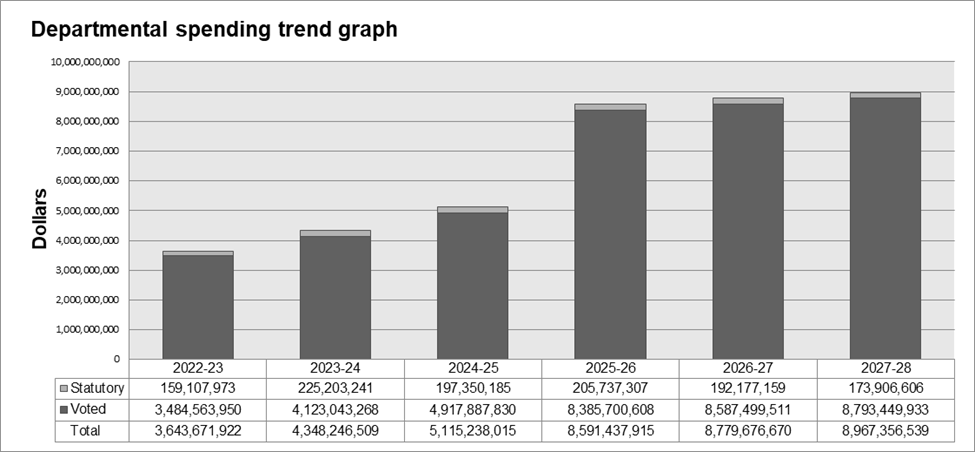
Text description of figure 2: Departmental spending 2022–23 to 2027–28
| Fiscal year | Total | Voted | Statutory |
|---|---|---|---|
| 2022-23 | $3,643,671,922 | $3,484,563,950 | $159,107,973 |
| 2023-24 | $4,348,246,509 | $4,123,043,268 | $225,203,241 |
| 2024-25 | $5,115,238,015 | $4,917,887,830 | $197,350,185 |
| 2025-26 | $8,591,437,915 | $8,385,700,608 | $205,737,307 |
| 2026-27 | $8,779,676,670 | $8,587,499,511 | $192,177,159 |
| 2027-28 | $8,967,356,539 | $8,793,449,933 | $173,906,606 |
Analysis of statutory and voted funding over a six-year period
The variance in future years is primarily related to the fluctuations in the cashflow profiles of transfer payment programs (mainly contributions to electric vehicles manufacturers).
For further information on ISED's departmental appropriations, consult the 2025-26 Main Estimates.
Future-oriented condensed statement of operations
The future-oriented condensed statement of operations provides an overview of ISED's operations for 2024-25 to 2025-26.
Table 14 Future-oriented condensed statement of operations for the year ended March 31, 2026 (dollars)
| Financial information | 2024-25
Forecast results |
2025-26
Planned results |
Difference
(planned results minus forecasted) |
|---|---|---|---|
| Total expenses | $5,376,419,496 | $8,827,624,224 | $3,451,204,728 |
| Total revenues | $328,251,087 | $400,411,824 | $72,160,737 |
| Net cost of operations before government funding and transfers | $5,048,168,409 | $8,427,212,400 | $3,379,043,991 |
-
Analysis of forecasted and planned results
The expected variance in total expenses year-over-year is mainly attributable to increases in transfer payments, particularly for the electric vehicle battery manufacturers, the Strategic Innovation Fund, and the Universal Broadband Fund. Given the complexity of some of ISED's programming, and the requirement to align the funding profile with the recipients forecasted spending, further changes to the 2025-26 planned results could occur during the fiscal year.
Total revenues (net of those earned on behalf of government) are projected to increase year-over-year, mainly as the Canadian Intellectual Property Office (CIPO)'s revolving fund expects higher revenues for patent maintenance and trademarks partially due to increased examination capacity.
A more detailed Future-Oriented Statement of Operations and associated Notes for 2025-26, including a reconciliation of the net cost of operations with the requested authorities, is available on ISED's website.
Human resources
This section presents an overview of the department's actual and planned human resources from 2022-23 to 2027-28.
Table 15: Actual human resources for core responsibilities and internal services
| Core responsibilities and internal services | 2022-23
Actual full-time equivalents |
2023-24
Actual full-time equivalents |
2024-25
Forecasted full-time equivalents |
|---|---|---|---|
| Companies, Investment and Growth | 4,129 | 4,282 | 4,350 |
| Science, Technology, Research and Commercialization | 106 | 111 | 115 |
| People, Skills and Communities | 195 | 202 | 166 |
| Subtotal | 4,430 | 4,595 | 4,631 |
| Internal services | 1,852 | 1,819 | 1,579 |
| Total | 6,282 | 6,414 | 6,210 |
-
Analysis of human resources over the last three years
People, Skills and Communities: The decrease in forecast FTEs is due to winding down of temporary employees in support of the Canada Digital Adoption Program: Stream 1 and the Universal Broadband Fund.
Science, Technology, Research and Commercialization: N/A - Variance is less than 10%
Companies, Investment and Growth: N/A - Variance is less than 10%
Internal services: The variance resulted from a realignment of FTEs between internal services and programs. The realignment exercise was initiated in 2024-25 to meet the Directive on Internal Services Coding.
Table 16: Human resources planning summary for core responsibilities and internal services
| Core responsibilities and internal services | 2025-26
Planned full-time equivalents |
2026-27
Planned full-time equivalents |
2027-28
Planned full-time equivalents |
|---|---|---|---|
| Companies, Investment and Growth | 4,331 | 4,249 | 4,229 |
| Science, Technology, Research and Commercialization | 117 | 119 | 121 |
| People, Skills and Communities | 154 | 153 | 132 |
| Subtotal | 4,602 | 4,521 | 4,482 |
| Internal services | 1,566 | 1,568 | 1,572 |
| Total | 6,168 | 6,089 | 6,054 |
-
Analysis of human resources for the next three years
People, Skills and Communities: The variance in planned human resources reflects the winding down of the Universal Broadband Fund.
Science, Technology, Research and Commercialization: N/A - Variance is less than 10%
Companies, Investment and Growth: The variance primarily reflects the winding down of Zero Emission Vehicles and Clean Fuels.
Internal services: N/A - Variance is less than 10%
Corporate information
Departmental profile
Minister of Industry and Minister responsible for Canada Economic Development for Quebec Regions
The Honourable Mélanie Joly, P.C., M.P.
Minister of Artificial Intelligence and Digital Innovation and Minister responsible for the Federal Economic Development Agency for Southern Ontario
The Honourable Evan Solomon, P.C., M.P.
Minister of Women and Gender Equality and Secretary of State (Small Business and Tourism)
The Honourable Rechie Valdez, P.C., M.P.
Secretary of State (Rural Development)
Honourable Buckley Belanger, P.C., M.P.
Deputy ministers:
Philip Jennings
Sony Perron
Francis Bilodeau
Ministerial portfolio:
Enabling instrument(s):
Innovation, Science and Economic Development Canada's founding legislation is the Department of Industry Act, S.C. 1995
Year of incorporation / commencement:
1892
Departmental contact information
Mailing address:
Corporate Management Sector
Innovation, Science and Economic Development Canada
235 Queen Street
2nd Floor, East Tower
Ottawa, ON K1A 0H5
Telephone:
613-954-5031
TTY:
1-866-694-8389
Fax:
613-954-2340
Email:
Website(s):
Supplementary information tables
The following supplementary information tables are available on ISED's website:
- Details on transfer payment programs
- Gender-based analysis plus
- Horizontal initiatives
- Up-front multiyear funding
Information on ISED's departmental sustainable development strategy can be found on ISED's website.
Federal tax expenditures
ISED's Departmental Plan does not include information on tax expenditures.
The tax system can be used to achieve public policy objectives through the application of special measures such as low tax rates, exemptions, deductions, deferrals and credits. The Department of Finance Canada publishes cost estimates and projections for these measures each year in the Report on Federal Tax Expenditures.
This report also provides detailed background information on tax expenditures, including descriptions, objectives, historical information and references to related federal spending programs as well as evaluations and GBA Plus of tax expenditures.
Definitions
List of terms
- appropriation (crédit)
- Any authority of Parliament to pay money out of the Consolidated Revenue Fund.
- budgetary expenditures (dépenses budgétaires)
- Operating and capital expenditures; transfer payments to other levels of government, departments or individuals; and payments to Crown corporations.
- core responsibility (responsabilité essentielle)
- An enduring function or role performed by a department. The intentions of the department with respect to a core responsibility are reflected in one or more related departmental results that the department seeks to contribute to or influence.
- Departmental Plan (plan ministériel)
- A report on the plans and expected performance of an appropriated department over a 3-year period. Departmental Plans are usually tabled in Parliament each spring.
- departmental result (résultat ministériel)
- A consequence or outcome that a department seeks to achieve. A departmental result is often outside departments' immediate control, but it should be influenced by program-level outcomes.
- departmental result indicator (indicateur de résultat ministériel)
- A quantitative measure of progress on a departmental result.
- departmental results framework (cadre ministériel des résultats)
- A framework that connects the department's core responsibilities to its departmental results and departmental result indicators.
- Departmental Results Report (rapport sur les résultats ministériels)
- A report on a department's actual accomplishments against the plans, priorities and expected results set out in the corresponding Departmental Plan.
- fulltime equivalent (équivalent temps plein)
- A measure of the extent to which an employee represents a full person-year charge against a departmental budget. For a particular position, the full-time equivalent figure is the ratio of number of hours the person actually works divided by the standard number of hours set out in the person's collective agreement.
- gender-based analysis plus (GBA Plus) (analyse comparative entre les sexes plus [ACS Plus])
- Is an analytical tool used to support the development of responsive and inclusive policies, programs, and other initiatives. GBA Plus is a process for understanding who is impacted by the issue or opportunity being addressed by the initiative; identifying how the initiative could be tailored to meet diverse needs of the people most impacted; and anticipating and mitigating any barriers to accessing or benefitting from the initiative. GBA Plus is an intersectional analysis that goes beyond biological (sex) and socio-cultural (gender) differences to consider other factors, such as age, disability, education, ethnicity, economic status, geography (including rurality), language, race, religion, and sexual orientation.
Using GBA Plus involves taking a gender- and diversity-sensitive approach to our work. Considering all intersecting identity factors as part of GBA Plus, not only sex and gender, is a Government of Canada commitment.
- government priorities (priorités gouvernementales)
-
For the purpose of the 2025-26 Departmental Plan, government priorities are the high-level themes outlining the government's agenda in the November 23, 2021, Speech from the Throne: building a healthier today and tomorrow; growing a more resilient economy; bolder climate action; fight harder for safer communities; standing up for diversity and inclusion; moving faster on the path to reconciliation; and fighting for a secure, just and equitable world.
- horizontal initiative (initiative horizontale)
-
An initiative where two or more federal departments are given funding to pursue a shared outcome, often linked to a government priority.
- Indigenous business
- For the purpose of the Directive on the Management of Procurement Appendix E: Mandatory Procedures for Contracts Awarded to Indigenous Businesses and the Government of Canada's commitment that a mandatory minimum target of 5% of the total value of contracts is awarded to Indigenous businesses, a department that meets the definition and requirements as defined by the Indigenous Business Directory.
- non budgetary expenditures (dépenses non budgétaires)
-
Non-budgetary authorities that comprise assets and liabilities transactions for loans, investments and advances, or specified purpose accounts, that have been established under specific statutes or under non-statutory authorities in the Estimates and elsewhere. Non-budgetary transactions are those expenditures and receipts related to the government's financial claims on, and obligations to, outside parties. These consist of transactions in loans, investments and advances; in cash and accounts receivable; in public money received or collected for specified purposes; and in all other assets and liabilities. Other assets and liabilities, not specifically defined in G to P authority codes are to be recorded to an R authority code, which is the residual authority code for all other assets and liabilities.
- performance (rendement)
-
What a department did with its resources to achieve its results, how well those results compare to what the department intended to achieve, and how well lessons learned have been identified.
- performance indicator (indicateur de rendement)
-
A qualitative or quantitative means of measuring an output or outcome, with the intention of gauging the performance of an department, program, policy or initiative respecting expected results.
- plan (plan)
-
The articulation of strategic choices, which provides information on how a department intends to achieve its priorities and associated results. Generally, a plan will explain the logic behind the strategies chosen and tend to focus on actions that lead to the expected result.
- planned spending (dépenses prévues)
-
For Departmental Plans and Departmental Results Reports, planned spending refers to those amounts presented in Main Estimates.
A department is expected to be aware of the authorities that it has sought and received. The determination of planned spending is a departmental responsibility, and departments must be able to defend the expenditure and accrual numbers presented in their Departmental Plans and Departmental Results Reports.
- program (programme)
-
Individual or groups of services, activities or combinations thereof that are managed together within the department and focus on a specific set of outputs, outcomes or service levels.
- program inventory (répertoire des programmes)
-
Identifies all the department's programs and describes how resources are organized to contribute to the department's core responsibilities and results.
- result (résultat)
-
A consequence attributed, in part, to a department, policy, program or initiative. Results are not within the control of a single department, policy, program or initiative; instead they are within the area of the department's influence.
- statutory expenditures (dépenses législatives)
-
Expenditures that Parliament has approved through legislation other than appropriation acts. The legislation sets out the purpose of the expenditures and the terms and conditions under which they may be made.
- target (cible)
-
A measurable performance or success level that a department, program or initiative plans to achieve within a specified time period. Targets can be either quantitative or qualitative.
- voted expenditures (dépenses votées)
-
Expenditures that Parliament approves annually through an appropriation act. The vote wording becomes the governing conditions under which these expenditures may be made.